The Trump administration has reportedly proposed fresh import duties targeting 14 trading partners under Section 301 of the US Trade Act. India could secure a lower tariff rate of 17% if a formal bilateral trade agreement is concluded.
New Delhi/Washington: The United States is seeking to revive its sweeping international tariff programme through a new legal framework, proposing fresh import duties on goods from 14 major trading partners, including India, China, Japan and the European Union.
The proposed measures represent another significant development in global trade relations as President Donald Trump’s administration attempts to restore its tariff agenda following reported legal setbacks involving earlier emergency-based import duties.
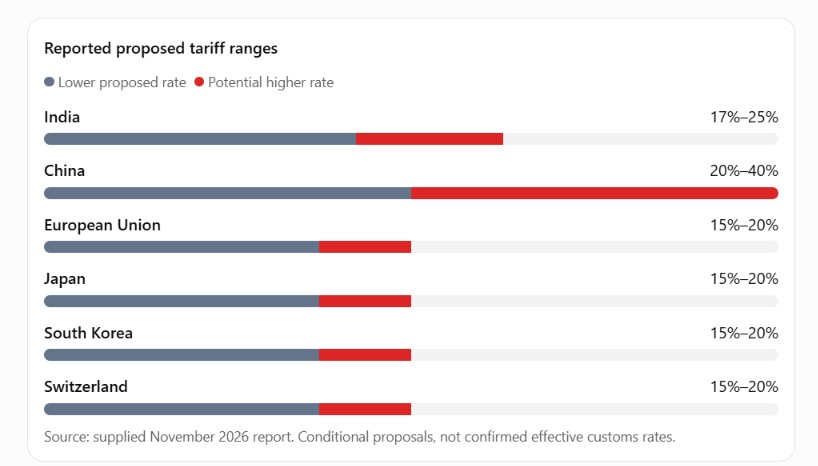
Under the latest proposal, Indian goods could face tariffs of up to 25%, although a formal trade agreement between New Delhi and Washington could bring the proposed rate down to 17%.
See more of our coverage in your search results.
Add INDYASTORY on GoogleThe measures remain subject to public consultation, regulatory review and further international negotiations. According to the supplied reporting, a final decision could emerge as early as January 2027.
Trump Administration Turns to Section 301 to Restore Tariffs
The proposed import duties follow an investigation conducted under Section 301 of the Trade Act of 1974, which authorises the United States to respond to certain foreign trade practices considered unreasonable, discriminatory or restrictive to American commerce.
The latest investigation reportedly examined industrial production capacity across several economies, focusing on government policies that US authorities believe contribute to excessive manufacturing output and distort international competition.
Washington has argued that excess industrial capacity can place American manufacturers at a competitive disadvantage when overseas producers supply international markets at prices influenced by government support.
The proposed measures would allow the administration to pursue its trade objectives through a statutory framework different from the emergency powers reportedly used to impose earlier reciprocal tariffs.
See more of our coverage in your search results.
Add INDYASTORY on GoogleHowever, the findings reflect the US administration’s assessment of international trade practices. Affected economies may hold different views regarding their industrial development policies and compliance with international trade obligations.
India Faces 25% Tariff Risk Without a Trade Agreement
India remains among the significant economies affected by the proposed tariff framework.
According to the supplied report, Indian products could face a 17% tariff if New Delhi and Washington successfully conclude a bilateral trade agreement addressing the relevant US trade concerns.
See more of our coverage in your search results.
Add INDYASTORY on GoogleWithout an agreement, the proposed rate could reach 25%.
The eight-percentage-point difference could have meaningful consequences for Indian manufacturers competing in the American market, particularly across export-oriented industries with relatively narrow profit margins.
India has sought favourable access to the US market while protecting domestic interests in sensitive sectors, including agriculture and dairy.
The proposed tariff structure could therefore increase the commercial importance of concluding negotiations while preserving sufficient flexibility for India’s domestic economic policies.
Nevertheless, the final rate, product coverage and implementation date remain uncertain.
China Could Face Tariffs of Up to 40%
China faces one of the highest potential tariff rates identified in the supplied reporting.
The proposed framework reportedly includes a 20% tariff consistent with an earlier trade arrangement between Washington and Beijing.
However, the rate could rise to 40% if negotiations deteriorate and the two countries fail to maintain their existing trade understanding, according to an unnamed US official cited in the report.
Relations between the United States and China remain particularly significant because of their extensive commercial links and competition across advanced manufacturing, artificial intelligence, semiconductors and other strategically important industries.
Further tariff increases could influence international supply chains, manufacturing costs and investment decisions.
The existing trade truce between the two economies reportedly faces a potential expiration in January 2027 unless both governments agree to extend it.
The higher tariff rate remains a conditional possibility rather than a confirmed measure.
European Union, Japan and South Korea Also Face Proposed Duties
Several established American trading partners are also included in the proposed framework.
Imports from the European Union could reportedly face a 15% tariff, potentially increasing to 20% depending on subsequent developments.
Japan, South Korea and Switzerland face similar proposed rates, according to the supplied information.
The inclusion of major industrial economies reflects the broad scope of Washington’s investigation into manufacturing capacity and international trade practices.
These economies play important roles in global automotive manufacturing, industrial machinery, electronics, pharmaceuticals and advanced technology supply chains.
Changes in their access to the American market could affect commercial relationships extending well beyond direct bilateral trade.
Multinational businesses operating across several jurisdictions may also need to reconsider production locations, sourcing arrangements and distribution strategies if the proposed duties take effect.
Which Countries Are Included in the New US Tariff Proposal?
The reported Section 301 measures cover 14 economies, including:
- Bangladesh
- Cambodia
- China
- European Union
- India
- Indonesia
- Japan
- South Korea
- Malaysia
- Singapore
- Switzerland
- Taiwan
- Thailand
- Vietnam
Potential measures involving Mexico and Norway reportedly remain under consideration but were not included in the latest announcement.
The inclusion of several Southeast Asian manufacturing economies is particularly relevant to India, which competes with many of these countries for export orders and international manufacturing investment.
The precise rates for all affected economies will need to be confirmed through official USTR documentation.
What Is Structural Excess Manufacturing Capacity?
Structural excess capacity describes circumstances in which an industry’s production capabilities exceed sustainable demand over an extended period.
Such conditions can arise through various factors, including weak domestic demand, industrial investment cycles, government incentives and policies that encourage businesses to maintain or expand production.
Trade disputes can emerge when countries believe these conditions enable foreign manufacturers to supply international markets under circumstances that disadvantage domestic producers.
The United States has reportedly identified structural manufacturing capacity as a central issue in its latest Section 301 investigation.
However, industrial expansion policies can also serve legitimate economic objectives, including employment generation, technological development and infrastructure modernisation.
Determining whether particular policies constitute actionable trade practices requires detailed examination of the relevant evidence and applicable legal standards.
Will the New US Tariffs Be Added to Existing Duties?
One important feature of the reported proposal concerns the interaction between the new tariffs and duties arising from a separate investigation into forced labour-related trade practices.
According to the supplied reporting, the proposed manufacturing-related duties would not be added directly to certain existing tariffs of 10% or 12.5% arising from that investigation.
For products covered by both measures, the higher applicable rate would reportedly apply.
This approach could prevent the cumulative application of those two specific tariff measures.
However, businesses should not assume that every other import duty would be excluded.
Ordinary customs duties, product-specific trade remedies and separate sectoral tariffs may remain applicable depending on the final regulatory framework.
Exporters and importers will need to examine the official implementation rules before determining the complete customs liability associated with individual shipments.
Oil, Gas, Pharmaceuticals and Other Products May Receive Exemptions
The reported tariff proposal includes potential exemptions for certain categories of goods.
These may include oil and natural gas, selected food products that cannot be grown domestically in the United States, and products already subject to separate sector-specific tariff measures.
Certain pharmaceutical products and critical minerals could also be excluded from the proposed additional duties, according to the supplied information.
Product exemptions are particularly important for India because of its established pharmaceutical manufacturing industry and role in supplying affordable medicines to international markets.
However, a general reference to pharmaceutical exemptions does not necessarily mean that every medicine, ingredient or pharmaceutical-related product will qualify.
The exact scope of exemptions will depend on tariff classifications and the final regulatory text.
How the Proposed Tariffs Could Affect Indian Exporters
The implications for Indian businesses will vary across industries, depending on applicable tariff rates, exemptions, competitive conditions and commercial arrangements.
Textiles and Apparel
India’s textile and garment manufacturers compete with exporters from Bangladesh, Vietnam, Cambodia and other Asian economies.
A favourable negotiated tariff could help Indian suppliers improve their position when American retailers evaluate sourcing costs.
Without a trade agreement, however, higher duties could reduce price competitiveness and place pressure on export margins.
Electronics and Smartphones
India’s electronics manufacturing industry has attracted investment as global companies diversify production and assembly operations.
A competitive tariff arrangement could support export-oriented manufacturing, although the benefits would depend on product-specific treatment and domestic manufacturing efficiency.
Pharmaceuticals
India is an important supplier of generic medicines and pharmaceutical ingredients.
Potential exemptions could limit the impact on eligible products, but manufacturers will need to verify the final conditions governing pharmaceutical imports.
Engineering and Automotive Components
Indian manufacturers supplying machinery, industrial equipment and automotive components could face changing landed costs in the American market.
A negotiated reduction in tariffs could provide additional flexibility for exporters and their US customers.
Gems and Jewellery
Changes in import duties could influence pricing, demand and profitability within India’s gems and jewellery industry.
The magnitude of the impact would depend on final product coverage and the ability of businesses to absorb or redistribute additional costs.
What a 17% Tariff Could Mean for Indian Manufacturing
A tariff reduction from 25% to 17% could provide a meaningful financial advantage for eligible shipments.
For example, goods with a customs value of $100,000 would attract an illustrative duty of $25,000 at a 25% rate, compared with $17,000 at a 17% rate.
The difference would amount to $8,000 before considering other applicable duties, taxes and fees.
Although US importers generally pay customs duties, the economic burden may be shared among suppliers, importers, retailers and consumers through adjustments to commercial prices.
For Indian manufacturers, a lower tariff could create additional room for pricing negotiations and improve competitiveness against alternative suppliers.
However, long-term manufacturing competitiveness also depends on productivity, infrastructure, skilled labour, supply-chain reliability and product quality.
A favourable tariff arrangement would therefore represent one component of India’s broader manufacturing strategy.
Could the New Tariffs Increase Prices for American Consumers?
Import tariffs can increase the cost of bringing foreign-produced goods into the United States.
Depending on market conditions, businesses may absorb some additional expenses, negotiate lower prices with suppliers or pass a portion of the costs to consumers.
Industries with limited alternative suppliers may experience different outcomes from sectors where businesses can quickly change sourcing arrangements.
Supporters of tariffs argue that such measures can protect domestic industrial capacity, address unfair trade practices and encourage local manufacturing investment.
Critics argue that broad import duties can increase consumer prices, raise operating costs for American businesses and contribute to uncertainty in international trade.
The eventual economic impact will depend on the scale of the measures, available exemptions, supply-chain responses and broader economic conditions.
Why the Administration Is Using a Different Legal Framework
The latest proposal follows reported legal challenges to earlier tariffs introduced through emergency economic powers.
According to the supplied report, the US Supreme Court invalidated those earlier measures in February 2026, prompting the administration to explore alternative statutory authorities.
Section 301 requires an investigation into specified foreign trade practices and generally involves administrative procedures, including consultations and opportunities for public comment.
These procedural requirements distinguish it from certain emergency-based trade measures.
However, the use of Section 301 does not make tariffs immune from judicial scrutiny or international trade disputes.
The validity of any particular measure will depend on the relevant statutory authority, administrative process and applicable legal requirements.
The precise scope of the reported Supreme Court judgment should be confirmed against the official ruling.
United States Also Proposes Separate Tariff Changes for Brazil
In a separate development, US authorities reportedly announced plans to modify existing trade measures involving Brazil.
The proposals include increasing out-of-quota duties on certain sugar imports and introducing a potential 10% tariff on finished aircraft.
These measures reportedly arise from a separate investigation concerning Brazilian trade and digital policies rather than the latest 14-economy manufacturing capacity investigation.
Any implementation could have implications for international agricultural trade and commercial aviation supply chains.
The final product coverage and effective dates remain subject to official regulatory confirmation.
What Happens Next in India-US Trade Negotiations?
Attention is expected to shift towards the USTR’s public consultation process and continued negotiations between Washington and affected trading partners.
India’s immediate economic interest lies in securing predictable access to the American market while protecting sensitive domestic sectors.
A formal bilateral trade agreement could reduce uncertainty for manufacturers, exporters and international investors.
However, the proposed 17% rate is conditional and should not be treated as an implemented tariff.
For businesses operating across international supply chains, the most important developments will include the final regulatory notices, product-specific exemptions and any confirmed bilateral trade commitments.
The coming months could determine whether the proposed framework becomes a lasting feature of American trade policy or undergoes further modification through negotiations and legal review.
For India, the outcome will have implications not only for its relationship with the United States but also for its position within increasingly competitive global manufacturing and export markets.