The strategic partnership will combine artificial intelligence, automation and specialised finance expertise to transform BP’s core financial operations, with the new operating model expected to take effect in 2027.
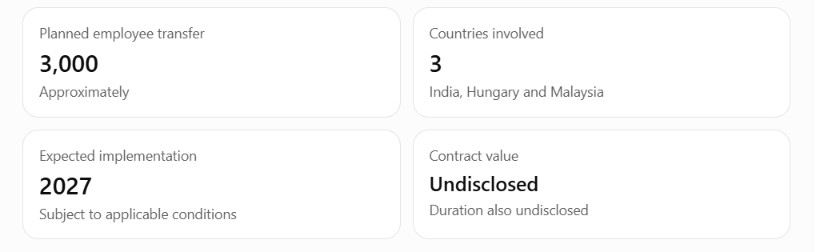
Bengaluru: Indian information technology services major Wipro has reportedly secured a strategic finance transformation agreement with British energy company BP, involving the planned transfer of approximately 3,000 employees across India, Hungary and Malaysia.
Announced on November 25, 2026, the partnership aims to modernise BP’s core finance operations through artificial intelligence, automation and technology-enabled business processes.
The agreement represents a combination of traditional business process outsourcing and AI-driven enterprise transformation, reflecting the changing requirements of global corporations seeking greater operational efficiency and long-term cost competitiveness.
See more of our coverage in your search results.
Add INDYASTORY on GoogleThe financial value and duration of the agreement have not been disclosed.
The new operating model is expected to become operational in 2027, subject to applicable conditions.
Wipro to Integrate Around 3,000 BP Employees
A significant component of the agreement involves the planned transition of approximately 3,000 existing BP employees to Wipro.
The employees are based across India, Hungary and Malaysia, although the company has not disclosed the country-wise distribution of the affected workforce.
The transition is expected to bring specialised finance operations expertise into Wipro’s business process services division, strengthening its ability to manage complex financial functions for multinational enterprises.
See more of our coverage in your search results.
Add INDYASTORY on GoogleUnlike conventional outsourcing agreements that primarily involve transferring operational responsibilities to an external service provider, this partnership combines workforce integration with a broader technology transformation programme.
The arrangement could allow Wipro to combine BP employees’ existing operational knowledge with its own consulting, automation and artificial intelligence capabilities.
However, specific details concerning employment terms, compensation, benefits and individual transition arrangements have not been disclosed in the supplied announcement.
See more of our coverage in your search results.
Add INDYASTORY on GoogleArtificial Intelligence to Drive BP’s Finance Transformation
The partnership places artificial intelligence and automation at the centre of BP’s planned finance transformation.
Large multinational corporations manage complex financial operations involving multiple jurisdictions, regulatory requirements, currencies and business divisions.
Technology-enabled finance systems can potentially improve the efficiency of these operations by reducing repetitive manual tasks, strengthening data consistency and accelerating routine financial processes.
Potential applications of AI and automation in enterprise finance include:
- Financial reporting and reconciliation.
- Invoice processing and accounts payable.
- Transaction monitoring and exception management.
- Financial forecasting and analytics.
- Compliance monitoring and internal controls.
- Workflow optimisation and operational reporting.
These represent general applications of AI in financial operations rather than confirmed individual deliverables under the BP agreement.
For BP, the broader objective is expected to include improving operational efficiency, simplifying financial processes and strengthening long-term cost competitiveness.
The effectiveness of the transformation will depend on implementation quality, data governance, system integration and employee training.
BP to Retain Oversight of Financial Governance
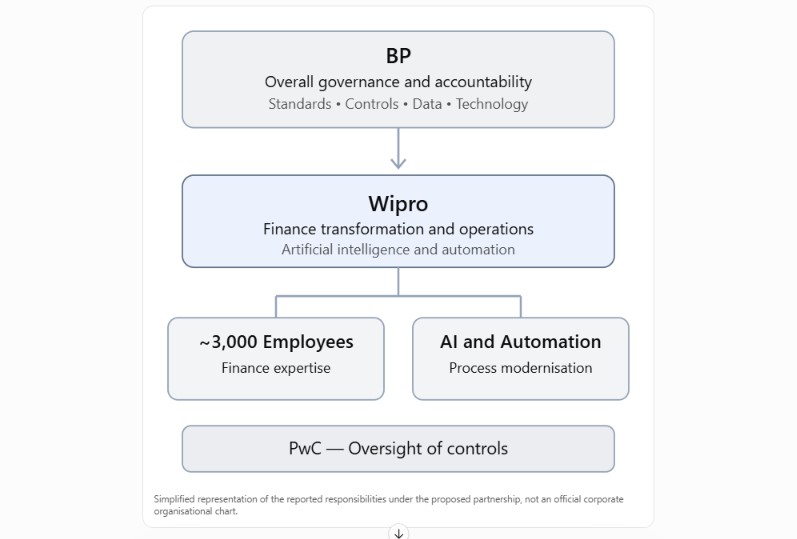
Despite the planned transfer of operational responsibilities, BP will reportedly retain overall accountability for financial standards, controls, data and technology governance.
Professional services firm PwC is expected to provide oversight of controls under the new operating framework.
The arrangement highlights the importance of maintaining governance and accountability when critical financial processes are managed in collaboration with an external technology services provider.
Financial operations involve sensitive corporate information, regulatory reporting obligations and internal controls that require reliable oversight.
Introducing AI into these processes also creates additional considerations involving data protection, cybersecurity, model reliability and the accuracy of automated decisions.
Maintaining appropriate human supervision will remain particularly important for financial activities that require professional judgement or regulatory accountability.
The reported governance structure seeks to distinguish operational service delivery from BP’s continuing responsibility for its financial standards and controls.
Wipro Leadership Emphasises AI-Powered Business Transformation
Wipro Chief Executive Officer and Managing Director Srini Pallia reportedly described the engagement as an important opportunity to combine the company’s industry expertise with its artificial intelligence capabilities.
The agreement is expected to leverage Wipro Intelligence, its AI-related capabilities, alongside consulting and business process services.
Pallia also reportedly welcomed the BP employees expected to join Wipro, highlighting the importance of integrating their specialised skills into the company’s technology-led transformation strategy.
For Wipro, the partnership could strengthen its experience in delivering finance transformation services to large international enterprises.
BP Chief Financial Officer Kate Thomson reportedly emphasised the company’s objective of simplifying its finance operations while providing employees with opportunities to develop their skills.
The leadership statements indicate that workforce integration and technology modernisation are both central to the proposed operating model.
Why the Wipro-BP Deal Is Different From Traditional IT Outsourcing
Traditional IT outsourcing arrangements often focus on application maintenance, infrastructure management, technical support or business process delivery.
The emerging model increasingly combines these services with artificial intelligence, advanced analytics, workflow automation and consulting.
The Wipro-BP agreement reflects this broader transition by combining an existing workforce with technology-enabled operational transformation.
Rather than focusing exclusively on transferring responsibilities to a lower-cost service provider, such arrangements can involve redesigning business processes to improve productivity, scalability and operational consistency.
This approach could create opportunities for IT services companies to participate more directly in their clients’ business transformation programmes.
However, it also requires providers to demonstrate measurable outcomes rather than relying solely on workforce expansion or conventional service delivery metrics.
What the Partnership Could Mean for Wipro
The agreement could provide Wipro with several strategic opportunities within the global enterprise services market.
The addition of experienced finance operations professionals could expand its domain expertise across multiple geographies.
The partnership could also strengthen its capabilities in finance and accounting outsourcing, enterprise automation and AI-enabled business process management.
Large-scale engagements of this nature may help technology services companies develop industry-specific solutions that can potentially be adapted for other clients.
Nevertheless, because the financial terms and contract duration have not been disclosed, the agreement’s potential contribution to Wipro’s revenue, profitability and operating margins cannot be reliably estimated.
Investors will need to assess future company disclosures for information concerning contract execution, transition expenses and financial performance.
The reported workforce transfer should also not be interpreted as the creation of 3,000 entirely new jobs, as the employees are expected to move from BP to Wipro under the partnership.
Why BP Is Modernising Its Finance Operations
Global energy companies operate in a complex commercial environment involving fluctuating commodity prices, substantial infrastructure investments and evolving regulatory requirements.
Efficient financial operations can help such businesses manage costs, allocate resources and maintain visibility across their international operations.
Artificial intelligence and automation could support faster information processing and improve the consistency of routine financial activities.
However, technology implementation alone does not guarantee lower costs or improved financial performance.
Successful finance transformation requires clearly defined objectives, reliable underlying data, appropriate controls and effective coordination between operational teams and technology providers.
For BP, the reported partnership forms part of a broader effort to simplify operations and improve long-term competitiveness.
The actual financial benefits will depend on how successfully the new operating model is implemented.
Indian IT Companies Move Towards AI-Led Outsourcing
The Wipro-BP partnership comes as India’s information technology services industry continues to evolve beyond conventional outsourcing models.
Global enterprises are increasingly exploring artificial intelligence to improve operational productivity, streamline internal processes and modernise legacy technology systems.
Indian IT services companies have responded by expanding their capabilities in generative AI, enterprise automation, cloud computing, data engineering and technology consulting.
Finance and accounting operations represent one area where these capabilities can be combined with established business process services.
However, the transition towards AI-led outsourcing also presents challenges.
Service providers must invest in workforce training, develop reliable technology platforms and ensure that automation complies with industry-specific regulatory requirements.
Traditional pricing models based primarily on the number of employees assigned to a project may also evolve as clients increasingly focus on measurable business outcomes.
The industry’s long-term competitiveness could depend on its ability to combine specialised human expertise with reliable AI-enabled services.
What the Deal Could Mean for Employees
The planned transfer of BP employees across India, Hungary and Malaysia highlights the continuing importance of experienced professionals in AI-driven business transformation.
Although automation can reduce the need for some repetitive activities, finance operations continue to require expertise in accounting standards, regulatory compliance, risk management and complex decision-making.
Employees working within technology-enabled finance environments may increasingly need to develop skills in financial analytics, digital platforms, process automation and AI-assisted workflows.
The partnership could create opportunities for professional development, depending on the training programmes and employment arrangements introduced during the transition.
However, no specific commitments concerning individual roles, job security, salary structures or future workforce requirements have been disclosed in the supplied information.
Further clarity is expected as Wipro and BP prepare to implement the new operating model.
What Happens Next?
The proposed finance transformation model is expected to take effect in 2027, subject to applicable conditions.
The implementation process could involve employee transitions, technology integration, operational restructuring and the establishment of appropriate governance mechanisms.
Important developments to monitor will include the completion of workforce transfers, deployment of automation technologies and any subsequent financial disclosures from the companies.
For Wipro, the partnership represents an opportunity to strengthen its position in AI-enabled enterprise finance services.
For BP, the objective is to establish a more efficient finance operating model while retaining accountability for governance and financial controls.
The agreement reflects a broader shift in the global outsourcing industry, where technology providers are increasingly expected to deliver operational expertise, artificial intelligence capabilities and measurable business improvements through integrated service models.
Its success will ultimately depend on execution, workforce integration and the ability of the partnership to deliver sustainable improvements in financial operations.