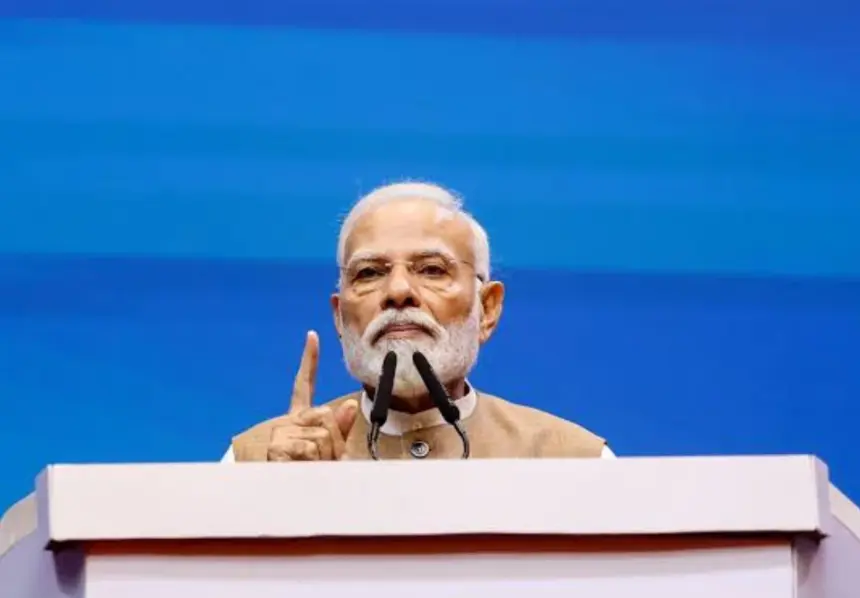
Prime Minister Narendra Modi said India’s telecom industry has moved well beyond providing connectivity, with mobile phones increasingly becoming important tools for governance and access to public services.
Addressing the 10th edition of the India Mobile Congress (IMC) 2026 in New Delhi on Thursday, Modi said the country’s telecom transformation should be measured not only by network coverage, spectrum and internet speeds, but also by how digital connectivity is changing the delivery of government services.
“Mobile phone has become a tool of good governance,” Modi said.
He said mobile connectivity has evolved significantly over the past decade, moving from being primarily a communication platform to becoming part of India’s wider digital public infrastructure.
5G has reached every district, PM Modi says
Modi used the evolution of India Mobile Congress to highlight the progress of the country’s telecom sector.
See more of our coverage in your search results.
Add INDYASTORY on GoogleHe recalled that 5G was launched in India at the 2022 edition of IMC, followed by a focus in 2023 on expanding the technology from initial rollout towards wider public reach.
More Read

According to Modi, 5G connectivity has now reached every district in India.
He said the country has more than 5.5 lakh base stations from which 5G networks are operating, while average mobile internet speeds have increased to around 10 times the level recorded in 2022.
The figures cited by the Prime Minister reflect the scale of India’s ongoing telecommunications expansion.
More Read

From digital divide to wider access
Modi said India faced a significant digital divide a decade ago, when newer technologies were increasingly becoming accessible mainly to sections of the population with greater resources.
See more of our coverage in your search results.
Add INDYASTORY on GoogleHe said the government’s Digital India programme sought to address that gap by placing mobile connectivity at the centre of efforts to expand digital access.
The objective, according to Modi, was not simply to give people faster internet but to use digital infrastructure to improve access to services and opportunities.
That shift has increasingly connected telecom infrastructure with areas such as government services, banking, education and digital transactions.
See more of our coverage in your search results.
Add INDYASTORY on GoogleTelecom’s role became clearer during Covid
The Prime Minister also pointed to the Covid-19 pandemic as an example of the importance of India’s digital ecosystem.
He said digital connectivity allowed offices, banks and educational institutions to continue functioning when normal activity had been severely disrupted in many parts of the world.
More Read

The experience demonstrated that telecommunications infrastructure could act as an essential economic and social utility rather than merely as a communications network.
For India, the rapid adoption of digital services during the pandemic also accelerated the integration of mobile connectivity into everyday economic activity.
India Mobile Congress shifts from networks to digital impact
The theme of the 2026 edition of India Mobile Congress is “Scale Without Boundaries.”
Modi said the theme reflected India’s own experience of expanding telecom and digital infrastructure across a large and diverse population.
He argued that the country’s telecom progress should no longer be judged only through measurements such as network speed or spectrum availability.
The more important question, he said, is how connectivity improves people’s access to public services and supports better governance.
“For Indians, telecom means much more.”
That broader definition places mobile technology closer to the centre of India’s digital economy and public-service delivery system.
IMC has tracked India’s telecom transformation
Modi also highlighted the changing role of India Mobile Congress itself.
The Prime Minister recalled the 2022 5G launch and India’s subsequent engagement with the global telecommunications community, including the country’s hosting of the International Telecommunication Union (ITU) in 2024.
Over the years, IMC has increasingly become a platform for telecom companies, technology businesses, startups, policymakers and international experts to discuss India’s digital infrastructure and the next stage of communications technology.
The 2026 edition brings together telecom operators, industry executives, technology experts and startup representatives from India and other countries.
Digital infrastructure becoming part of governance
The comments reflect a broader shift in how governments view telecommunications infrastructure.
Mobile networks are increasingly used as a foundation for digital identity, payments, public-service access, online education, financial services and communication between citizens and government institutions.
For India, this has coincided with the rapid expansion of mobile internet and digital platforms.
The challenge now is to ensure that expanding connectivity translates into reliable and affordable access to services across urban and rural areas.
IMC 2026 underway in New Delhi
The 10th edition of India Mobile Congress is being held in the national capital from October 7 to October 10.
The event is being organised by the Department of Telecommunications (DoT) and the Cellular Operators Association of India (COAI).
With telecom companies, technology firms and startups participating, the event is also intended to showcase India’s ambitions in next-generation connectivity and digital technologies.
Modi’s remarks at the event placed that technological expansion within a wider policy framework: India’s telecom network is not being viewed simply as infrastructure for faster communication, but increasingly as a platform for governance, economic activity and access to public services.