India’s digital payments providers may need to rethink how they charge merchants for UPI soundboxes if transaction-based merchant fees become more widely applicable. With small retailers unlikely to welcome both monthly device rentals and payment-processing charges, companies including Paytm, PhonePe, BharatPe and other payment providers could face pressure to introduce new pricing models.
India’s Unified Payments Interface (UPI) has transformed the way consumers pay at neighbourhood shops, restaurants, pharmacies and other businesses.
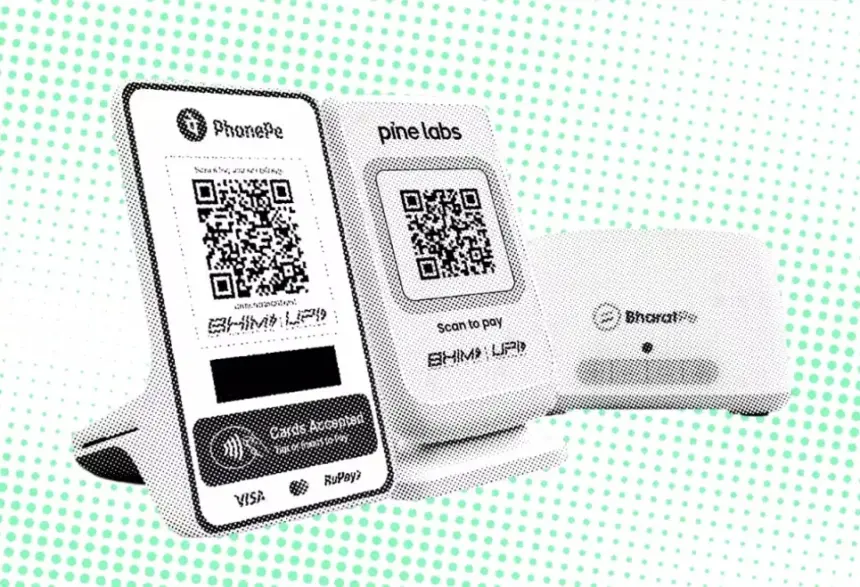
One of the most visible products supporting this transformation is the payment soundbox, a compact device that announces successful payments so merchants do not need to check their smartphones after every transaction.
For payment companies, these devices have also become a source of recurring revenue through monthly rental charges.
See more of our coverage in your search results.
Add INDYASTORY on GoogleHowever, that commercial model could face a significant adjustment if merchant discount rate (MDR) charges are introduced or expanded for eligible UPI payments.
According to the supplied industry report, payment companies may have to choose between collecting transaction-based fees and continuing to charge monthly soundbox rentals because many merchants are unlikely to accept both.
The report identifies BharatPe, Google Pay, MobiKwik, Paytm, PhonePe and Pine Labs among the payment businesses potentially affected by the changing economics of merchant payment acceptance.
The central issue is simple: businesses may be willing to pay for the convenience of a soundbox or for payment processing, but two separate recurring costs could make digital payment acceptance more expensive.
The eventual impact will depend on which UPI transactions are subject to merchant charges, the applicable fee rates and whether providers revise their device pricing.
See more of our coverage in your search results.
Add INDYASTORY on GoogleWhat Is a UPI Soundbox and How Does It Work?
A UPI soundbox is a payment notification device used by merchants to receive audible confirmation of digital transactions.
When a customer scans a merchant’s QR code and completes a payment, the connected payment system sends information to the device.
The soundbox then announces the amount received, subject to network connectivity and successful payment notification.
See more of our coverage in your search results.
Add INDYASTORY on GoogleFor example, when a customer pays ₹250, the device may announce that ₹250 has been received.
This gives shopkeepers an immediate operational benefit.
They do not need to repeatedly open a mobile application or inspect a transaction message while serving customers.
Soundboxes can be particularly useful in busy retail environments where staff handle multiple transactions throughout the day.
They also help reduce confusion when customers show payment screenshots or when merchants need to distinguish completed payments from unsuccessful attempts.
However, an audible alert is not a substitute for checking transaction records when resolving disputes, reconciliation problems or suspected fraud.
Why Payment Companies Charge Monthly Soundbox Rent
Soundboxes involve costs beyond the initial hardware.
Payment companies may need to pay for device manufacturing, distribution, connectivity, maintenance, customer support and replacement services.
Monthly rental fees provide recurring revenue that can help recover these expenses.
Depending on the provider and commercial arrangement, merchants may face installation charges, deposits, recurring rentals or other contractual terms.
The exact pricing varies and should be checked against each company’s current merchant agreement.
For a small shopkeeper, the attraction of soundbox rental is often predictable expenditure.
A fixed monthly charge is relatively easy to budget, regardless of fluctuations in transaction volume.
For payment companies, rental income can provide a more stable revenue stream than charging only for payment transactions.
But this balance could change if a transaction-based MDR becomes applicable to a broader range of UPI merchant payments.
What Is MDR in UPI Payments?
Merchant discount rate, or MDR, is a payment acceptance charge generally paid by merchants to payment service providers or other participating entities.
The fee may be expressed as a percentage of transaction value, subject to the payment method and applicable pricing rules.
For example, a hypothetical MDR of 0.5% on a ₹1,000 payment would represent a ₹5 merchant charge.
However, this is only an illustration and not a confirmed MDR rate for standard UPI transactions.
In India, the distinction between different UPI funding instruments is particularly important.
Ordinary UPI transactions directly linked to bank accounts have generally operated under a zero-MDR policy.
Certain UPI transactions involving prepaid payment instruments or credit-based payment products may be governed by different commercial arrangements.
An interchange fee, where applicable, is also not necessarily identical to an MDR charged directly to a merchant.
Consequently, any proposal to change UPI merchant pricing must specify which transaction types are affected.
Without an official notification, it would be inaccurate to suggest that every UPI payment will automatically attract MDR.
Why Merchants May Refuse to Pay Both MDR and Soundbox Rent
Small retailers operate with different profit margins, transaction volumes and cash-flow requirements.
For some, the cost of accepting payments is a relatively minor expense.
For others, especially businesses selling low-margin products, even small additional charges can affect profitability.
The concern becomes more significant when a merchant faces both a fixed rental fee and a variable transaction fee.
Illustrative monthly merchant costs
Consider a shop using a hypothetical soundbox rental of ₹125 per month and a hypothetical MDR of 0.5%.
| Monthly eligible UPI payment value | Soundbox rent | Illustrative MDR | Combined monthly cost |
|---|---|---|---|
| ₹25,000 | ₹125 | ₹125 | ₹250 |
| ₹50,000 | ₹125 | ₹250 | ₹375 |
| ₹1,00,000 | ₹125 | ₹500 | ₹625 |
| ₹2,00,000 | ₹125 | ₹1,000 | ₹1,125 |
These are hypothetical calculations, not announced UPI merchant charges or verified soundbox tariffs. They assume every transaction in the example is eligible for the stated fee.
The example highlights an important difference between the two pricing models.
A fixed rental stays the same across different payment volumes.
A percentage-based transaction charge increases as the value of eligible transactions rises.
For a merchant processing ₹2 lakh in eligible monthly payments, a 0.5% transaction fee would cost ₹1,000 before adding soundbox rental.
Whether that amount is affordable depends on the retailer’s margins, sales mix and other expenses.
Will MDR Replace Monthly Soundbox Rental?
The supplied report suggests that payment companies may consider replacing monthly device rentals with transaction-based fees rather than collecting both.
That would represent a change in how businesses pay for digital payment services.
However, a complete replacement is not inevitable.
Providers could adopt several commercial approaches depending on regulatory requirements and market competition.
A company might waive soundbox rental for merchants generating sufficient eligible payment volume.
Another might offer a fixed monthly subscription covering hardware and selected merchant services.
Some providers could introduce different plans for small merchants and larger businesses.
A hybrid approach may also be possible where permitted, although merchants could be reluctant to accept a combination of fixed and variable charges.
The eventual business model will depend on payment rules, merchant demand and the costs providers need to recover.
How Could Paytm and PhonePe Be Affected?
Paytm and PhonePe are among the best-known businesses offering merchant payment services and soundbox products in India.
The devices provide a physical connection between payment companies and merchants.
For payment providers, that relationship can extend beyond receiving UPI transactions.
Merchant platforms may also offer business dashboards, transaction histories, settlement information and other financial or operational services.
If transaction-based fees become more widely applicable, payment companies may reconsider how they package these offerings.
Soundboxes could be offered at a lower rental, included in a broader subscription or subsidised through revenue from other eligible services.
However, the supplied report does not establish that Paytm or PhonePe has formally announced the elimination of soundbox rent.
Their actual pricing decisions must be verified through company communications.
What About BharatPe, Google Pay, MobiKwik and Pine Labs?
The implications could extend across India’s merchant payments ecosystem.
BharatPe, MobiKwik and Pine Labs participate in various merchant payment and financial-technology services.
Google Pay also has a substantial presence in India’s digital payments market, although product availability and commercial arrangements vary between providers.
The economics of a company primarily distributing payment hardware may differ from those of a platform earning revenue from multiple merchant services.
For example, a provider with substantial revenue from software subscriptions or other business products may have different incentives from one relying heavily on device rentals.
The market response will therefore depend on each company’s business model.
It would be premature to assume that all six named companies will respond to possible MDR changes in the same way.
Could Merchants Switch to QR Codes Without Soundboxes?
One possible response to higher costs would be increased reliance on basic QR-code payments without additional audio hardware.
A printed QR code can allow customers to initiate payments without requiring a dedicated soundbox.
Merchants can then check payment confirmations through their mobile applications or transaction records.
This approach reduces dependence on a rented device, although it may be less convenient for businesses handling frequent payments.
Soundboxes are especially useful when a shop is busy, internet access on the owner’s phone is unreliable or employees need clear payment announcements.
For merchants processing relatively few transactions, the monthly cost of a device may be harder to justify.
Therefore, higher payment acceptance costs could encourage businesses to compare the convenience of hardware against lower-cost alternatives.
Why UPI’s Low-Cost Structure Matters
UPI’s growth has been supported by its ease of use, interoperability and the low direct cost of standard bank-account-based transactions for consumers and merchants.
Its widespread availability has made digital payments practical for businesses of different sizes.
A small retailer can accept payments through a QR code without necessarily investing in a conventional card terminal.
For consumers, UPI offers a convenient alternative to cash for everyday purchases.
Any policy change affecting merchant charges therefore requires consideration of both payment-industry economics and broader digital adoption.
Payment companies need sustainable revenue to maintain infrastructure, support users and develop services.
Merchants, meanwhile, need affordable methods of accepting payments.
Finding an appropriate balance between those interests is central to the policy debate.
How UPI Merchant Pricing Could Affect Small Businesses
The impact of additional fees will vary significantly across business categories.
Grocery shops and other businesses operating with relatively narrow gross margins may be more sensitive to payment-processing charges.
Larger retailers may have greater flexibility to negotiate terms or absorb expenses across substantial sales volumes.
Service businesses may also respond differently depending on their pricing and cost structures.
For a merchant, the relevant calculation is not merely the percentage charged on a transaction.
It is the total cost of accepting payments, including hardware, connectivity, subscriptions and other contractual charges.
Business owners should also distinguish between charges on all UPI payments and charges applicable only to particular payment instruments.
That difference can materially change their expected monthly expenses.
Could MDR Encourage Payment Providers to Offer More Services?
A change in revenue structure could influence the development of merchant payment platforms.
Rather than relying mainly on device rentals, providers may place greater emphasis on value-added services.
These could include accounting integrations, inventory management, sales analytics, reconciliation tools and customer relationship features.
Such services may help merchants run their businesses more efficiently.
However, the value of these products depends on whether merchants actually need and use them.
Charging for additional services without delivering clear operational benefits may not be commercially sustainable.
The long-term opportunity for payment companies may involve offering services that justify their cost rather than simply imposing additional charges for existing functionality.
The Difference Between Payment Charges and Consumer UPI Fees
A crucial distinction is that a fee charged to a merchant is not automatically a fee charged to the customer.
MDR generally concerns the cost to businesses of accepting certain payments.
Consumer transaction charges, where applicable, are a separate matter.
The supplied report focuses on merchant pricing and soundbox rental economics.
It does not establish that consumers will have to pay extra for ordinary UPI transfers.
Readers should therefore avoid interpreting the reported proposal as confirmation that all UPI payments are becoming chargeable for users.
Any confirmed changes must be examined according to the applicable payment instrument, merchant category and official fee structure.
What Should Merchants Check Before Changing Soundbox Providers?
Merchants assessing their payment acceptance costs should review their existing commercial agreements.
The most important details include the monthly device rental, any applicable transaction charges and the conditions under which fees may change.
They should also examine installation charges, device ownership, cancellation terms and replacement costs.
Another consideration is whether the provider offers reliable payment notifications and transaction reconciliation.
A cheaper service may not be the best choice if it creates operational difficulties.
Equally, a merchant should not assume that a more expensive service is necessary when a basic QR code and mobile application are sufficient.
The appropriate arrangement depends on the business’s actual requirements.
What Happens Next in India’s UPI Soundbox Market?
The next significant development will be an official clarification of any changes to MDR rules.
Merchants and payment companies will need to understand which transactions are covered, the fee structure and the implementation date.
Following that, providers may publish revised pricing plans or offer new packages combining payment acceptance with hardware or software services.
Competitive pressure could also influence whether companies continue charging device rentals.
If merchants have access to multiple affordable alternatives, payment providers may need to demonstrate the value of their products more clearly.
Until official rules and company announcements are available, specific changes to soundbox pricing remain uncertain.
Conclusion: UPI Merchant Fees Could Change the Economics of Soundboxes
The possibility of broader UPI merchant charges raises important questions for India’s digital payments industry.
Soundboxes have become useful tools for shopkeepers because they provide immediate audible confirmation of transactions.
For payment companies, monthly rentals have helped create a recurring revenue model around those devices.
But if more UPI merchant transactions become subject to processing charges, merchants may become less willing to pay separate device rentals.
That could encourage payment providers to rethink subscriptions, hardware pricing and bundled merchant services.
The outcome will depend on official payment rules, competitive pressure and the financial requirements of businesses.
For retailers, the priority will remain the same: accepting digital payments conveniently, securely and at a sustainable cost.