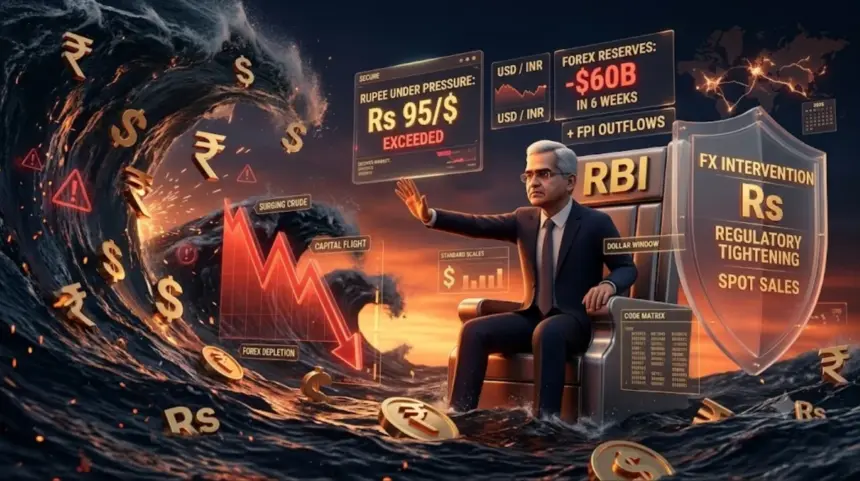
RBI intervention can ease currency-market stress, but a lasting improvement depends on the demand for dollars, export earnings and foreign investment.
Large dollar inflows and tighter foreign-exchange rules have given the Reserve Bank of India more tools to manage currency volatility. Yet those measures cannot, on their own, remove the economic pressures weighing on the rupee.
The explanation lies in the difference between stabilising a market and changing its underlying balance of demand and supply.
Selling dollars, encouraging foreign-currency deposits and restricting certain derivative transactions can ease immediate pressure. But if import payments and capital outflows continue to generate strong demand for dollars, the rupee can remain vulnerable.
See more of our coverage in your search results.
Add INDYASTORY on GoogleThe RBI has maintained that its intervention is intended to contain excessive volatility rather than defend a particular exchange rate. A currency weakening gradually is therefore different from a market experiencing disorderly trading.
Why oil prices matter for the rupee
India’s dependence on imported crude makes energy prices an important influence on its foreign-exchange requirements.
When oil becomes more expensive, importers generally need more dollars to pay their bills, assuming purchase volumes remain similar. That additional demand can put pressure on the rupee.
A larger energy import bill can also widen the current-account deficit unless stronger exports, services earnings or other receipts offset it.
Lower oil prices would help ease this pressure. They would not necessarily remove other sources of weakness, including foreign investment outflows or broader strength in the US dollar.
See more of our coverage in your search results.
Add INDYASTORY on GoogleForeign investment affects dollar availability
Foreign investors selling Indian assets can create another source of demand for foreign currency when they repatriate the proceeds.
Their decisions depend on more than India’s economic growth. Corporate earnings, valuations, currency risk and returns available in competing markets all influence investment allocations.
A weaker rupee can also reduce an overseas investor’s dollar-denominated return. That means a growing economy and a depreciating currency can coexist: economic growth does not automatically ensure that foreign-currency inflows exceed outflows.
See more of our coverage in your search results.
Add INDYASTORY on GoogleFor the rupee, sustained investment matters because it adds a source of dollar supply alongside export receipts and other overseas earnings.
What the RBI’s swap facility achieved
The RBI’s concessional foreign-exchange swap facility attracted $143.6 billion in inflows as of September 18, 2026, according to Reuters, citing central-bank data.
Foreign Currency Non-Resident (Bank), or FCNR(B), deposits accounted for $132.98 billion, measured up to August 31. Overseas foreign-currency borrowings and external commercial borrowings contributed the remainder.
The FCNR(B) window closed on August 31, while eligible borrowing-related facilities were scheduled to remain available until December 31.
These inflows strengthened the available foreign-currency buffer. However, a deposit or borrowing programme creates funding obligations as well as immediate inflows. It does not permanently eliminate the economy’s need to finance imports and other external payments.
Why exporters and importers can amplify pressure
Expectations about the exchange rate can change when businesses buy and sell dollars.
An exporter expecting further rupee weakness may postpone converting overseas earnings, hoping to receive more rupees later. An importer with the same expectation may bring forward dollar purchases or hedge future payments earlier.
Together, those decisions can reduce near-term dollar supply while increasing demand. This timing effect is often described as “leads and lags”.
It can intensify market pressure even when the underlying commercial payments have not changed substantially. However, hedging a genuine business exposure is a normal risk-management activity and should not automatically be treated as speculation.
What the 20% forex reserve requirement covers
The Foreign Exchange Risk Reserve, or FERR, requires authorised dealers to maintain a cash reserve against specified foreign-exchange derivative contracts.
According to reporting on the RBI’s October clarification, the user-contract requirement covers qualifying rupee-linked contracts exceeding $2 million equivalent, where the user purchases foreign currency to hedge current-account transactions.
It is not a blanket charge on every currency derivative. The clarification includes exclusions, including user contracts involving foreign-currency sales and certain capital-account-related hedges.
For an applicable contract, the reserve is calculated at 20% of its rupee-equivalent notional amount. It is maintained by the authorised dealer with the RBI, rather than automatically being a 20% payment charged directly to the customer.
Currency safeguards can carry business costs
Requiring banks to set aside cash has an opportunity cost. Banks may reflect some of that cost in the pricing of qualifying hedging products, depending on competition and contract terms.
Businesses could consequently face higher costs when protecting themselves against currency movements. Reuters reported that the new restrictions disrupted the forward market and increased hedging costs for importers.
The policy balance is therefore delicate: measures intended to discourage excessive positioning also need to preserve access to legitimate risk management.
Why falling reserves do not reveal the full intervention bill
A decline in headline foreign-exchange reserves should not automatically be described as an equal amount of dollars sold to defend the rupee.
Reserve values can change because of transactions, exchange-rate movements affecting non-dollar holdings and changes in gold prices. Timing also matters when comparing reserve data with market intervention.
Similarly, selling dollars in the domestic market can absorb rupee liquidity. The RBI can use separate liquidity operations to manage the resulting effect on the banking system.
What could provide more durable support?
A more favourable balance between foreign-currency receipts and payments would help. That could come through lower energy costs, stronger export and services earnings, or sustained capital inflows.
RBI intervention remains important for preventing market stress from becoming self-reinforcing. But the direction of the rupee ultimately depends on wider economic and financial conditions.
For readers tracking the currency, the useful indicators extend beyond individual RBI announcements: oil prices, capital flows, trade receipts, global dollar conditions and the cost of hedging all matter.