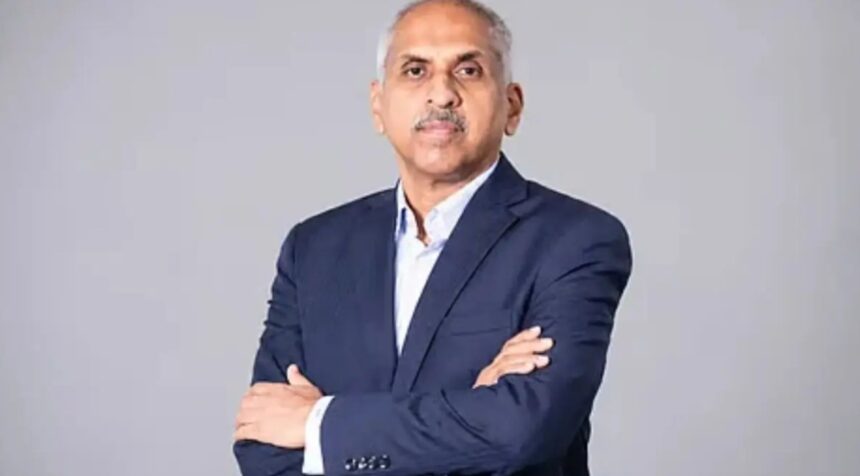
Equitas Small Finance Bank’s board has approved Balaji Nuthalapadi as interim CEO, subject to RBI approval. The leadership transition follows founder P.N. Vasudevan’s resignation amid investor concerns, with the bank continuing its search for a permanent chief executive.
Equitas Small Finance Bank has announced the proposed appointment of executive director Balaji Nuthalapadi as its interim chief executive officer, subject to approval from the Reserve Bank of India (RBI), following the resignation of founder, managing director and CEO P.N. Vasudevan.
The bank’s board approved the proposal on November 3, 2026, based on the recommendation of its Nomination and Remuneration Committee.
Nuthalapadi is expected to oversee the lender during its leadership transition, while the board continues searching for a permanent chief executive.
See more of our coverage in your search results.
Add INDYASTORY on GoogleThe appointment comes at an important time for the private-sector small finance bank, which is pursuing ambitious growth targets while seeking to address investor concerns surrounding governance, management continuity and business performance.
Vasudevan has reportedly indicated that he will continue serving as managing director and CEO until his successor formally assumes responsibility.
The precise date on which Nuthalapadi will take charge has not been established in the supplied announcement.
Equitas Small Finance Bank Interim CEO Appointment: Key Details
The board’s decision marks an important step in the lender’s leadership succession process.
However, the appointment is not yet unconditional because regulatory approval is required.
See more of our coverage in your search results.
Add INDYASTORY on GoogleEquitas SFB Leadership Change
| Particulars | Reported details |
|---|---|
| Bank | Equitas Small Finance Bank |
| Proposed interim CEO | Balaji Nuthalapadi |
| Current reported designation | Executive Director |
| Outgoing MD and CEO | P.N. Vasudevan |
| Board approval date | November 3, 2026 |
| Regulatory condition | RBI approval |
| Permanent CEO search | Internal and external candidates |
| Interim tenure | Not specified in supplied report |
| Transition effective date | Subject to confirmation |
Source: Leadership details provided in the supplied report. The bank’s official stock exchange filing and RBI approval status should be checked before publication.
The board is reportedly considering candidates both within and outside the organisation for the permanent leadership position.
This approach provides flexibility to evaluate executives familiar with Equitas’ operations alongside candidates with experience at other financial institutions.
See more of our coverage in your search results.
Add INDYASTORY on GoogleThe final appointment will depend on the bank’s selection process and applicable regulatory requirements.
Who Is Balaji Nuthalapadi, Equitas SFB’s Proposed Interim CEO?
Balaji Nuthalapadi is an experienced banking executive who reportedly spent nearly three decades with Citigroup before joining Equitas Small Finance Bank.
During his career at Citi, he held several senior positions involving banking operations and management.
At Equitas, he has been associated with technology development and operational transformation initiatives.
His existing involvement in the bank’s systems and operational processes may help provide continuity during the management transition.
For a financial institution, leadership familiarity with operational infrastructure is particularly relevant because banking activities depend on effective risk controls, technology systems, regulatory compliance and customer service.
However, investors should avoid assuming that a strong operational background alone guarantees improved financial performance.
The effectiveness of the transition will also depend on the broader management team, the bank’s strategy and its ability to manage credit and funding risks.
Why Did P.N. Vasudevan Resign From Equitas Small Finance Bank?
The proposed leadership change follows the resignation of P.N. Vasudevan, who played a central role in establishing and developing the Equitas banking business.
According to the supplied report, Vasudevan’s resignation followed prolonged investor concerns regarding his daughter’s association with a non-banking financial company (NBFC).
The issue had reportedly been raised by investors during meetings over several years.
In his resignation communication, Vasudevan stated that the relationship had been disclosed to the bank’s board and the RBI.
He also said there had been no business transactions between Equitas and the related NBFC apart from a short-term deposit made several years earlier, which had subsequently been repaid.
These statements reflect Vasudevan’s account of the matter.
The supplied information does not establish any regulatory finding of misconduct or improper related-party transactions.
It would therefore be inaccurate to describe the matter as proven wrongdoing.
What Did Vasudevan Say About Investor Concerns?
Vasudevan reportedly acknowledged that investors had repeatedly questioned the relationship involving his daughter’s NBFC.
His resignation letter suggested that some market participants considered the issue an ongoing source of uncertainty affecting the bank’s share valuation.
The concerns appear to have influenced discussions about management leadership and shareholder confidence.
However, the existence of investor concerns does not itself establish a breach of banking regulations or corporate governance standards.
Investors should examine official disclosures, independent audit information and any relevant regulatory communications before drawing conclusions.
A transparent succession process may help clarify the bank’s future management structure, but its effect on investor sentiment remains uncertain.
Vasudevan to Continue Until Successor Takes Charge
One important aspect of the transition is the reported plan for Vasudevan to continue in his existing position until a successor takes charge.
This arrangement could support continuity in the bank’s executive leadership.
Financial institutions operate within complex regulatory frameworks and require consistent oversight of credit risk, liquidity, technology and customer operations.
An orderly transition can help avoid gaps in executive responsibility.
However, the bank must also comply with applicable approval requirements and its formal governance procedures.
The precise sequence of leadership changes will become clearer once Equitas publishes further disclosures.
Investors should distinguish between the board’s approval of an interim appointment and the actual date on which the new executive assumes the CEO role.
Equitas SFB Share Price Falls After Resignation Announcement
The leadership developments reportedly affected market sentiment towards Equitas Small Finance Bank shares.
According to the supplied report, the bank’s stock declined sharply during the two trading sessions following the announcement of Vasudevan’s resignation.
However, exact share-price movements and percentage declines were not provided.
It would therefore be inappropriate to publish a specific percentage loss without checking exchange records.
Bank stocks can respond to unexpected senior management changes because leadership stability influences expectations about business strategy, governance and execution.
However, a share-price decline following an announcement does not prove that the development was its sole cause.
Broader market movements, bank earnings, valuation and other company-specific factors may also influence the stock.
Investors will now be monitoring the progress of the CEO appointment and the bank’s operating performance.
Equitas SFB’s Business Strategy Through FY31
Beyond the leadership transition, the bank has outlined ambitious medium-term growth objectives.
According to the supplied report, Equitas has a five-year business plan extending through March 2031.
The strategy targets annual growth of more than 20% in both advances and deposits.
The bank is also targeting an average return on assets of approximately 1.5%.
Equitas Small Finance Bank: Reported FY31 Targets
| Metric | Reported target |
|---|---|
| Planning horizon | Through March 2031 |
| Annual advances growth | Above 20% |
| Annual deposit growth | Above 20% |
| Average return on assets | Approximately 1.5% |
| Unsecured microfinance share | Around 10% of advances |
These are management targets and reported portfolio figures, not guaranteed outcomes. The exact definitions and base periods should be confirmed in the bank’s disclosures.
For a small finance bank, growing deposits and advances together is important because the institution must maintain an appropriate funding structure while expanding lending operations.
However, rapid growth also creates execution and credit-quality challenges.
The quality of new loans, cost of deposits and regulatory capital requirements can influence whether expansion translates into sustainable profitability.
Why the Bank’s Microfinance Exposure Matters
The supplied report indicates that unsecured microfinance loans account for approximately 10% of Equitas Small Finance Bank’s advances.
Microfinance lending can support access to credit for underserved borrowers.
However, unsecured loans generally lack traditional collateral, making repayment performance and customer creditworthiness particularly important.
Microfinance portfolios can also be sensitive to local economic conditions, borrower indebtedness and disruptions affecting household cash flows.
A lower concentration in unsecured microfinance can reduce exposure to that segment relative to a more heavily concentrated portfolio.
Nevertheless, the overall credit risk depends on the quality of lending across all business segments.
Investors should therefore review the bank’s gross and net non-performing assets, loan restructuring, collection efficiency, credit costs and provisioning coverage.
The reported 10% figure should also be checked against the bank’s latest portfolio classification.
What Does a 1.5% Return on Assets Target Mean?
Return on assets, or RoA, is an important profitability indicator for banks.
It measures the profit generated relative to the institution’s average assets over a given period.
A higher RoA can indicate that a bank is using its asset base efficiently, although comparisons should account for business mix and risk.
Equitas has reportedly targeted an average RoA of approximately 1.5% under its medium-term business plan.
For illustration, a bank with average assets of ₹1,00,000 crore and a 1.5% annual RoA would generate approximately ₹1,500 crore in annual net profit.
This is a mathematical example, not a forecast of Equitas’ assets or earnings.
Achieving the stated profitability target will depend on funding costs, loan yields, operating expenses, credit losses and balance-sheet growth.
The bank’s future financial results will provide evidence of progress towards this objective.
Why Deposit Growth Is Important for Equitas
Deposits are a key funding source for a banking institution.
Sustained deposit growth can support lending expansion and help manage reliance on alternative funding sources.
However, attracting deposits involves costs.
Banks must balance competitive interest rates with the need to maintain profitable lending margins.
For Equitas, the reported ambition to increase deposits by more than 20% annually would require sustained customer acquisition and retention.
Investors should examine the composition of deposits, including current and savings accounts, fixed deposits and other funding categories.
The cost of funds and stability of deposits are important when evaluating the quality of balance-sheet growth.
What Will the New CEO Need to Prioritise?
The incoming leadership will inherit both growth opportunities and operational challenges.
Leadership Stability
A clear management structure can help provide continuity for employees, customers, regulators and investors.
The permanent CEO appointment will be an important indicator of the bank’s succession planning.
Asset Quality
Controlling credit costs and maintaining healthy repayment performance will remain central to sustainable lending growth.
Deposit Mobilisation
Growing a stable deposit base will be important for supporting the bank’s lending ambitions.
Technology and Operations
Continued investment in digital banking, operational efficiency and risk-management systems may support customer service and scalability.
Governance and Investor Communication
Transparent disclosures and clear accountability can help investors evaluate the bank’s management processes.
These priorities apply regardless of which candidate ultimately becomes permanent CEO.
Could the CEO Transition Affect Equitas SFB’s Growth Outlook?
A leadership change may affect investor expectations, but its financial consequences cannot be determined from the announcement alone.
If the transition is orderly, the bank may continue implementing its existing business strategy.
However, a new permanent CEO could reassess priorities, operating processes or capital allocation decisions.
The extent of any changes will depend on the appointee, the board’s direction and business conditions.
Investors should watch for updates to the bank’s growth targets, asset-quality guidance and profitability expectations.
Near-term market sentiment may remain sensitive to leadership developments, but long-term shareholder returns will depend substantially on financial performance.
Key Risks for Equitas Small Finance Bank Investors
Several factors remain relevant when evaluating the bank.
Management transition: The timeline for regulatory approval and permanent CEO selection remains uncertain.
Credit quality: Rising delinquencies or loan losses could affect profitability.
Unsecured lending exposure: Microfinance and other unsecured portfolios may experience elevated stress during difficult economic periods.
Funding costs: Competition for deposits could place pressure on net interest margins.
Growth execution: Expanding advances and deposits by more than 20% annually would require disciplined underwriting and funding management.
Governance perception: Investor confidence may remain sensitive to the clarity and quality of corporate disclosures.
Valuation risk: The market price may already reflect expectations about earnings, growth and risk.
These factors should be considered alongside the bank’s business strategy and financial position.
What Happens Next at Equitas Small Finance Bank?
The next important development will be confirmation of the regulatory approval process for Nuthalapadi’s proposed interim appointment.
The bank is also expected to continue evaluating potential candidates for the permanent CEO position.
Official announcements should clarify the appointment’s effective date, tenure and any additional governance arrangements.
Investors will also monitor upcoming quarterly results and updates on advances, deposits, asset quality and profitability.
The bank’s ability to maintain operating continuity while managing the leadership transition will be particularly important.
Frequently Asked Questions
Who has been appointed interim CEO of Equitas Small Finance Bank?
The bank’s board has reportedly approved executive director Balaji Nuthalapadi as interim CEO, subject to RBI approval.
Has the RBI approved the interim CEO appointment?
The supplied report states that regulatory approval is required. It does not establish that the RBI has already granted approval.
Why did P.N. Vasudevan resign?
His resignation followed prolonged investor concerns related to his daughter’s association with an NBFC, according to the supplied report. Vasudevan stated that the relationship had been disclosed to the bank’s board and the RBI.
Who will become the permanent CEO?
The permanent CEO has not been identified in the supplied report. The board intends to consider internal and external candidates.
Will Vasudevan continue as CEO?
He has reportedly indicated that he will remain managing director and CEO until his successor assumes responsibility, subject to the bank’s formal transition arrangements.
What is Equitas’ FY31 growth target?
The bank reportedly aims for annual growth above 20% in advances and deposits, alongside an average return on assets of approximately 1.5%.
Conclusion
Equitas Small Finance Bank’s proposed appointment of Balaji Nuthalapadi as interim CEO marks an important step in the lender’s management transition following the resignation of founder P.N. Vasudevan.
The board approved the proposal on November 3, 2026, subject to RBI approval.
Nuthalapadi’s extensive banking experience and involvement in Equitas’ operational and technology initiatives could provide management continuity during the transition.
However, the appointment process and the search for a permanent CEO remain ongoing.
Investors will also be assessing the bank’s ability to achieve its medium-term growth and profitability targets while maintaining asset quality and deposit stability.
The leadership transition may influence near-term market sentiment, but long-term performance will depend on disciplined business execution, governance and sustainable earnings.