
Canva is undertaking a major organisational restructuring affecting around 22% of its workforce. CEO Melanie Perkins has described the changes as the company’s hardest moment in 13 years, with job cuts, role changes and relocations expected.
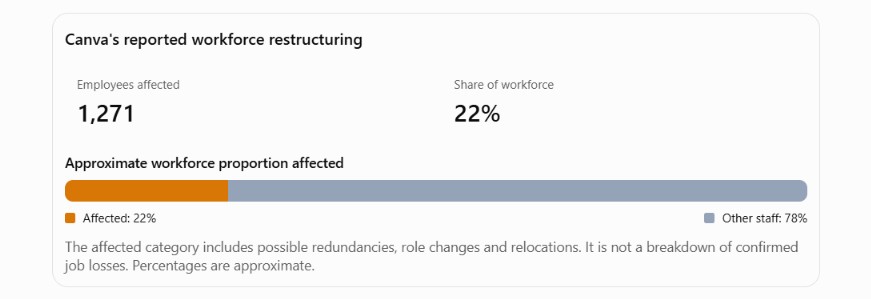
Canva, the Australian technology company behind one of the world’s widely used online design platforms, has reportedly announced a major workforce restructuring affecting at least 1,271 employees as artificial intelligence reshapes the software industry.
The changes affect approximately 22% of the company’s workforce and include job losses, changes in employee responsibilities and relocations to central operating hubs, according to the supplied account of an internal communication.
Chief Executive Officer Melanie Perkins described the reorganisation as “the hardest moment in our 13-year history,” highlighting the scale of the changes facing the Sydney-based business.
See more of our coverage in your search results.
Add INDYASTORY on GoogleThe company is seeking to simplify its organisational structure, reduce specialised functions and return to smaller teams with greater responsibility for delivering products.
The decision comes as AI-powered tools are changing how consumers and businesses create visual content, edit images and complete design-related tasks.
However, the reported figure of 1,271 should not be interpreted as a confirmed number of layoffs. The company has not specified in the supplied account how many affected workers will ultimately lose their jobs.
Canva Restructuring 2026: Key Details
| Particulars | Reported details |
|---|---|
| Company | Canva |
| Headquarters | Sydney, Australia |
| Employees affected | At least 1,271 |
| Share of workforce affected | Approximately 22% |
| Nature of changes | Job cuts, role changes and relocations |
| CEO | Melanie Perkins |
| Main business driver | AI-related product and organisational changes |
| Product-team hub | Greater concentration in Sydney |
| Hybrid work changes | Reportedly from January 2027 |
| Exact confirmed layoffs | Not disclosed in supplied report |
Figures are based on the supplied report and require verification against Canva’s official employee communication.
The distinction between affected employees and confirmed redundancies is particularly important.
See more of our coverage in your search results.
Add INDYASTORY on GoogleA workforce restructuring can include positions being eliminated, employees moving into different jobs and staff being asked to relocate.
Without a detailed breakdown, it is not possible to determine how many employees will leave Canva.
Why Is Canva Restructuring Its Workforce?
The reported changes are part of Canva’s response to the rapid development of artificial intelligence.
See more of our coverage in your search results.
Add INDYASTORY on GoogleAI tools increasingly allow users to generate images, create presentations, edit visual content and automate tasks that previously required specialist software knowledge.
For design software companies, this presents both opportunities and competitive challenges.
AI can help existing platforms offer faster and more accessible creative workflows. At the same time, it can reduce the need for users to rely on individual software applications for particular tasks.
In her reported employee communication, Perkins acknowledged that new technology was changing what customers could create, how they worked and what they expected from software products.
She also indicated that incremental organisational adjustments would not be sufficient to address the changes facing the business.
The restructuring therefore appears intended to reshape Canva’s operating model rather than simply reduce its workforce.
However, the supplied report does not establish the exact proportion of job cuts attributable directly to automation or AI tools.
Melanie Perkins Calls Restructuring Canva’s Hardest Moment
Perkins, who co-founded Canva with Cliff Obrecht and Cameron Adams, has overseen the company’s growth from a design technology startup into a global software business.
The latest restructuring represents a substantial organisational change.
According to the supplied report, Perkins wants Canva to operate with smaller, more empowered teams and fewer narrowly defined specialisations.
This approach reflects a broader shift among some technology businesses towards combining responsibilities, shortening decision-making processes and using AI to assist employees with routine tasks.
Smaller teams may allow companies to develop and release products more quickly.
However, organisational simplification also creates risks.
Businesses undergoing large restructurings must manage disruption to ongoing projects, employee uncertainty, possible loss of specialist knowledge and changes in internal responsibilities.
The effectiveness of the changes will depend on how Canva implements them and whether the new structure improves product development and customer experience.
Will All 1,271 Canva Employees Lose Their Jobs?
No such conclusion can be drawn from the information currently supplied.
The figure covers employees affected by a wider restructuring, including possible job losses, role changes and relocation requirements.
Perkins reportedly did not specify the total number of employees who would be made redundant.
The final employment impact will depend on the positions eliminated, alternative roles offered, relocation arrangements and how individual employees respond.
For accurate reporting, the announcement should therefore be described as a restructuring affecting more than 1,200 people, rather than 1,271 confirmed layoffs.
Employees directly affected will also need clarity on the timing of changes, available positions, relocation support and applicable employment arrangements.
Canva Plans to Concentrate More Product Teams in Sydney
Another important part of the reported reorganisation involves Canva’s workplace structure.
Sydney is expected to become a central base for a larger share of the company’s product teams.
The changes are intended to increase in-person collaboration and reduce organisational complexity.
The supplied report also indicates that most hybrid employees will be expected to work from the office two to three days per week starting in January.
Given the November 2026 reporting date, this would imply January 2027, subject to confirmation in the original memo.
These measures could change working arrangements for employees who previously operated in distributed teams.
For some workers, the new structure may involve relocating closer to major company hubs.
For others, it may mean changing responsibilities or collaborating with different teams.
The company has not provided sufficient information in the supplied report to establish how the policy will apply across all offices or countries.
How AI Is Changing the Design Software Industry
Canva’s restructuring comes amid growing competition across the creative software market.
Artificial intelligence is increasingly integrated into products for graphic design, video editing, presentations, marketing content and document creation.
AI-assisted tools can help users generate draft designs, remove image backgrounds, create illustrations and adapt content for different formats.
These capabilities are changing the expectations of customers who previously depended on specialised software or professional assistance for certain tasks.
For established software businesses, the challenge is to remain useful as AI makes individual creative functions more widely available.
Platforms must consider how to combine generation, editing, collaboration, brand management and publishing into products that users continue to value.
Companies may also need to reassess how they price services when features that were once differentiated become common across competing platforms.
However, AI adoption does not necessarily remove the need for design expertise.
Complex commercial projects still require judgement about brand identity, messaging, accessibility, accuracy and intellectual property rights.
The longer-term impact will depend on how technology changes user behaviour and how software companies adapt their products.
Why Canva’s Business Model Faces New Competition
Canva built much of its appeal around making design easier for people without extensive technical training.
Its browser-based tools, templates and collaborative features made it possible for individuals and businesses to create presentations, posters, marketing materials and other visual content.
AI is now making some of these tasks faster.
That creates an opportunity for Canva to expand what its platform can do, but it also increases competitive pressure.
Users may be able to complete certain creative tasks through general-purpose AI assistants or alternative design products.
For Canva, retaining customers will depend on providing a useful combination of creative features, collaboration, workflow integration and reliability.
The company must also balance investment in AI development with operating costs and potential financial returns.
The supplied report suggests that growth has slowed compared with Canva’s earlier expansion, adding pressure to adapt its organisational structure.
The exact growth figures and reporting period should be verified before drawing conclusions about the company’s current financial performance.
Canva’s Journey From Startup to Global Design Platform
Canva was founded in 2013 by Melanie Perkins, Cliff Obrecht and Cameron Adams.
The company’s origins can be traced to Perkins and Obrecht’s earlier venture, Fusion Books, which focused on making school yearbook design more accessible.
The founders recognised that many traditional design applications required substantial training.
Their ambition was to build software that allowed users to create professional-looking visual content through an easier, browser-based interface.
Canva subsequently expanded into a broader design and publishing platform used by individuals, educators and businesses.
Its offerings have grown beyond basic graphics to include presentations, documents, collaboration features, video and AI-assisted creative tools.
This expansion helped establish Canva as a significant company in Australia’s technology sector.
However, sustaining growth as a mature software platform requires a different operating approach from expanding an early-stage startup.
The latest reorganisation reflects those changing business requirements.
Canva Valuation: From $40 Billion to $26 Billion
Canva’s private-market valuation has experienced substantial changes over time.
The company reached a reported valuation of approximately $40 billion in 2021, during a period of strong investor interest in high-growth technology businesses.
Its valuation subsequently declined to around $26 billion in 2022 amid a broader technology-sector repricing.
Canva’s Reported Historical Valuation
| Period | Approximate valuation |
|---|---|
| 2021 | $40 billion |
| 2022 | $26 billion |
| Later periods | Reportedly recovered; current value unverified |
The movement illustrates how private technology valuations can change with interest rates, growth expectations and investor sentiment.
However, a private-company valuation is not the same as the continuously traded market capitalisation of a listed company.
Such valuations may come from funding rounds, employee share transactions or other private-market assessments.
The supplied report does not establish Canva’s exact valuation in November 2026.
Could the Restructuring Affect Canva’s IPO Plans?
Canva has been discussed as a potential future public-market candidate.
A listing would provide public investors with an opportunity to assess the company’s financial performance, growth prospects and valuation.
However, the latest restructuring introduces additional questions about its operating strategy.
Potential investors may want to understand whether the changes are expected to reduce costs, accelerate product development or improve profitability.
They may also examine any restructuring expenses, employee retention challenges and the effect on product delivery.
A leaner organisational structure could support efficiency if the transition is implemented successfully.
Conversely, disruption from a major reorganisation could affect execution.
No confirmed Canva IPO date, offering size or listing valuation is established in the supplied report.
Investors should avoid treating potential listing discussions as an announced IPO timetable.
Are AI Tools Causing Layoffs Across the Technology Sector?
Canva’s reported changes reflect broader questions facing technology companies as AI capabilities improve.
Some businesses are integrating AI into internal workflows to automate repetitive tasks and improve productivity.
Others are redesigning their products because customers increasingly expect AI-assisted features.
These developments can change the skills companies require and how teams are organised.
However, it would be inaccurate to attribute every technology-sector job reduction directly to AI.
Hiring decisions can also be influenced by slowing revenue growth, earlier overexpansion, investor expectations, financing costs and changes in business strategy.
For Canva, the supplied report connects the restructuring to both AI-driven industry changes and the company’s desire for simpler operations.
The ultimate consequences for employment will depend on which roles are removed, which are transformed and whether new positions emerge.
What Happens Next for Canva?
Several developments will be important in assessing the impact of the restructuring.
The first is clarity about the number of confirmed redundancies compared with staff offered alternative roles or relocation.
The second is how Canva reorganises product development and collaboration around its Sydney operations.
The company will also need to demonstrate whether the new structure allows it to respond more effectively to AI-related competition.
Future financial disclosures may provide insight into revenue growth, operating expenses and the cost of the restructuring.
If Canva advances towards a public listing, investors will likely examine the company’s AI strategy, profitability and customer retention alongside its broader business performance.
Conclusion
Canva’s reported restructuring represents a significant development for the Australian design software company as it adapts to a rapidly changing technology industry.
At least 1,271 employees, representing approximately 22% of its workforce, are reportedly affected by job cuts, changes in responsibilities or relocation requirements.
CEO Melanie Perkins has described the process as the company’s hardest moment in 13 years.
The changes are intended to simplify Canva’s structure, concentrate more product teams in Sydney and support faster development in an increasingly AI-driven software market.
However, the final number of job losses remains unclear.
The company’s future performance will depend on whether the organisational changes improve efficiency, strengthen its product offering and support sustainable growth.
For the wider technology industry, the development highlights how AI is influencing not only software features but also employment structures and business strategy.