Razorpay is reportedly preparing to raise ₹5,000–₹6,000 crore through an IPO after receiving regulatory clearance. The fintech company is targeting a valuation of around $5 billion, with a potential listing in December 2026 or early 2027.
Razorpay, one of India’s prominent fintech platforms, has reportedly received clearance from the Securities and Exchange Board of India (SEBI) for its proposed initial public offering (IPO), bringing the company closer to a stock market debut.
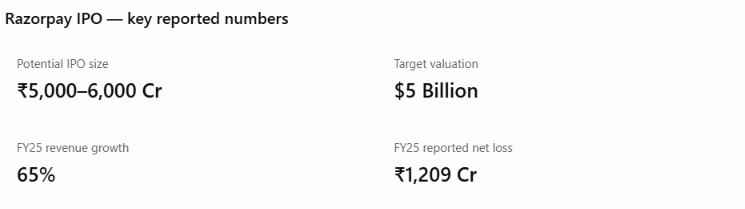
The public issue is expected to raise approximately ₹5,000–₹6,000 crore, with Razorpay targeting a valuation of around $5 billion, according to the reported IPO plans.
The company could explore a listing as early as December 2026, although the first quarter of 2027 is understood to be another possible window. The final schedule will depend on market conditions, regulatory requirements and the completion of the offering process.
See more of our coverage in your search results.
Add INDYASTORY on GoogleThe development comes as India’s primary market continues to attract companies seeking capital for expansion and opportunities for existing shareholders to partially monetise their holdings.
For Razorpay, the IPO would represent an important transition from a privately held fintech business to a publicly traded company subject to additional disclosure and governance requirements.
However, investors will be closely examining the company’s profitability, valuation and long-term growth prospects before assessing the offering.
Razorpay IPO: Issue Size, Valuation and Expected Listing Date
Razorpay’s proposed offering is expected to include a fresh issue of shares worth approximately ₹2,700 crore, alongside an offer for sale (OFS) by existing shareholders.
The total issue size is reportedly being considered in the range of ₹5,000–₹6,000 crore.
See more of our coverage in your search results.
Add INDYASTORY on GoogleThe final structure could change before the company publishes its official offer documents.
Razorpay IPO Key Details
| Particulars | Reported details |
|---|---|
| Company | Razorpay |
| Proposed IPO size | ₹5,000–₹6,000 crore |
| Target valuation | Around $5 billion |
| Proposed fresh issue | ₹2,700 crore |
| Remaining component | Offer for sale |
| Regulatory status | SEBI clearance reported |
| Possible listing | December 2026 or Q1 2027 |
| Issue price band | Not announced |
| Subscription dates | Not announced |
| Listing exchange | Not confirmed in supplied report |
These details are based on the supplied report. Final issue terms and regulatory status must be verified against official disclosures.
Axis Capital, Kotak Mahindra Capital, JPMorgan and Citi have reportedly been appointed to manage the offering.
See more of our coverage in your search results.
Add INDYASTORY on GoogleThe participation of several investment banks reflects the scale and complexity of the proposed transaction.
However, investment bank appointments and preliminary valuations do not guarantee that an IPO will launch on the anticipated schedule.
What Does SEBI Clearance Mean for Razorpay?
SEBI’s review is an important stage in India’s IPO process.
Companies seeking to raise capital from public investors must comply with applicable securities regulations and disclosure requirements.
Razorpay reportedly pursued the confidential pre-filing route, which allows eligible issuers to submit draft offer documents without immediately making the complete filing public.
This route can provide flexibility when companies are preparing a large offering but have not yet finalised its timing.
It may also allow management to assess regulatory observations before proceeding with further disclosures.
However, receiving SEBI observations should not be interpreted as regulatory endorsement of a company’s investment merits, financial performance or IPO valuation.
Investors will need to examine the final offer documents once they become available.
These disclosures should provide greater clarity on financial statements, business risks, promoter shareholding, litigation, related-party transactions and the use of proceeds.
Why Razorpay’s IPO Matters for India’s Fintech Industry
Razorpay’s proposed listing would add another payments-focused technology business to the publicly traded investment universe, subject to successful completion of the IPO.
India’s digital payments ecosystem has expanded through increasing merchant adoption, electronic transactions and wider use of financial technology services.
Razorpay has benefited from participating in this broader shift, offering products that help businesses accept payments and manage different aspects of their financial operations.
A public listing could give investors an opportunity to evaluate the company’s financial performance alongside other listed financial technology and payments businesses.
It could also provide additional capital for growth, depending on the final amount raised through the fresh issue.
However, the attractiveness of the IPO will depend heavily on the price investors are asked to pay relative to the company’s earnings potential.
A large customer base or substantial transaction volume does not automatically translate into strong profitability.
Razorpay’s Reported $5 Billion Valuation Explained
The proposed $5 billion valuation is one of the most closely watched aspects of Razorpay’s IPO plans.
A company’s equity valuation represents the estimated market value of its outstanding shares, rather than the amount of cash it raises in an offering.
For example, Razorpay could seek to raise ₹5,000–₹6,000 crore through the IPO while targeting a much larger overall valuation.
The relationship between the amount raised and the percentage of equity offered will depend on the final capital structure, issue price and number of shares sold.
Investors should also distinguish between fresh capital raised by the company and proceeds received by existing shareholders through an OFS.
A fresh issue increases the company’s equity capital, while an offer for sale generally transfers shares from existing holders to new investors.
The final offer documents will be essential for understanding how the transaction affects ownership, dilution and the company’s financial resources.
Razorpay FY25 Revenue Grows 65% to ₹3,783 Crore
Razorpay reportedly recorded revenue of approximately ₹3,783 crore during FY25, representing year-on-year growth of 65%.
The increase reflects substantial expansion in its reported business scale.
However, the company also recorded a net loss of approximately ₹1,209 crore during the financial year.
The supplied report attributes a significant part of the reported loss to employee stock option-related expenses and costs associated with shifting the company’s domicile to India.
Razorpay Financial Highlights
| Financial metric | FY25 reported result |
|---|---|
| Revenue | ₹3,783 crore |
| Revenue growth | 65% YoY |
| Net loss | ₹1,209 crore |
| Annual payments processed | Approximately $180 billion |
The revenue, loss and payment-volume figures require confirmation from company filings. Revenue and total payment volume are different measures and should not be compared as though they represent the same type of income.
Although revenue growth was strong, the reported net loss highlights an important consideration for investors.
Fintech companies can operate at substantial transaction volumes while experiencing pressure from technology spending, employee costs, customer acquisition expenses and business expansion.
Investors should examine how much of the reported loss reflects recurring operating expenses and how much relates to exceptional or non-cash items.
The distinction matters when assessing the sustainability of future earnings.
What Does Razorpay’s ₹1,209 Crore Loss Mean for Investors?
Razorpay’s reported loss requires careful interpretation because the headline figure alone does not fully explain the company’s underlying financial position.
Expenses linked to employee stock option plans can affect reported profit without necessarily creating an equivalent immediate cash outflow.
Similarly, costs associated with corporate restructuring may not recur at the same level every year.
However, these factors should not automatically be excluded when assessing the company’s financial health.
Investors need to understand the accounting treatment, economic implications and potential future costs associated with such expenses.
Important financial indicators will include operating cash flow, adjusted and statutory profitability, revenue growth, operating margins and the company’s ability to generate earnings as it scales.
If Razorpay can sustain revenue growth while improving cost efficiency, its earnings profile could strengthen over time.
Conversely, slower growth or continuing high expenses could complicate the path towards profitability.
The final prospectus should provide the information needed for a more detailed assessment.
Razorpay’s Reverse Flip to India Ahead of IPO
One of Razorpay’s important preparatory developments was its reported shift in corporate domicile from the United States to India.
The restructuring, commonly described as a reverse flip, was reportedly completed in May 2025.
According to the supplied information, the process involved an estimated tax outgo of approximately $150 million.
A reverse flip generally refers to a corporate restructuring through which a business changes its holding-company structure or domicile from an overseas jurisdiction to India.
Such transactions can involve tax, legal, regulatory and shareholder considerations.
For Razorpay, the move formed part of preparations associated with its domestic corporate structure and potential Indian public listing.
The company reportedly converted into a public limited company in April 2025.
However, the tax consequences, final corporate structure and accounting impact should be verified through official disclosures before publication.
Razorpay Secures GIFT City Payment Services Licence
Razorpay has also reportedly secured a final Payment Service Provider licence from the International Financial Services Centres Authority (IFSCA) for operations in GIFT City.
The development could support the company’s expansion into cross-border payment services and international financial technology solutions.
GIFT City’s International Financial Services Centre provides a regulatory framework for eligible financial activities involving international markets.
Depending on the precise licence permissions, payment service providers may be able to offer specified cross-border payment and related financial services.
For Razorpay, international payment capabilities could provide opportunities to serve businesses with overseas customers and suppliers.
However, licensing approval does not guarantee immediate revenue growth.
The company will need to build commercial demand, comply with regulatory obligations and manage the operational requirements of international payments.
Investors should also distinguish between services permitted under the company’s licence and products that are actually launched and generating revenue.
From Payment Gateway to Diversified Fintech Platform
Founded in 2014 by Harshil Mathur and Shashank Kumar, Razorpay began as a platform helping businesses accept digital payments.
Over time, it expanded into a broader range of financial technology services.
Its product ecosystem now includes payment acceptance, business financial operations, payroll-related solutions and other services intended to simplify money management for enterprises.
The company has also developed offerings associated with lending and international payments.
According to the supplied report, Razorpay processes approximately $180 billion in payments annually and serves millions of businesses.
This transaction volume indicates significant activity across its platform.
However, total payment volume is not equivalent to revenue.
A payments business generally earns only a portion of the value processed, depending on its product mix, commercial arrangements and applicable fees.
The difference between gross transaction activity and revenue is particularly important when comparing fintech companies with traditional financial institutions.
What Could Drive Razorpay’s Growth After Listing?
Several factors may influence Razorpay’s long-term business prospects.
1. Increasing Digital Payment Adoption
Greater acceptance of digital payments among businesses can create demand for payment processing and related technology services.
However, competitive pricing and regulatory requirements can influence how much revenue companies generate from this activity.
2. Expansion Into Additional Financial Services
A broader product portfolio may create opportunities to serve existing merchants with additional services.
The success of this strategy will depend on product adoption, operating efficiency and the profitability of individual offerings.
3. International Payments
Cross-border payment services could expand Razorpay’s addressable market.
However, international operations bring regulatory complexity, foreign exchange exposure and additional competition.
4. Enterprise Customer Growth
Large business clients can generate substantial transaction volumes and demand sophisticated payment infrastructure.
At the same time, enterprise contracts may involve negotiated pricing and higher service expectations.
5. Improved Operating Efficiency
As the company grows, better technology utilisation and cost management could support profitability.
The financial outcome will depend on whether revenue expansion exceeds the growth in operating expenses.
Why India’s IPO Market Could Be Important for Razorpay
Razorpay’s reported listing preparations come during a period of significant primary-market activity.
According to figures in the supplied report, Indian companies raised approximately ₹84,400 crore through IPOs during the first half of FY27, representing around 30% year-on-year growth.
These figures require independent verification before publication.
A strong fundraising environment may provide an opportunity for large private businesses to access public capital.
However, IPO demand can be selective, particularly when valuations are high or businesses have not yet demonstrated consistent profitability.
For Razorpay, investors will likely examine financial performance, corporate governance, customer economics and the intended use of proceeds alongside the proposed valuation.
The wider IPO market’s strength does not guarantee that any particular issue will attract sufficient demand at its preferred price.
Key Risks Investors Should Evaluate in Razorpay’s IPO
Despite its substantial business scale and revenue growth, Razorpay faces several considerations that could affect its valuation.
Profitability risk: The company reported a sizeable FY25 net loss, making the sustainability of its earnings model an important question.
Regulatory exposure: Payments and financial technology businesses operate within frameworks that can change over time.
Competition: Razorpay competes in markets where pricing, technology quality, merchant relationships and service reliability are important.
Valuation sensitivity: A $5 billion valuation may depend on expectations of significant future revenue and earnings growth.
Technology and cybersecurity: Payment platforms must maintain secure, reliable systems and protect sensitive financial information.
International expansion: Cross-border services can introduce additional compliance requirements and operational costs.
IPO timing: Unfavourable market conditions could affect the final valuation, subscription schedule or decision to proceed.
Investors should consider these risks together with the company’s growth opportunities.
When Will Razorpay Announce Its IPO Price Band?
The exact subscription dates, price band, lot size and final share allocation have not been established in the supplied report.
These details are expected to become clear when the company formally announces the offering and publishes the relevant issue documents.
Investors should rely on official exchange announcements and company disclosures rather than treating preliminary media estimates as confirmed terms.
The proposed December 2026 or first-quarter 2027 listing window remains subject to change.
Should Investors Consider Razorpay’s IPO?
Razorpay’s planned public offering may attract interest because of its presence in India’s digital payments industry, strong reported revenue growth and expanded financial technology operations.
However, investors should avoid making decisions based solely on its brand recognition or the proposed $5 billion valuation.
The company’s reported FY25 loss, business economics and future capital requirements deserve careful examination.
The final prospectus will be especially important for understanding revenue composition, expenses, cash flows, related-party transactions and the proposed use of fresh issue proceeds.
A disciplined assessment should compare Razorpay’s valuation with the quality and sustainability of its underlying business.
Conclusion
Razorpay’s reported SEBI clearance represents a significant development in its preparations for an Indian stock market listing.
The fintech company is reportedly considering a ₹5,000–₹6,000 crore IPO at a targeted valuation of approximately $5 billion, with a possible launch in December 2026 or early 2027.
Its reported 65% revenue growth in FY25 reflects expanding business operations, while the ₹1,209 crore net loss highlights the importance of evaluating profitability alongside growth.
The company’s reverse flip to India, expansion into broader financial services and GIFT City licensing initiative also form part of its evolving business strategy.
For investors, the key questions will concern the final IPO valuation, the sustainability of revenue growth, the path towards profitability and the use of funds raised through the offering.
Until the official offer documents are released, the proposed issue size and listing schedule should be treated as provisional.