
An analysis attributed to IS suggests that 31 of 101 IPOs that debuted at a premium during Samvat 2082 later fell below their issue prices. The findings highlight why strong listing-day demand does not always produce lasting returns.
A strong stock market debut can create excitement around a newly listed company, but the initial gains do not always survive once trading settles.
An analysis of initial public offerings during Samvat 2082, attributed to IS, suggests that nearly one-third of companies that listed above their IPO prices subsequently slipped below their original issue prices.
Of the 149 IPOs covered in the reported analysis, 101 made their stock market debuts at a premium. Their average listing-day gain was approximately 11.7%.
See more of our coverage in your search results.
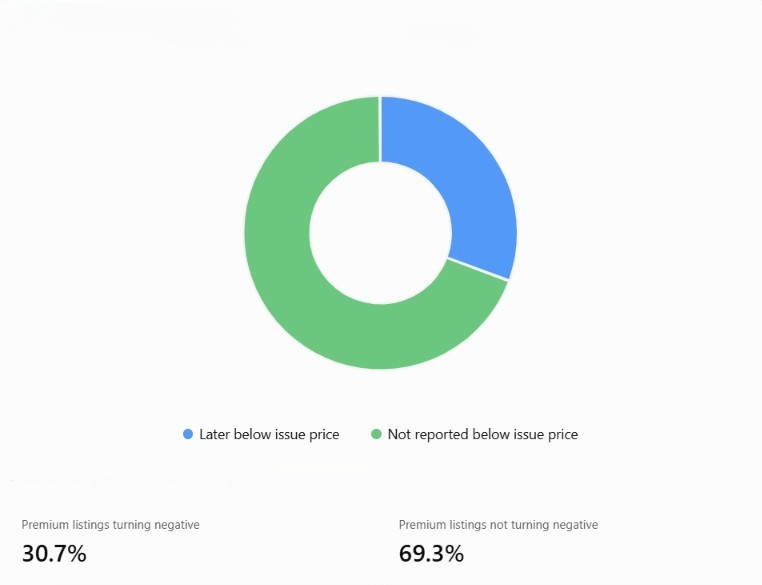
Add INDYASTORY on GoogleHowever, 31 of those 101 premium listings later traded below their offer prices, demonstrating the difference between immediate investor demand and sustained share-price performance.
The findings are particularly relevant as India’s primary market continues to attract companies planning public offerings.
For retail investors, the data highlights an important distinction: an IPO can deliver a positive listing-day return without becoming a successful long-term investment.
Samvat 2082 IPO Performance: What Do the Numbers Show?
The reported analysis covered 149 IPOs that entered the stock market during Samvat 2082.
Of these, 101 opened above their respective issue prices, indicating that approximately 67.8% of the covered companies delivered a premium on their debut.
See more of our coverage in your search results.
Add INDYASTORY on GoogleBut subsequent performance produced a less encouraging picture for some of those initial winners.
Thirty-one IPOs that had opened at a premium later traded below their issue prices.
IPO Listing Performance in Samvat 2082
| Metric | Reported figure |
|---|---|
| Total IPOs analysed | 149 |
| IPOs that debuted at a premium | 101 |
| Share of IPOs with premium listings | 67.8% |
| Average reported listing gain | 11.7% |
| Premium listings that later fell below issue price | 31 |
| Share of premium listings that turned negative | 30.7% |
The difference between listing-day performance and later returns is important because an IPO’s first trading session can be influenced by short-term demand, limited supply and market sentiment.
See more of our coverage in your search results.
Add INDYASTORY on GoogleOver time, investors receive more information about quarterly earnings, management execution, business risks and valuation.
That information can lead to substantial changes in a newly listed company’s share price.
Small IPO Listing Gains Were More Vulnerable
The reported findings suggest that companies with modest listing gains were more likely to fall below their original issue prices.
Approximately 46% of IPOs that delivered single-digit listing gains subsequently turned negative relative to their offer prices.
By comparison, around 20% of IPOs that debuted with double-digit gains reportedly fell below their issue prices.
This difference suggests that a small initial premium did not provide much protection against subsequent price declines.
However, larger listing gains should not be treated as evidence that a company is fundamentally stronger.
A stock that opens substantially above its offer price can still become overvalued, especially if expectations exceed the company’s future earnings potential.
The reported percentages are descriptive historical observations, not probabilities that can reliably predict an individual IPO’s future performance.
Why Do IPO Shares Fall After Strong Listings?
There are several reasons why a company can perform well on listing day but struggle in subsequent trading.
1. Initial Demand May Be Driven by Short-Term Expectations
IPO subscriptions can attract investors seeking immediate listing gains rather than long-term ownership.
When a stock begins trading, some investors may sell to realise profits.
If selling pressure becomes stronger than demand from new buyers, the share price can decline.
The degree of selling pressure depends on the shareholder mix, available float and market conditions.
2. IPO Valuations May Already Reflect High Growth Expectations
A public offering can be priced at a valuation that assumes substantial future expansion.
If actual earnings growth falls short of those expectations, investors may revise the price they are willing to pay.
A company can continue growing while its share price declines if its valuation multiple contracts.
This is why valuation matters alongside revenue and profit growth.
3. Quarterly Results Can Change Investor Sentiment
Before listing, investors primarily rely on historical financial statements and information in the offer documents.
After listing, the company publishes regular financial results that provide additional evidence of business performance.
Unexpected changes in profitability, costs, cash flows or management guidance may influence investor expectations.
4. Shareholder Selling Can Increase Supply
Some newly listed companies have shareholders whose ability to sell is restricted for a specified period.
When applicable lock-in periods expire, eligible investors may sell some or all of their holdings.
This can increase the supply of shares available for trading.
However, lock-in expiry does not automatically mean that selling will occur.
5. Broader Market Conditions May Change
Interest rates, economic expectations, sector valuations and market liquidity can all influence newly listed stocks.
Even businesses with healthy operating performance may experience share-price declines during periods of market weakness.
IPOs Listed at a Discount Can Also Recover
The Samvat 2082 analysis reportedly found that almost half of the IPOs that debuted below their issue prices subsequently recovered to trade above those prices.
This is an important counterpoint to the decline in some premium listings.
A disappointing listing does not necessarily mean the underlying business lacks long-term prospects.
New financial information, improvements in profitability, better market conditions or changes in valuation expectations can support a subsequent recovery.
However, the reported recovery percentage requires confirmation of the underlying company universe and observation date.
Investors should also distinguish between a stock briefly moving above its issue price and delivering a sustained positive return.
The broader lesson is that the first trading day’s performance provides only limited information about the company’s longer-term investment outcome.
Top IPO Listing-Day Performers in Samvat 2082
The supplied report identifies several companies that recorded particularly strong first-day performances.
Templens reportedly led the listing-day returns with a gain of approximately 111.3%.
Bharat Coking Coal followed with a reported premium of 96%, while ESDS Software recorded around 77%.
Reported Top Listing-Day Gainers
| Company | Listing-day gain |
|---|---|
| Templens | 111.3% |
| Bharat Coking Coal | 96.0% |
| ESDS Software | 77.0% |
The company identities, actual listing returns, listing dates and price-adjustment conventions require verification against exchange records.
Such large initial returns can attract considerable attention.
However, a high listing premium measures the difference between the IPO issue price and the market price at a particular point during the listing session.
It does not establish the return that every IPO applicant actually earned.
Investors who did not receive an allotment and instead purchased shares after a sharp listing-day rise may have experienced very different outcomes.
Rubicon Research and Omnitech Engineering Lead Reported Post-Listing Gains
The list of strongest subsequent performers differed from the listing-day leaderboard.
According to the supplied analysis, Rubicon Research delivered a post-listing return of approximately 242%, while Omnitech Engineering gained around 201%.
ESDS Software also featured among the strongest performers, with a reported return of 157%.
Reported Post-Listing Performers
| Company | Reported return |
|---|---|
| Rubicon Research | 242% |
| Omnitech Engineering | 201% |
| ESDS Software | 157% |
Returns have been reproduced from the supplied report. Before publication, confirm whether these percentages are measured from IPO issue prices or initial exchange trading prices, and establish the calculation date.
These observations demonstrate why the definition of investment return matters.
An investor allotted shares at the IPO price can earn a different return from someone who buys the stock on listing day.
Likewise, percentage gains can change significantly depending on whether the starting point is the offer price, listing price or closing price on the first trading session.
For accurate financial reporting, any ranking of IPO wealth creators should clearly disclose its methodology.
Historical IPO Data Shows the Same Challenge
The supplied report also refers to research attributed to Business Today and Axis Capital covering 407 IPOs between July 2020 and July 2026.
That historical analysis reportedly found average listing gains of approximately 21%.
However, several of the companies subsequently traded below their original offer prices.
The figures reinforce the distinction between an IPO’s initial reception and the investment experience that follows.
The two studies should not be treated as directly comparable without reviewing their methodology.
They cover different periods and may use different definitions of IPO returns, observation dates or company selection.
The type of average used is also important because a small number of unusually strong listings can substantially influence an arithmetic mean.
For investors, the central insight remains that listing-day returns are not a substitute for evaluating business fundamentals.
Jio Platforms: Reported Example Requires Verification
The supplied report identifies Jio Platforms as an example of a newly listed company whose share price remained above its issue price after a positive debut.
It claims that the company listed at ₹1,358 against an issue price of ₹1,119 and later traded at ₹1,437.40 on November 3, 2026.
The report also cites IPO fundraising of ₹30,213 crore and subscription of 22.19 times.
These are material, time-sensitive claims that have not been independently verified and should not be published as confirmed market history without checking official NSE and BSE records.
More broadly, the business areas mentioned in the report—broadband, enterprise technology, digital services and artificial intelligence—illustrate factors that may influence the valuation of a large technology-oriented business.
However, such growth opportunities must be assessed alongside profitability, capital requirements, competition and the valuation investors pay.
A company’s industry exposure alone does not establish that its stock will outperform after listing.
Why Listing-Day Gains Are Not the Same as Wealth Creation
A listing gain measures the difference between an IPO’s offer price and a stock’s market price at a specified point after it begins trading.
Long-term investment returns, by contrast, depend on the price paid, the price eventually realised and any applicable distributions or corporate actions.
Consider a hypothetical IPO priced at ₹100 per share.
Suppose the stock opens at ₹125, delivering a 25% listing premium.
An investor who received an IPO allotment and sold at ₹125 would realise a gross gain of ₹25 per share before costs and taxes.
However, an investor who purchased the stock at ₹125 and later sold at ₹90 would incur a 28% price loss on that purchase.
The company would also be trading 10% below its original issue price.
This example shows how the same IPO can produce very different investment outcomes depending on when an investor buys and sells.
What Should Investors Check Before Applying for an IPO?
The Samvat 2082 findings highlight the importance of evaluating the business behind the offering.
Business Model and Competitive Position
Investors should understand how the company generates revenue, which customers it serves and whether it has a sustainable competitive advantage.
A business operating in a fast-growing industry may still face significant competition or weak pricing power.
Profitability and Cash Flow
Revenue growth is important, but investors should also examine operating profit, net profit and cash generated from operations.
A company reporting accounting profits without corresponding cash generation may require closer examination.
IPO Valuation
Investors should compare the offer valuation with relevant listed companies while considering differences in business models, growth, profitability and risk.
A high-quality company can still become an unattractive investment if its shares are purchased at an excessive price.
Use of Issue Proceeds
An IPO can include both fresh shares and an offer for sale.
Fresh issue proceeds generally go to the company, whereas OFS proceeds are received by selling shareholders.
The intended use of funds can help investors understand whether the transaction supports expansion, debt reduction or shareholder exits.
Corporate Governance
Promoter background, related-party transactions, legal disputes, auditor observations and financial disclosures deserve careful attention.
These factors can influence the quality and reliability of reported earnings.
Post-Listing Share Supply
Investors should examine applicable lock-in arrangements, public shareholding and the possibility of future equity issuance.
An increase in available shares can influence market pricing, especially when trading liquidity is limited.
Does a High IPO Subscription Guarantee Better Returns?
No. Subscription data measures demand relative to available shares during the offer period.
It does not directly establish whether the company’s valuation is reasonable.
Oversubscription can be influenced by limited share availability, short-term market sentiment, institutional demand and expectations of listing gains.
Similarly, unofficial grey market premiums are not reliable substitutes for financial analysis.
A heavily subscribed IPO can perform poorly after listing, while an offering with limited initial enthusiasm may later recover.
Investors should evaluate subscription figures as one piece of information rather than a forecast of future returns.
What Could Samvat 2083 Mean for IPO Investors?
The outlook for new public offerings remains closely connected to company valuations, market liquidity and corporate fundraising requirements.
According to the supplied report, more than 20 IPOs could approach the market in the closing months of 2026.
Potential issuers mentioned include Avaada Electro, Carlsberg India and Prism, the company associated with OYO.
The broader reported pipeline includes 252 companies proposing to raise approximately ₹4.5 lakh crore.
However, these pipeline figures, company filing statuses and proposed schedules require current regulatory verification.
Not every company preparing an IPO will necessarily complete its listing within the expected period.
The performance of recently listed companies could also influence investor appetite for new offerings.
After a period of significant primary-market activity, pricing discipline and profitability may become especially important considerations.
What Should Investors Watch After an IPO Lists?
Post-listing performance should be evaluated through more than the daily share price.
Investors can monitor quarterly earnings, operating cash flow, management guidance and progress on the use of IPO proceeds.
Changes in promoter shareholding, major investor transactions and applicable lock-in expiries may also affect market supply.
For younger or rapidly growing businesses, investors should assess whether revenue expansion is translating into sustainable profitability.
For established businesses, capital efficiency, debt management and the consistency of cash generation may be particularly relevant.
The appropriate indicators will vary across industries.
Conclusion
The reported Samvat 2082 IPO data presents a clear warning against treating listing-day gains as evidence of lasting investment success.
Although 101 of 149 IPOs reportedly debuted above their issue prices, 31 of those initial winners subsequently traded below their offer prices.
Smaller listing premiums appeared particularly vulnerable, while some companies that initially disappointed investors later recovered.
These patterns demonstrate that the first trading session captures only a small part of a newly listed company’s investment journey.
For investors entering Samvat 2083, the more durable approach is to examine business quality, financial performance, valuation, governance and the intended use of IPO proceeds.
A successful IPO debut can be encouraging, but sustainable shareholder returns ultimately depend on what happens after the listing excitement fades.