
Maxwell Engineering Solutions’ ₹57.64 crore IPO reportedly received bids worth more than ₹20,000 crore as retail, institutional and non-institutional investors subscribed heavily. The SME issue is expected to list on NSE Emerge on November 6.
Maxwell Engineering Solutions has emerged as one of the most heavily subscribed SME public offerings in the reported November 2026 IPO calendar, with its initial public offering attracting bids for approximately 128.94 crore equity shares against 26.24 lakh shares available for subscription.
The IPO closed with an overall subscription of 491.39 times, according to the figures reported for the final bidding day.
Demand was particularly strong among non-institutional investors, whose allocated portion received 600.47 times subscription. Retail participation was also substantial at 556.10 times, while qualified institutional buyers subscribed 259.45 times their available quota.
See more of our coverage in your search results.
Add INDYASTORY on GoogleThe strong response has shifted attention towards share allotment and the company’s expected debut on the NSE Emerge platform on November 6, 2026.
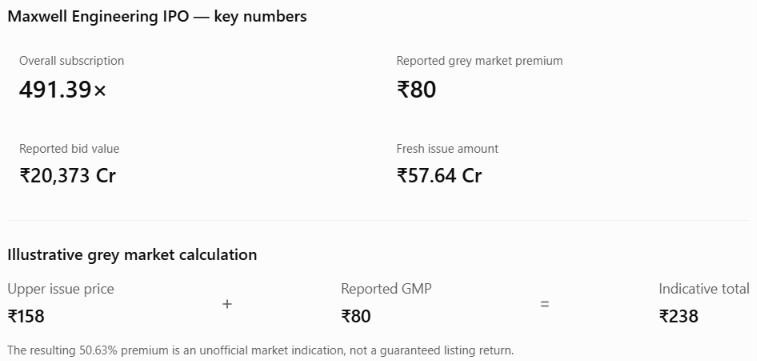
Meanwhile, unofficial grey market quotations indicated a premium of approximately ₹80 per share over the IPO’s upper price band of ₹158.
That translates into an indicative premium of about 50.6%, although grey market transactions are unofficial and do not guarantee a corresponding stock exchange listing price.
For investors, the central question is whether the strong subscription demand is supported by the company’s operating fundamentals, valuation and long-term growth prospects.
Maxwell Engineering IPO Subscription Reaches 491.39 Times
Maxwell Engineering’s IPO attracted strong participation across investor categories, with reported bids substantially exceeding the shares available for subscription.
See more of our coverage in your search results.
Add INDYASTORY on GoogleAccording to the supplied subscription data, investors applied for approximately 128.94 crore shares against a net offer of 26.24 lakh shares.
The resulting subscription multiple was approximately 491.39 times.
At the upper price band of ₹158, the reported bid quantity represents a notional application value of around ₹20,372.52 crore.
See more of our coverage in your search results.
Add INDYASTORY on GoogleThis figure describes the value of shares requested by investors at the issue price. It does not represent the capital that the company will actually receive.
Maxwell Engineering IPO Subscription Details
| Investor category | Reported subscription |
|---|---|
| Non-institutional investors (NII) | 600.47 times |
| Retail individual investors | 556.10 times |
| Qualified institutional buyers (QIB) | 259.45 times |
| Overall IPO subscription | 491.39 times |
Source: Figures provided in the underlying market report, pending official exchange confirmation.
The figures indicate substantial demand across retail, institutional and high-net-worth investor categories.
However, subscription intensity should not be interpreted as a direct measure of the company’s fair valuation.
In relatively small public offerings, the number of shares available can be limited compared with the volume of applications, resulting in unusually high oversubscription multiples.
Non-Institutional Investors Lead IPO Demand
The non-institutional investor portion received the strongest response, with reported subscription reaching 600.47 times.
Within this category, the portion designated for larger non-institutional applications reportedly attracted 717.19 times subscription.
The smaller non-institutional investor segment received 367.03 times subscription.
Retail investors subscribed approximately 556.10 times their allocation.
Qualified institutional buyers, meanwhile, subscribed 259.45 times their portion.
The participation of multiple investor categories suggests broad interest in the offering rather than demand being concentrated solely among retail traders.
Nevertheless, the eventual performance of Maxwell Engineering shares will depend on post-listing market conditions, liquidity, valuation and the company’s operating results.
Strong bidding during the subscription period does not guarantee that investors will achieve listing gains.
Maxwell Engineering IPO GMP: What Does the ₹80 Premium Mean?
Maxwell Engineering shares reportedly attracted a grey market premium of approximately ₹80 before their expected listing.
Based on the IPO’s upper price band of ₹158, the calculation produces an illustrative price of ₹238 per share.
Maxwell Engineering IPO GMP Calculation
| Particulars | Amount |
|---|---|
| Upper IPO issue price | ₹158 |
| Reported grey market premium | ₹80 |
| Illustrative price including GMP | ₹238 |
| Implied premium | 50.63% |
The calculation indicates that unofficial market participants were reportedly willing to pay a premium equivalent to approximately half the IPO issue price.
However, the ₹238 figure is not an official listing-price estimate.
The grey market operates outside the regulated stock exchange mechanism, and quotations are not independently verified exchange transactions.
Premiums can change sharply before listing, particularly when investor expectations shift or the broader market becomes volatile.
Additionally, grey market activity may not reflect the actual supply and demand that emerges once shares begin trading on NSE Emerge.
Investors should therefore avoid treating the reported GMP as a guaranteed return.
Maxwell Engineering IPO Listing Date and Allotment Details
Maxwell Engineering Solutions is expected to make its stock market debut on NSE Emerge on Friday, November 6, 2026, according to the supplied issue schedule.
Following the closure of bidding, investors will be looking for the final basis of allotment and confirmation of share credits.
The allotment process determines which applicants receive shares when the number of valid applications exceeds the available allocation.
With the retail segment reportedly subscribed more than 556 times, demand substantially exceeded the available retail shares.
However, an individual investor’s allotment probability cannot be calculated accurately using the subscription multiple alone.
The result depends on valid application counts, investor categories, applicable allotment rules, lot sizes and the final basis of allotment.
How to Check Maxwell Engineering IPO Allotment Status
Investors should check the official registrar named in the company’s final IPO documents.
After the allotment information is published, applicants can generally select the IPO, enter their PAN or application details, and view the result.
Brokerage platforms and depository participants may also provide allotment notifications once the relevant records are updated.
Investors should avoid unfamiliar websites requesting sensitive banking information or payments to release allotment results.
Maxwell Engineering IPO Price Band and Issue Size
Maxwell Engineering Solutions launched its public offering with a reported price band of ₹150 to ₹158 per equity share.
The company’s fresh issue size was approximately ₹57.64 crore.
The offering is intended to support investments in manufacturing equipment, production infrastructure, debt repayment and working capital.
Maxwell Engineering IPO Key Details
| Particulars | Reported details |
|---|---|
| Company | Maxwell Engineering Solutions |
| IPO type | SME IPO |
| Issue size | ₹57.64 crore |
| Price band | ₹150–₹158 |
| Upper price band | ₹158 |
| Overall subscription | 491.39 times |
| Reported GMP | ₹80 |
| Expected listing date | November 6, 2026 |
| Listing platform | NSE Emerge |
The IPO timetable, issue structure and final issue price must be confirmed against the official prospectus and exchange announcements.
The company’s fresh issue proceeds are intended to finance several operational initiatives.
Unlike an offer for sale, where proceeds go to selling shareholders, a fresh issue provides capital to the issuing business after deducting applicable expenses.
This distinction matters when assessing whether IPO fundraising is expected to support business expansion.
What Does Maxwell Engineering Solutions Do?
Founded in 2022, Maxwell Engineering Solutions manufactures precision-engineered components used in underwater pelletizing systems.
Underwater pelletizing technology is used in certain industrial processing applications to convert molten material into pellets through controlled cutting and cooling processes.
Manufacturing components for such equipment requires precision engineering, specialised machinery and adherence to customer specifications.
Maxwell Engineering’s business is therefore linked to industrial equipment manufacturing rather than consumer-facing products.
The company operates a manufacturing facility in Vadodara, Gujarat, which reportedly became operational in July 2025.
Its manufacturing capabilities include computer numerical control (CNC) machining, vertical machining centres (VMC), milling equipment, electrical discharge machining (EDM) and wire-cut machinery.
These technologies support the production of components that require dimensional accuracy and specialised machining processes.
Exports Account for About 84% of Revenue
One notable feature of Maxwell Engineering’s business is its reliance on international customers.
According to the supplied company information, exports contributed approximately 84% of revenue during the four-month period ended July 2026.
This suggests that international markets represent a substantial part of the company’s commercial activity.
Export exposure can create opportunities to serve overseas industrial customers and participate in specialised manufacturing supply chains.
However, it also creates risks associated with foreign exchange movements, international demand, logistics, trade restrictions and customer concentration.
For example, an exporter receiving payments in foreign currencies may experience changes in reported revenue or profitability when exchange rates move.
The financial effect depends on the company’s invoicing currency, procurement costs, hedging arrangements and contractual terms.
Investors should also examine whether the company’s export revenue is diversified across several countries and customers or concentrated among a limited number of buyers.
High export exposure is not inherently positive or negative. Its investment significance depends on the stability, profitability and diversity of the underlying business.
Maxwell Engineering Reports Around 36% EBITDA Margin
The company reportedly recorded an EBITDA margin of approximately 36% for the four months ended July 2026.
EBITDA margin measures operating earnings before interest, taxes, depreciation and amortisation as a percentage of the applicable revenue measure.
A margin near 36% indicates relatively high operating profitability during the reported period.
However, investors should avoid assuming that a four-month margin will necessarily be maintained throughout a full financial year.
Operating margins can change with production volumes, customer mix, input prices, foreign exchange movements and manufacturing costs.
A newly established production facility can also experience changing utilisation rates as operations expand.
The sustainability of margins should therefore be assessed using multiple reporting periods, cash-flow information and the company’s full financial disclosures.
How Will Maxwell Engineering Use Its IPO Funds?
Maxwell Engineering has identified several purposes for its proposed fresh issue proceeds.
The largest stated allocation is for purchasing new plant and machinery, followed by working capital and investment in manufacturing infrastructure.
Proposed IPO Fund Utilisation
| Purpose | Amount |
|---|---|
| Purchase of new machinery | ₹18 crore |
| Establishment of a new facility | ₹6.50 crore |
| Repayment of borrowings | ₹4.30 crore |
| Working capital requirements | ₹14 crore |
| Total specified allocations | ₹42.80 crore |
Source: Proposed allocations in the supplied report. These figures do not account for the entire gross issue amount; consult the final prospectus for issue expenses, remaining objects and precise deployment arrangements.
Machinery Investment Could Support Capacity Growth
The proposed ₹18 crore investment in new machinery represents a substantial part of the company’s identified capital expenditure.
Additional equipment may allow Maxwell Engineering to improve manufacturing throughput, expand product capabilities or reduce dependence on external processing.
However, the commercial benefits will depend on installation schedules, demand and the efficiency with which equipment is used.
New Facility Could Expand Manufacturing Infrastructure
The company also plans to allocate approximately ₹6.50 crore towards a new facility.
The investment could support greater production capacity and operational flexibility.
Investors should review the prospectus for the facility’s proposed location, implementation schedule, approvals and expected completion date.
Debt Repayment May Strengthen the Balance Sheet
Approximately ₹4.30 crore is earmarked for repayment of borrowings.
Debt reduction can lower financing expenses and improve a company’s financial flexibility.
The eventual impact depends on the outstanding debt, interest rates and the amount of borrowing that remains after repayment.
Working Capital Allocation Supports Operations
The company proposes to use around ₹14 crore for working capital.
Manufacturing businesses require capital to purchase raw materials, maintain inventories and finance the period between production and customer payments.
Working capital requirements can rise as revenue grows, particularly when customers operate on extended credit terms.
For Maxwell Engineering, effective management of receivables, inventory and supplier payments will be important as the company expands.
Why Are Investors Showing Strong Interest in Maxwell Engineering?
Several business characteristics may help explain investor attention to Maxwell Engineering, although the specific reasons for bidding demand cannot be established without investor-level evidence.
The company operates in a specialised precision engineering segment, where manufacturing capabilities and customer specifications can influence competition.
Its substantial export contribution provides exposure to international industrial demand.
The reported EBITDA margin of approximately 36% also highlights operating profitability during the stated reporting period.
Furthermore, the IPO proceeds are intended partly for machinery and capacity expansion, potentially supporting future business growth.
However, a high-margin business is not automatically an attractive investment at every valuation.
Investors must consider the price paid for future earnings, the sustainability of customer orders and the financial resources required for expansion.
Maxwell Engineering IPO: Key Risks Investors Should Know
The issue’s strong demand should be evaluated alongside business and market risks.
Export concentration: With exports accounting for approximately 84% of revenue in the cited period, changes in international demand and trade conditions could affect business performance.
Limited operating history: The company was established in 2022, while its Vadodara manufacturing facility reportedly began operations in July 2025. Historical performance may not fully demonstrate how the business responds to different economic conditions.
Capacity expansion risk: Machinery purchases and facility investments may involve execution delays, cost increases or slower-than-expected utilisation.
Customer concentration: Investors should examine the prospectus to determine how much revenue depends on major customers.
Margin sustainability: The reported 36% EBITDA margin covers a four-month period and may not represent a normalised full-year margin.
SME liquidity risk: Shares traded on SME platforms may experience limited liquidity and sharp price movements. Applicable trading-lot rules can also affect transactions.
Valuation risk: Strong subscription figures and grey market premiums do not establish that the final issue price represents fair value.
Does 491-Times Subscription Guarantee Listing Gains?
No. A heavily subscribed IPO can still experience volatility or trade below its issue price after listing.
Subscription figures reflect demand during the bidding process, not necessarily demand at every price once trading begins.
Investors may also change their positions after allotment, creating differences between pre-listing expectations and actual stock market activity.
For SME companies, these changes can be especially visible because the publicly traded share base may be relatively small.
The reported ₹80 grey market premium should therefore be considered a measure of unofficial sentiment rather than a reliable prediction of returns.
What Should Investors Watch After Listing?
After Maxwell Engineering begins trading, investors should monitor its market valuation, trading liquidity and financial disclosures.
The company’s ability to execute the proposed ₹18 crore machinery investment and expand manufacturing infrastructure will be important.
Investors should also evaluate whether export growth continues and whether operating margins remain healthy as production volumes change.
Cash-flow generation will provide useful insight into the quality of reported earnings.
In addition, any material changes in customer concentration, borrowings, working capital and capital expenditure should be assessed alongside revenue growth.
Conclusion
Maxwell Engineering Solutions’ IPO attracted extraordinary reported demand, closing with 491.39-times subscription and bids for approximately 128.94 crore shares.
Non-institutional investors led the bidding, while retail and institutional investors also subscribed heavily.
The reported ₹80 grey market premium has added to attention ahead of the company’s anticipated NSE Emerge listing on November 6, 2026.
The company’s precision engineering operations, export exposure and manufacturing expansion plans provide relevant business context for the public offering.
However, investors should weigh those factors against export dependence, limited operating history, project execution requirements, valuation and SME market liquidity.
Ultimately, the company’s ability to generate sustainable earnings and cash flows will be more important to long-term shareholders than subscription multiples or unofficial pre-listing premiums.