India’s IPO market could see another wave of public offerings in November and December 2026, with Razorpay, Avaada Electro, Carlsberg India and several other companies reportedly preparing to tap investors after a strong four-month fundraising period.
India’s primary market may be heading towards another busy period, with more than 20 companies reportedly preparing to launch initial public offerings (IPOs) during the second half of November and December 2026.
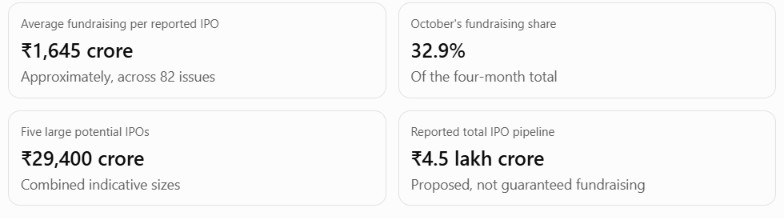
The anticipated activity follows a strong fundraising period between July and October, when 82 mainboard IPOs collectively mobilised approximately ₹1.35 lakh crore, according to figures cited in the market report.
Although the IPO calendar could temporarily slow in early November, a substantial pipeline of companies is expected to keep investors focused on new listings before the end of the year.
See more of our coverage in your search results.
Add INDYASTORY on GoogleAmong the businesses mentioned in the prospective IPO pipeline are Avaada Electro, Carlsberg India, AGS Health, Razorpay and Prism, the company associated with hospitality platform OYO. Other potential issuers span real estate, financial services, pharmaceuticals, manufacturing, education and technology.
However, investors should distinguish between companies exploring public listings and those with officially announced subscription dates. Expected IPO sizes, launch schedules and valuations can change significantly before an offer reaches the market.
India’s IPO Market Raises Nearly ₹1.35 Lakh Crore in Four Months
The reported figures indicate that India’s mainboard IPO market maintained strong fundraising momentum from July through October 2026.
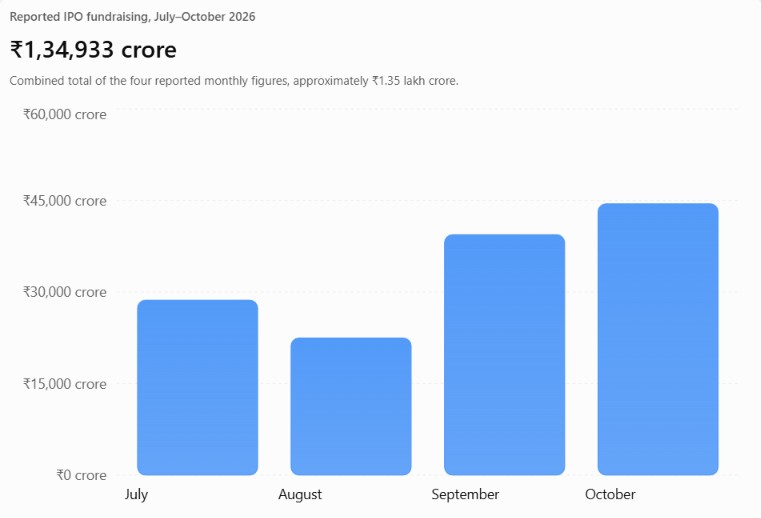
October emerged as the largest fundraising month of the four-month period, with 13 offerings mobilising approximately ₹44,450 crore.
September recorded the highest number of IPOs, with 34 issues collectively raising around ₹39,380 crore.
See more of our coverage in your search results.
Add INDYASTORY on GoogleAugust saw 23 public offerings generating approximately ₹22,453 crore, while July contributed 12 issues worth nearly ₹28,650 crore.
Month-wise IPO Fundraising: July–October 2026
| Month | Number of IPOs | Reported funds raised |
|---|---|---|
| July 2026 | 12 | ₹28,650 crore |
| August 2026 | 23 | ₹22,453 crore |
| September 2026 | 34 | ₹39,380 crore |
| October 2026 | 13 | ₹44,450 crore |
| Total | 82 | ₹1,34,933 crore |
Source: Figures provided in the underlying market report; independent exchange-level verification is pending. Amounts may be rounded.
The four-month total works out to approximately ₹1.35 lakh crore, underscoring the reported scale of fundraising activity.
See more of our coverage in your search results.
Add INDYASTORY on GoogleAn important distinction is that the number of offerings and the amount raised do not necessarily move together. September recorded more issues than October, but October’s reported fundraising was higher, suggesting that larger offerings contributed significantly to the month’s total.
For investors, this pattern illustrates how a relatively small number of large IPOs can influence overall primary market fundraising.
Upcoming IPOs in November and December 2026: Companies to Watch
Several large private companies are reportedly exploring IPO launches before the end of 2026.
Among the expected offerings, Avaada Electro carries the largest indicative issue size in the supplied pipeline, at approximately ₹7,600 crore.
Carlsberg India’s proposed offering is estimated at ₹6,700 crore, while healthcare services company AGS Health is associated with an indicative issue size of ₹6,600 crore.
Fintech company Razorpay could potentially seek around ₹5,000 crore, while Prism, associated with OYO, is mentioned with a proposed issue size of approximately ₹3,500 crore.
Five Potential Large IPOs
| Company | Indicative issue size |
|---|---|
| Avaada Electro | ₹7,600 crore |
| Carlsberg India | ₹6,700 crore |
| AGS Health | ₹6,600 crore |
| Razorpay | ₹5,000 crore |
| Prism (OYO-associated business) | ₹3,500 crore |
| Combined indicative amount | ₹29,400 crore |
These amounts are estimates from the supplied report, not verified final offer sizes. Company identities, filing status and proposed amounts require confirmation from official offer documents.
If all five companies proceeded with offerings of the indicated sizes, their combined fundraising would amount to approximately ₹29,400 crore.
However, the eventual amount raised could differ depending on prevailing market conditions, investor demand, valuation discussions, regulatory approvals and the final composition of each offer.
Companies may also postpone or revise IPO plans if market conditions become less favourable.
Other Companies Reportedly Preparing for Public Listings
Beyond the larger potential offerings, several mid-sized companies have been mentioned in the IPO pipeline.
These include Runwal Enterprises, Veritas Finance, Casagrand Premier Builder, Milestone Gears, Swara Baby Products, Pride Hotels and Integris MedTech.
According to the supplied report, some of these companies may target offerings in the broad range of ₹1,000 crore to ₹2,000 crore.
The actual fundraising amount for each business will depend on its final offer structure, financial requirements and regulatory documentation.
Additional names mentioned as potential IPO candidates include:
- Fibe
- Virupaksha Organics
- Silverton Industries
- Crystal Crop Protection
- Gujarat Victory Forging
- BVG India
- Learnfluence Education
- Jerai Fitness
- Parijat Industries
- Jesons Industries
- Torrent Gas
These names represent a prospective pipeline rather than a confirmed calendar of public offerings.
An IPO filing does not establish a fixed launch date, while an investment bank mandate or reported fundraising plan does not guarantee that a company will proceed with a listing.
Investors should rely on the latest exchange announcements, regulatory filings and final offer documents when evaluating individual opportunities.
India’s 2026 IPO Fundraising Reportedly Reaches ₹1.58 Lakh Crore
The broader 2026 fundraising figures also suggest substantial activity in the primary market.
According to the supplied market data, 109 mainboard IPOs raised approximately ₹1.58 lakh crore during the reported year-to-date period.
Separately, the pipeline reportedly includes 252 companies proposing to raise around ₹4.5 lakh crore, based on figures attributed to Prime Database by Trivesh D, Chief Operating Officer of Tradejini.
These figures highlight the scale of companies exploring public-market fundraising.
However, the proposed pipeline amount should not be interpreted as money that will necessarily enter the market.
Not every company that files draft offer documents proceeds with an IPO. Some businesses revise their fundraising requirements, delay launches or abandon listing plans depending on market conditions.
The pipeline also spans companies at different stages of preparation, making it inappropriate to treat all proposed issues as immediately available investment opportunities.
Why Are Companies Planning IPOs Despite Market Uncertainty?
Companies pursue public listings for several reasons, and the purpose of an IPO can significantly influence how investors assess it.
1. Funding business expansion
A company may use proceeds from a fresh share issue to finance new facilities, expand capacity, invest in technology or enter additional markets.
Such fundraising can strengthen a company’s ability to pursue long-term growth without relying entirely on debt financing.
2. Reducing outstanding debt
IPO proceeds may also help businesses repay borrowings and lower interest expenses.
For debt-heavy companies, reducing leverage can improve financial flexibility, although investors must evaluate the actual debt reduction proposed and its likely effect on future profitability.
3. Providing exits to existing shareholders
Some IPOs include an offer for sale (OFS), allowing promoters or existing investors to sell their shares.
In an OFS, the selling shareholders receive the proceeds rather than the issuing company.
That distinction is important because a large IPO does not necessarily mean the business itself is receiving an equivalent amount of new capital.
4. Improving access to capital markets
A public listing can improve a company’s access to future equity fundraising and broaden its shareholder base.
However, listed status also brings additional disclosure requirements, governance expectations and scrutiny of financial performance.
Why IPO Valuations Could Become More Important
After a period of heavy fundraising, investors may become more selective about the prices they are willing to pay for newly listed companies.
A company may demonstrate rapid revenue growth but still offer limited investment value if its IPO price assumes exceptionally strong future earnings.
Conversely, a profitable business with a sustainable competitive position may attract interest if its offer valuation is considered reasonable relative to its fundamentals.
For businesses in technology and fintech, investors may examine revenue quality, cash flow, customer acquisition costs, profitability and long-term growth potential.
For manufacturing companies, capital expenditure requirements, operating margins, production capacity and debt obligations may be more relevant.
Real estate and infrastructure-related businesses can require additional scrutiny of project execution, customer collections, working capital and the timing of revenue recognition.
There is no single valuation measure suitable for every IPO. Price-to-earnings ratios, price-to-sales multiples, enterprise value, return on capital and cash-flow metrics should be assessed according to the company’s business model.
Could Heavy IPO Fundraising Affect Stock Market Liquidity?
A large volume of new share offerings can influence the flow of investment funds across the equity market.
When investors commit capital to IPO subscriptions, some money may temporarily shift away from secondary-market trading.
The broader effect depends on subscription demand, refunds, the size of fresh issues and the availability of new investment funds.
The supplied report also highlights the possibility of additional equity issuance through qualified institutional placements (QIPs), preferential allotments and rights issues.
Sunny Agrawal, Head of Fundamental Research at SBI Securities, was cited as identifying corporate capital expenditure requirements, balance-sheet deleveraging and other equity fundraising activity as factors that could influence market liquidity.
Another potential source of share supply is the expiry of lock-in periods for certain shareholders in recently listed companies.
When restrictions expire, eligible investors may gain the ability to sell shares, potentially leading to block transactions.
Such transactions can create short-term supply pressure in individual stocks, although the expiry of a lock-in period does not mean shareholders will necessarily sell.
Importantly, IPO fundraising does not automatically reduce total market liquidity permanently. The net impact depends on how funds are recycled, how investors allocate their portfolios and the prevailing market environment.
SEBI Approval Pipeline: Why Filing Status Matters
The Securities and Exchange Board of India (SEBI) plays a central role in the public offering process.
According to the supplied report, nearly 110 companies were awaiting regulatory approval for their proposed IPOs.
It also mentioned approximately 15–20 businesses at various stages associated with the confidential pre-filing route, along with another 10–15 companies expected to submit Draft Red Herring Prospectuses (DRHPs) in the coming weeks.
These figures describe potentially overlapping stages of IPO preparation and should not automatically be added together to estimate the total number of distinct companies.
A DRHP contains information about the issuer’s business operations, financial position, risks, management, legal matters and proposed use of funds.
Following the applicable regulatory process, eligible companies can move towards final offer documentation, price-band announcements and public subscriptions.
However, regulatory observations should not be confused with an endorsement of an IPO’s investment quality or valuation.
The responsibility for evaluating the investment remains with the investor.
What Should Retail Investors Check Before Applying for an IPO?
A crowded IPO calendar can create pressure to participate in multiple offerings, particularly when recent listings have attracted strong market attention.
Rather than relying solely on subscription figures or expectations of listing-day gains, investors should examine several fundamental aspects of each issue.
Financial performance: Review revenue growth, operating profit, net profit, operating cash flow and the consistency of earnings.
Use of IPO proceeds: Determine whether the company is raising fresh capital for growth, repaying debt or primarily enabling shareholder exits.
Valuation: Compare the proposed IPO price with relevant listed peers, while considering differences in growth, profitability, business quality and risk.
Business risks: Examine customer concentration, regulatory exposure, debt levels, competition, litigation and dependence on key suppliers or promoters.
Shareholding structure: Review promoter holdings, selling shareholders and potential dilution.
Offer documentation: Read the RHP, including its risk factors, financial statements, related-party transactions and litigation disclosures.
IPO subscription levels may provide information about investor demand, but they do not guarantee positive returns.
Similarly, grey market premium estimates are unofficial, can change rapidly and should not be treated as reliable forecasts of listing performance.
What Happens Next for India’s IPO Market?
The reported pipeline suggests that India’s primary market could remain active through the closing weeks of 2026.
However, the final number of public offerings will depend on regulatory progress, company readiness, financial-market conditions and investor appetite.
The most important upcoming developments will be official price-band disclosures, confirmed subscription dates, final offer sizes and updated financial statements.
Investors will also be watching how newly listed companies perform after their market debuts, as sustained secondary-market performance can influence demand for subsequent IPOs.
Conclusion
India’s IPO market has reportedly raised nearly ₹1.35 lakh crore through 82 mainboard offerings between July and October 2026, providing a strong backdrop for the next group of prospective public listings.
With more than 20 IPOs potentially approaching in November and December, attention is shifting towards large proposed issues such as Avaada Electro, Carlsberg India, AGS Health, Razorpay and Prism, alongside numerous mid-sized businesses.
The size of the reported pipeline reflects continuing corporate interest in public equity fundraising.
For investors, however, the central question is not simply how many IPOs will launch, but whether individual companies offer credible business models, sustainable financial performance and reasonable valuations.
Until official offer documents and subscription dates are published, the upcoming IPO calendar should be treated as provisional.