
HGS India’s ₹34.56 crore IPO attracted strong interest from retail, institutional and non-institutional investors. With allotment expected on November 4 and listing scheduled for November 6, attention has shifted to the company’s financial performance and unofficial grey market premium.
HGS India Ltd, a manufacturer of geophones and seismic cables, drew substantial investor interest as its ₹34.56 crore initial public offering closed for subscription on November 3, 2026.
The SME public issue was subscribed approximately 231.18 times by the end of the final bidding day, according to the subscription figures reported for the offering.
Non-institutional investors led the demand, subscribing to more than 425 times their allocated portion. Retail investors and qualified institutional buyers also participated strongly, indicating interest across multiple investor categories.
See more of our coverage in your search results.
Add INDYASTORY on GoogleFollowing the closure of bidding, attention has shifted to the allotment process and the company’s expected stock market debut on the NSE Emerge platform.
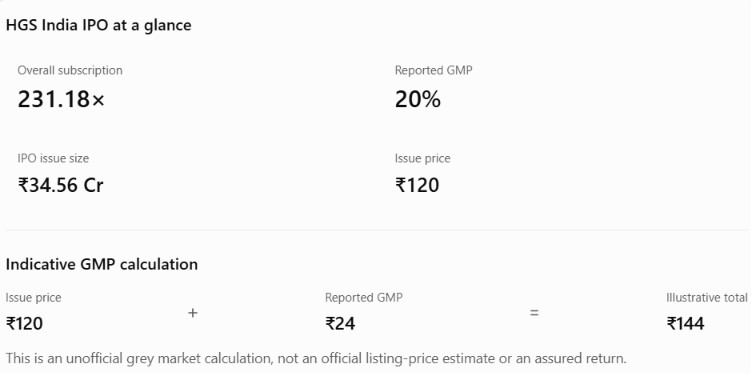
Meanwhile, unofficial grey market indications suggested that HGS India shares were commanding a premium of approximately 20% over the issue price of ₹120.
However, grey market activity is unregulated and does not guarantee the price at which a stock will list.
HGS India IPO Subscription Reaches 231.18 Times
The IPO received bids for approximately 47.77 crore equity shares against the reported net offer size of 20.66 lakh shares available for public subscription.
The offering attracted approximately 1.21 lakh applications over the three-day bidding period beginning October 30.
See more of our coverage in your search results.
Add INDYASTORY on GoogleThe final subscription figures indicate that investor demand substantially exceeded the number of shares available.
HGS India IPO Subscription by Investor Category
| Investor category | Reported subscription |
|---|---|
| Non-institutional investors (NII) | 425.02 times |
| Retail investors | 235.70 times |
| Qualified institutional buyers (QIB) | 137.90 times |
| Overall subscription | 231.18 times |
Source: Subscription details supplied in the market report. Final exchange figures should be independently confirmed.
Non-institutional investors recorded the highest demand relative to their allocated quota.
See more of our coverage in your search results.
Add INDYASTORY on GoogleRetail participation was also substantial, with the reserved portion subscribed more than 235 times.
Qualified institutional buyers subscribed to approximately 137.9 times their portion.
While heavy oversubscription can demonstrate strong demand during an IPO, it does not establish that the shares will deliver positive returns after listing.
Market conditions, valuation, liquidity and company fundamentals can influence the subsequent trading performance.
HGS India IPO GMP Today: What Does the 20% Premium Indicate?
HGS India shares reportedly traded at a grey market premium of approximately 20% over the IPO price of ₹120 per share.
Based on that reported premium, the indicative calculation is:
- IPO issue price: ₹120
- Reported grey market premium: Approximately ₹24
- Illustrative price including GMP: ₹144
- Indicative premium over issue price: 20%
The ₹144 figure is only an arithmetic illustration derived from the reported grey market premium. It is not an official listing-price forecast.
The grey market is an unofficial market in which participants express interest in IPO shares before their stock exchange debut.
Because grey market transactions are not conducted through the regulated exchange trading mechanism, reported premiums may be difficult to verify independently.
GMP figures can also change rapidly as sentiment, demand and broader market conditions evolve.
Investors should therefore avoid relying exclusively on grey market indications when assessing a newly listed company.
HGS India IPO Allotment Date and Listing Schedule
Following the close of bidding on November 3, HGS India was expected to finalise the basis of allotment on November 4, 2026.
The company’s stock market debut was expected on November 6, 2026, through NSE Emerge, the SME listing platform of the National Stock Exchange.
Important IPO Dates
| Event | Reported date |
|---|---|
| IPO opens | October 30, 2026 |
| IPO closes | November 3, 2026 |
| Expected allotment | November 4, 2026 |
| Expected listing | November 6, 2026 |
| Listing platform | NSE Emerge |
These dates reflect the proposed schedule in the supplied report. Investors should confirm the final timetable through the official issue documents and exchange notices.
The allotment process determines which applicants receive shares when demand exceeds the available allocation.
Due to the strong subscription figures, many applicants may not receive an allotment.
The probability of allotment differs by investor category and depends on the applicable allocation rules, the number of valid applications and the final basis of allotment.
How to Check HGS India IPO Allotment Status
Once the basis of allotment is finalised and made available, investors can check their application status through the official registrar’s IPO allotment portal.
Applicants generally need information such as their PAN, application number or other details supported by the registrar’s system.
Investors should follow these steps:
- Visit the official website of the IPO registrar named in the final offer documents.
- Open the IPO allotment status section.
- Select HGS India, if the issue is available.
- Enter the requested application or identification details.
- Submit the information to view the allotment result.
Investors may also receive notifications from their broker, bank or depository participant.
An expected allotment date does not necessarily mean the final allotment information will be available at the beginning of that day.
Applicants should rely on official registrar and exchange information rather than unverified third-party allotment links.
HGS India IPO Issue Size and Offer Structure
HGS India launched its IPO at a fixed issue price of ₹120 per equity share.
The offering consisted of 28.80 lakh equity shares with an aggregate issue size of approximately ₹34.56 crore.
The IPO included both a fresh issue of shares and an offer for sale by existing shareholders.
HGS India IPO Details
| Particulars | Details |
|---|---|
| Total issue size | ₹34.56 crore |
| Total shares offered | 28.80 lakh |
| Fixed issue price | ₹120 per share |
| Fresh issue | 23.26 lakh shares |
| Offer for sale | 5.54 lakh shares |
| Listing exchange | NSE Emerge |
| Lead manager | HEM Securities |
The fresh issue component represents approximately ₹27.91 crore, calculated from the number of new shares and the issue price.
The offer-for-sale component represents approximately ₹6.65 crore.
This distinction is important because proceeds from the fresh issue, after relevant expenses, are available to the company, while proceeds from the offer for sale are received by the selling shareholders.
Therefore, not all ₹34.56 crore raised through the IPO will be available to HGS India for business expansion.
How Will HGS India Use Its IPO Proceeds?
The company intends to use the fresh issue proceeds for improvements to its manufacturing operations and other corporate requirements.
A significant portion of the funds has been earmarked for modernising its existing manufacturing facility at Manesar in Gurugram, Haryana.
Proposed Utilisation of IPO Funds
| Purpose | Proposed allocation |
|---|---|
| Replacement of plant and machinery | ₹15.04 crore |
| In-house gold plating facility | ₹1.05 crore |
| Infrastructure development | ₹3.26 crore |
| Other purposes | Balance of eligible net proceeds |
The planned replacement of machinery is intended to support the company’s existing production operations.
Manufacturing modernisation can potentially improve efficiency, reliability and production capabilities, although the financial benefits will depend on successful installation and utilisation.
The proposed in-house gold plating facility represents a backward integration initiative.
By bringing an additional manufacturing process under its own control, the company may be able to reduce reliance on external service providers and strengthen operational coordination.
However, the actual cost benefits will depend on production volumes, quality requirements and ongoing operating expenses.
HGS India also plans infrastructure development on the second floor of its existing manufacturing facility.
The remaining eligible funds are expected to be used for purposes including unidentified acquisitions and general corporate requirements, subject to the final offer document’s provisions.
Investors should examine the company’s prospectus to understand the precise net proceeds, issue expenses and deployment schedule.
What Does HGS India Do?
HGS India is a New Delhi-based manufacturer of equipment used in seismic data acquisition and geophysical applications.
Its product portfolio includes geophones, geophone strings, seismic cables, geophysical connectors and related accessories.
Geophones are sensors used to detect ground movement and convert mechanical vibrations into electrical signals that can be analysed.
These instruments play a role in subsurface investigations and seismic monitoring.
The company’s products are used across industries and research applications that require information about ground vibrations and geological structures.
Major Industries Served by HGS India
Oil and gas exploration: Seismic sensing equipment is used to support subsurface data collection and exploration studies.
Mineral exploration: Geophysical instruments help researchers and exploration companies investigate underground geological structures.
Defence research: Specialised sensing and monitoring systems can be relevant to research and testing applications.
Earthquake seismology: Seismic instruments assist in recording and studying ground movement.
Vibration monitoring: Sensors may be used in research and industrial environments where vibration measurements are required.
Marine and seabed surveys: Geophysical data acquisition equipment supports investigations of underwater geological environments.
Academic research: Universities and scientific institutions use seismic instruments for research, experimentation and educational purposes.
The diversity of these applications provides exposure to several specialised end markets.
However, the company’s future performance will depend on customer demand, product quality, competitive positioning and its ability to expand sales profitably.
HGS India Financial Results: Profit Rises Despite Revenue Decline
The company’s financial performance presents an important consideration for investors evaluating the strong IPO demand.
For the financial year ended March 2026, HGS India reported a net profit of approximately ₹11.64 crore, compared with ₹10.50 crore in the previous year.
This represents an increase of around 10.9% based on the reported rounded figures.
However, revenue from operations declined to approximately ₹45.16 crore from ₹49.10 crore, representing a fall of about 8%.
HGS India Financial Performance
| Financial metric | FY25 | FY26 | Change |
|---|---|---|---|
| Revenue from operations | ₹49.10 crore | ₹45.16 crore | -8.0% |
| Net profit | ₹10.50 crore | ₹11.64 crore | +10.9% |
| Net profit margin* | 21.4% | 25.8% | +4.4 percentage points |
Net profit margin is calculated here as reported net profit divided by revenue from operations. Official statements may use different definitions or include additional income.
The figures show that HGS India generated higher profit despite recording lower operating revenue.
An improvement in net profit margin suggests that profitability strengthened relative to the company’s revenue base.
However, the reason for the improvement cannot be established from the headline financial figures alone.
Potential contributing factors may include changes in operating costs, product mix, other income, finance costs or tax expenses.
Investors should consult the complete financial statements and management discussion in the prospectus before attributing the increase to any specific factor.
The revenue decline also deserves attention because the sustainability of profitability depends partly on whether the company can stabilise and expand its business.
HGS India IPO Valuation: What Should Investors Examine?
Using the reported FY26 net profit of ₹11.64 crore and the ₹34.56 crore total IPO issue size does not provide a valid price-to-earnings valuation by itself.
The issue size represents the capital raised through the offering, not the total equity market value of the company.
To assess valuation, investors need the post-issue number of outstanding shares and the relevant earnings-per-share calculation.
The company’s equity valuation should then be considered in relation to earnings, revenue growth, cash generation, capital requirements and business risks.
It is also important to distinguish between reported historical profits and expectations of future growth.
A high subscription multiple may reflect demand for a relatively small number of available shares, but it does not independently determine whether the issue price is attractive.
What Are the Main Risks in the HGS India IPO?
Despite strong demand, investors should consider several potential risks associated with the offering.
Declining revenue: Operating revenue fell by approximately 8% in FY26. Investors should examine whether this reflects temporary order timing or a more persistent challenge.
SME share liquidity: Stocks listed on SME platforms can experience relatively limited trading activity and wider price movements. Applicable trading-lot requirements may also affect investors’ ability to buy or sell shares.
Industry concentration: Demand for specialised seismic equipment may be affected by customer investment cycles and research or exploration spending.
Manufacturing execution: The company plans machinery replacement and infrastructure investment, which may involve implementation delays or cost overruns.
Valuation uncertainty: Strong subscription figures and grey market premiums can encourage optimistic expectations that may not be supported by subsequent financial performance.
Offer-for-sale component: Approximately ₹6.65 crore of the gross issue represents shares sold by existing shareholders rather than new funds available for business growth.
The presence of these risks does not establish that the IPO will perform poorly. It indicates the areas investors should evaluate before making decisions.
Does a 231-Times Subscription Guarantee Listing Gains?
No. A heavily oversubscribed IPO can still deliver disappointing listing-day performance.
Subscription multiples measure demand relative to the shares offered. They do not establish the long-term value of the underlying business.
IPO listing performance can be influenced by broader market sentiment, valuation, the number of freely tradable shares and the behaviour of investors after trading begins.
For smaller SME issues, price movements may be particularly volatile when trading liquidity is limited.
Investors should therefore assess the company’s financial condition and business outlook rather than using oversubscription as the sole reason to invest.
What Should Investors Watch Before HGS India’s Listing?
With the IPO bidding process completed, attention is likely to focus on the confirmed allotment, final listing schedule and the company’s opening market price.
The reported grey market premium suggests positive unofficial sentiment, but it should not be treated as a dependable prediction.
Investors should also review the company’s final prospectus, including its revenue performance, customer concentration, outstanding liabilities, risk factors and proposed capital expenditure.
After listing, operating performance and the effectiveness of the planned manufacturing investments will be important factors in evaluating the company’s longer-term prospects.
Conclusion
HGS India’s ₹34.56 crore IPO attracted exceptionally strong demand, with the issue reportedly subscribed 231.18 times by the end of bidding on November 3, 2026.
Non-institutional investors led the subscription activity, while retail and institutional participation also exceeded their allocated quotas substantially.
A reported 20% grey market premium has added to attention ahead of the company’s expected NSE Emerge debut on November 6.
However, the company’s recent financial results present a mixed picture: net profit increased while operating revenue declined.
For investors, the key considerations extend beyond IPO subscription figures and unofficial listing expectations.
The sustainability of earnings, business growth, use of issue proceeds, valuation and SME market liquidity will be important factors in assessing HGS India after its stock market debut.