Religare Broking has maintained its Buy rating on Suzlon Energy, citing a strong 6 GW order book, rising wind turbine deliveries and improving execution. However, margin pressure and project commissioning delays remain key risks.
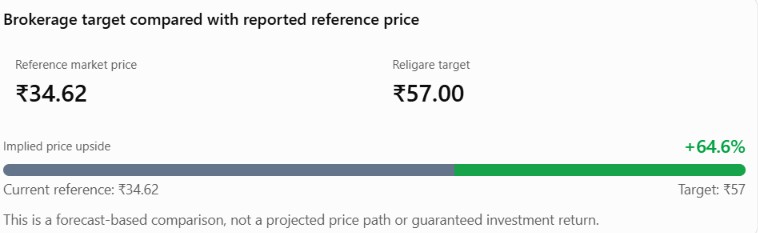
Suzlon Energy Ltd has attracted fresh attention after Religare Broking maintained a Buy rating on the renewable energy company with a target price of ₹57 per share, indicating potential upside of approximately 65% from the reported market price of ₹34.62.
The brokerage’s positive outlook is supported by Suzlon’s order book of around 6 gigawatts (GW), improving turbine deliveries and expectations of stronger project execution during the second half of the financial year ending March 2027.
However, the recommendation comes with an important qualification. Religare has lowered its FY27 EBITDA margin estimate to 15.8% from 18%, reflecting pressure from project mix, input costs, foreign exchange movements and expenses linked to the company’s Suzlon 2.0 transformation.
See more of our coverage in your search results.
Add INDYASTORY on GoogleThe revised estimate suggests that while Suzlon’s revenue growth prospects remain encouraging, the pace of profitability improvement will be important in determining whether the stock can approach the brokerage’s target.
Suzlon Energy Share Price Target: How Much Upside Does Religare Expect?
Religare Broking’s target price of ₹57 represents a potential gain of approximately 64.6% from the reported reference price of ₹34.62.
The calculation is based on the difference between the brokerage’s target and the quoted share price.
| Particulars | Value |
|---|---|
| Reported reference share price | ₹34.62 |
| Religare Broking target price | ₹57.00 |
| Potential gain per share | ₹22.38 |
| Implied upside | 64.6% |
| Brokerage recommendation | Buy |
Source: Brokerage recommendation and share-price reference provided in the underlying report. The target represents an analyst forecast, not an assured future market price.
The target implies substantial potential appreciation, but the actual return would depend on future earnings, valuation, market conditions and execution of the company’s business plans.
See more of our coverage in your search results.
Add INDYASTORY on GoogleA Buy recommendation reflects a brokerage’s investment assessment at a particular point in time. It is not a guarantee that the stock will reach the indicated price.
Why Is Religare Broking Bullish on Suzlon Energy?
Religare’s investment outlook rests largely on Suzlon’s growing order pipeline and improved ability to deliver wind energy equipment.
The company has reportedly accumulated an order book of approximately 6 GW, offering visibility into future business activity.
See more of our coverage in your search results.
Add INDYASTORY on GoogleThe brokerage also highlighted stronger turbine deliveries, increased project activity and expectations of a meaningful rise in execution during the second half of FY27.
At the same time, it acknowledged profitability-related challenges and reduced its margin assumptions.
This creates two distinct considerations for investors: the potential for strong business growth and the possibility that a higher proportion of revenue may be absorbed by operating expenses.
The next few quarterly results will therefore be important in establishing whether Suzlon can convert its order book into profitable growth.
1. Suzlon’s Wind Turbine Deliveries Rise 26% in Q2 FY27
Suzlon reported wind turbine deliveries of approximately 710 megawatts (MW) during the September 2026 quarter, compared with 565 MW in the corresponding period a year earlier, according to the supplied earnings information.
This represents year-on-year growth of approximately 25.7%.
Higher deliveries indicate improving operational execution and stronger project activity.
However, turbine delivery and project commissioning are not necessarily the same event.
A wind turbine may have been manufactured, transported and erected but still require grid connectivity, testing or other approvals before it becomes operational.
That distinction is particularly relevant to Suzlon’s current project pipeline.
Around 1.25 GW of Erected Turbines Await Commissioning
The company reportedly has approximately 1.25 GW of erected wind turbines awaiting commissioning.
This represents a meaningful volume of projects that have progressed through installation but have not yet completed the commissioning process.
Timely grid connectivity, site readiness and related project activities will be essential for bringing these assets into operation.
Commissioning delays may also affect milestone-linked billing, cash collection and project economics, depending on the contractual arrangements.
It would be inaccurate, however, to assume that the entire 1.25 GW backlog represents revenue that has not yet been recognised. Revenue recognition depends on the terms and accounting treatment of individual contracts.
2. Suzlon Expects Stronger Turbine Deliveries in H2 FY27
Suzlon’s management expects second-half FY27 turbine deliveries to be around 1.5–1.65 times the level achieved in the first half, according to the supplied conference-call highlights.
The expected acceleration reflects management’s confidence in the existing order book and its ability to execute projects during the remainder of the financial year.
A stronger second half could contribute to higher revenue, improve manufacturing capacity utilisation and support operating leverage.
However, the benefits will depend on the timing of deliveries, completion of project milestones and cost management.
Importantly, management guidance is forward-looking and should not be treated as an achieved result.
Investors should compare actual third- and fourth-quarter deliveries with the company’s expectations to assess execution progress.
3. Suzlon Q2 FY27 Revenue Rises 26% to ₹4,869 Crore
Suzlon’s reported consolidated revenue increased approximately 26% year-on-year to ₹4,869 crore in the September 2026 quarter.
The growth was supported by higher turbine deliveries and stronger project activity.
However, revenue expansion did not eliminate pressure on operating profitability.
Religare Broking identified several factors influencing margins.
Customer and project mix reportedly contributed approximately 150–180 basis points of margin pressure.
Commodity costs and foreign exchange inflation added another estimated 50 basis points of pressure, while investments related to Suzlon 2.0 contributed an additional impact of around 100 basis points.
These estimates help explain why the brokerage revised its FY27 EBITDA margin projection downward.
Suzlon’s EBITDA Margin Estimate Reduced to 15.8%
| Metric | Previous estimate | Revised estimate |
|---|---|---|
| FY27 EBITDA margin | 18.0% | 15.8% |
| Revision | — | Down 220 basis points |
Source: Religare Broking estimates cited in the supplied report. These are forecasts, not reported full-year results.
EBITDA margin measures operating earnings before interest, taxes, depreciation and amortisation as a percentage of revenue.
A lower margin means that a smaller proportion of revenue translates into EBITDA.
For illustration, on hypothetical revenue of ₹10,000 crore, an EBITDA margin of 18% would produce ₹1,800 crore in EBITDA. At 15.8%, EBITDA would be ₹1,580 crore.
That represents a difference of ₹220 crore on the same revenue base.
This example does not represent Suzlon’s actual full-year revenue forecast. It shows the potential financial significance of the revised margin assumption.
4. Suzlon’s 6 GW Order Book Provides Growth Visibility
Suzlon’s cumulative order book stood at approximately 6 GW, according to the reported company commentary.
Religare believes the pipeline provides close to 18 months of execution visibility.
A strong order book can support future revenue potential by providing a pipeline of projects that the company expects to deliver over time.
However, an order book is not equivalent to recognised revenue or guaranteed profit.
Actual financial performance depends on whether orders are executed on schedule, how contracts are priced and the costs incurred during production and installation.
Fresh Order Wins Cross 1.5 GW in H1 FY27
Suzlon reportedly secured more than 1.5 GW of new orders during the first half of FY27.
Of these, over 1.1 GW were attributed to its development company-led, or DevCo-led, business.
The contribution of the DevCo channel suggests that project development activities are becoming an important source of new business opportunities.
This may help Suzlon establish deeper involvement in renewable energy projects beyond the sale of wind turbine equipment.
Nevertheless, the profitability and working capital requirements associated with different project structures can vary.
The company will need to balance the pursuit of new orders with disciplined execution and financial returns.
5. PSU and Industrial Customers Account for a Large Part of the Order Book
Public sector undertakings and commercial and industrial customers reportedly represented approximately 78% of Suzlon’s order book.
This provides the company with exposure to multiple categories of renewable energy demand.
Public sector projects can support substantial capacity additions, while commercial and industrial customers may seek renewable energy solutions to reduce electricity costs, meet sustainability commitments or diversify power procurement.
However, these customer categories also carry execution risks.
Large renewable energy projects can be affected by land availability, transmission infrastructure, payment structures, financing and regulatory approvals.
The presence of a substantial order book is therefore encouraging, but investors should monitor how quickly orders move into execution, commissioning and cash generation.
6. Suzlon 2.0 Strategy: Moving Beyond Wind Turbine Manufacturing
Suzlon is pursuing a broader business transformation under its Suzlon 2.0 strategy.
The company is seeking to expand its role from a wind turbine original equipment manufacturer into a more integrated renewable energy solutions provider.
This approach involves activities such as technology development, project development, engineering, procurement and construction (EPC), and renewable asset management.
The strategy may enable Suzlon to participate in more stages of renewable energy projects and build a broader customer relationship.
However, business diversification also introduces new operating requirements, investment needs and execution responsibilities.
The financial benefits of such a transition generally depend on how efficiently the company scales these activities.
S175 5 MW Turbine Platform Attracts First Customer Order
Another development highlighted in the supplied report was Suzlon’s first customer order for its S175 5 MW wind turbine platform.
Higher-capacity turbines can potentially improve output per installation and offer benefits for certain wind project configurations.
Actual electricity generation and project economics depend on wind conditions, turbine availability, infrastructure and site-specific factors.
The S175 platform could strengthen Suzlon’s product offering as customers evaluate larger wind installations and more efficient project designs.
The company will still need to demonstrate reliable delivery, operational performance and commercially viable economics as the platform scales.
7. Solar and Battery Storage Could Expand Suzlon’s Opportunities
Suzlon is also exploring opportunities in solar energy, battery energy storage systems (BESS) and integrated renewable power solutions.
These areas are increasingly relevant as electricity buyers and power producers look for ways to manage renewable energy variability.
Wind and solar projects have different generation patterns, while energy storage systems can help shift electricity supply across different periods.
Integrated renewable solutions may allow companies to address a broader range of customer requirements.
For Suzlon, the potential opportunity is to expand beyond individual wind turbine supply contracts.
However, prospective opportunities in adjacent technologies should not automatically be included in earnings expectations without confirmed contracts, investment plans and evidence of commercial profitability.
Suzlon’s core wind energy operations remain central to evaluating its financial outlook.
What Could Prevent Suzlon Shares From Reaching ₹57?
Despite Religare’s positive recommendation, several uncertainties could affect Suzlon’s future performance and stock valuation.
Execution delays: A substantial erected turbine backlog highlights the importance of timely project commissioning. Prolonged delays could affect project cash flows and operational efficiency.
Pressure on margins: Commodity prices, foreign exchange fluctuations and unfavourable contract mix could continue to influence EBITDA profitability.
Working capital requirements: Faster execution and expansion into broader project services may increase the need for working capital.
Competitive pricing: Renewable energy equipment suppliers face pressure to offer competitive project economics, which can limit pricing flexibility.
Valuation risk: Even if the company performs well operationally, the share price may not achieve the brokerage’s target if market valuations contract.
Policy and infrastructure dependence: Wind energy investment can be affected by transmission availability, regulatory developments, financing conditions and the pace of renewable capacity additions.
These risks should be considered alongside the company’s growth opportunities rather than viewed as secondary concerns.
What Should Suzlon Investors Monitor in the Coming Quarters?
Investors assessing Suzlon’s outlook may benefit from tracking several operating and financial indicators.
One important indicator is whether the company successfully converts its approximately 1.25 GW erected turbine backlog into commissioned projects.
Another is whether H2 FY27 deliveries achieve the anticipated increase over the first half.
Fresh order inflows will also matter, particularly if they support the existing 6 GW pipeline without weakening contract margins.
Investors should assess whether EBITDA margins begin to recover as execution volumes increase, or whether cost pressures remain persistent.
The contribution of EPC and development-led operations, alongside progress on the S175 platform, could offer additional insight into Suzlon’s broader business transformation.
Finally, cash-flow generation will be important in determining whether reported growth is translating into financial strength.
Is Suzlon Energy a Buy at the Current Price?
Religare Broking has maintained a Buy rating with a ₹57 target price, based on its assessment of the company’s business outlook.
However, the reported ₹34.62 reference price and the associated 65% upside estimate should not be interpreted as a universal recommendation for every investor.
An appropriate investment decision depends on the individual’s financial objectives, risk tolerance, investment horizon and portfolio exposure.
The brokerage’s target is conditional on assumptions about future earnings and market valuation, and those assumptions may change.
Investors should review Suzlon’s official financial statements, recent corporate announcements, order book quality, cash flows and valuation before making decisions.
Conclusion
Suzlon Energy’s reported 6 GW order book, improved turbine deliveries and expected acceleration in project execution provide the foundation for Religare Broking’s ₹57 share price target.
The brokerage sees approximately 65% potential upside from its stated market price reference of ₹34.62.
Yet the revised FY27 EBITDA margin estimate of 15.8%, compared with 18% earlier, underlines the importance of profitability as well as revenue growth.
For Suzlon, converting erected turbines into commissioned projects, executing its order pipeline efficiently and controlling operating costs will be central to the investment outlook.
The coming quarters should provide further evidence of whether Suzlon can translate its renewable energy expansion plans into sustainable earnings growth.