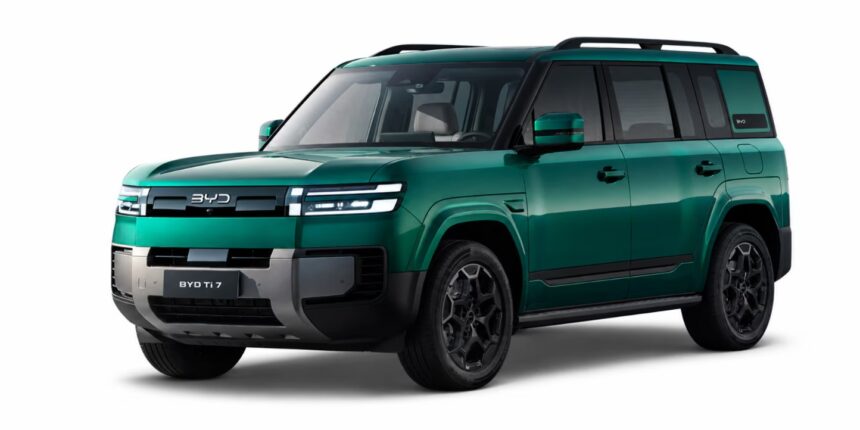
Tata Motors-owned Jaguar Land Rover has reportedly secured a preliminary injunction against BYD’s Ti7 SUV in a Dutch court, restricting its commercial activities in the European Union over similarities to the Land Rover Defender. BYD is expected to challenge the decision.
Chinese electric vehicle giant BYD is facing a significant legal obstacle in Europe after Jaguar Land Rover reportedly won a design-rights dispute involving the BYD Ti7 and the Land Rover Defender.
According to details of a November 20, 2026 ruling provided to TechLayers, the District Court of The Hague in the Netherlands granted JLR a preliminary injunction restricting BYD from importing, manufacturing, marketing or selling the Ti7 within the European Union.
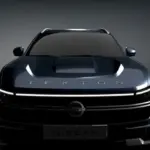
The dispute concerns the exterior appearance of the Ti7, a large plug-in hybrid SUV sold under BYD’s Fang Cheng Bao brand in China.
See more of our coverage in your search results.
Add INDYASTORY on GoogleJLR argued that the Chinese vehicle creates an overall visual impression too similar to its current-generation Defender, whose exterior design is protected by registered rights in Europe.
The reported ruling represents an interim legal development rather than a final decision on the underlying case.
BYD has reportedly rejected the infringement findings and plans to appeal.
Importantly, the Ti7 had not launched commercially in the European Union when the order was issued. The restrictions therefore concern potential future sales and other commercial activities rather than a recall of vehicles already purchased by EU customers.
Why Jaguar Land Rover Challenged the BYD Ti7
The legal dispute centers on the exterior styling of two large SUVs designed to project a rugged, off-road identity.
See more of our coverage in your search results.
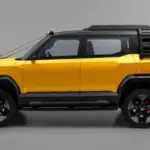
Add INDYASTORY on GoogleThe modern Land Rover Defender, internally known as the L663, was unveiled in 2019 and became one of JLR’s most recognizable vehicles.
Its design combines a relatively upright body, pronounced wheel arches, distinctive window treatment and carefully proportioned exterior surfaces.
BYD introduced the Ti7 in China in 2025 under its Fang Cheng Bao sub-brand, which focuses on SUVs and other vehicles with a strong adventure-oriented identity.
See more of our coverage in your search results.
Add INDYASTORY on GoogleBoth models use box-shaped styling, but JLR’s reported legal argument went beyond the fact that the vehicles share a generally upright silhouette.
The British manufacturer claimed that particular design elements, when considered together, reproduced the distinctive visual identity protected by its European registration.
In vehicle design disputes, this distinction is important.
A manufacturer does not necessarily gain exclusive rights over common design concepts such as a tall body, large wheels or an upright windscreen.
Instead, protection may apply to a registered combination of specific visual features and the overall impression those features create.
According to the supplied account of the ruling, the court found JLR’s argument sufficiently persuasive to justify interim restrictions.
Which Design Features Were Disputed?
The case reportedly focused on several aspects of the Ti7’s bodywork.
These included the rounded treatment of its body corners and shoulders, the shape of its wheel openings, its side-window arrangement, and distinctive detailing around the rear pillar.
The proportions and combined visual appearance of the vehicle were also relevant.
BYD reportedly argued that the Ti7 possessed clear differences from the Defender, particularly in its lighting, grille, bonnet and other exterior details.
However, the court’s preliminary assessment was that those differences did not sufficiently change the overall impression.
This does not mean the court determined that BYD copied Land Rover’s engine technology, chassis engineering, manufacturing methods or confidential technical information.
The dispute concerns registered exterior design rights rather than allegations that the vehicles share the same mechanical architecture.
That distinction is particularly relevant when comparing vehicles from different manufacturers that adopt similar styling themes.
What Does the Reported EU Injunction Actually Restrict?
The reported interim order targets commercial activities involving the Ti7 within the European Union.
According to the supplied judgment summary, the restrictions extend to ten BYD-related entities.
| Activity involving BYD Ti7 | Reported restriction |
|---|---|
| Importing vehicles into the EU | Restricted |
| Manufacturing within the EU | Restricted |
| Advertising or offering for sale | Restricted |
| Selling and delivering vehicles | Restricted |
| Commercial stocking and distribution | Restricted |
The measures are reportedly scheduled to take effect one week after formal service of the judgment.
The supplied account also describes alternative financial enforcement mechanisms, potentially involving penalties of up to €10 million for non-compliance.
Such penalties would not represent an automatic fine imposed simply because the injunction was granted. Their application would depend on the terms of the order and any subsequent violations.
An EU-wide injunction also should not be confused with an EU legislative ban on BYD as a company.
The reported restrictions concern a particular vehicle design and the defendants covered by the court order.
Other BYD models are not automatically prohibited merely because of this litigation.
Why the United Kingdom Is Different
One of the most important aspects of the dispute is the geographical scope of the injunction.
The Netherlands court reportedly granted restrictions applicable within the European Union but did not extend the order to BYD’s British subsidiary.
According to the supplied case summary, the court concluded that it lacked jurisdiction to impose the requested restrictions on the UK entity.
That means the reported Dutch injunction does not itself prohibit BYD from introducing the Ti7 in Britain.
The manufacturer has reportedly been preparing a UK-market version of the SUV, with deliveries discussed for January 2027.
However, those plans and their timing require confirmation from BYD.
JLR could still pursue separate legal proceedings under applicable British intellectual property law.
Consequently, the reported decision creates different immediate circumstances for BYD’s EU operations and its potential UK business.
BYD Ti7: Plug-in Hybrid SUV Specifications
The Ti7 forms part of BYD’s broader strategy to expand its portfolio of electrified passenger vehicles.
Unlike a fully electric SUV, the Ti7 uses plug-in hybrid technology, combining a petrol engine with an electric drivetrain and a rechargeable battery.
This allows the vehicle to operate using electric power for certain journeys while retaining an internal combustion engine for additional driving flexibility.
The supplied report describes the following specifications for a proposed UK-market configuration.
Reported BYD Ti7 UK Specifications
| Specification | Reported details |
|---|---|
| Engine | 1.5-litre turbocharged petrol |
| Powertrain | Plug-in hybrid |
| Drive configuration | All-wheel drive |
| Combined power | 300 kW, approximately 402 hp |
| Battery capacity | 35.6 kWh |
| Electric driving range | Up to 119 km, WLTP |
| Seating | Seven occupants |
| Length | 5,146 mm |
| Width | 1,995 mm |
| Height | 1,865 mm |
| Proposed UK price | £47,995 |
These figures have not been independently verified against official UK-market specifications. Final equipment, pricing, homologation and performance figures may vary.
With its large dimensions, seven-seat configuration and electrified powertrain, the Ti7 would occupy a competitive segment of the SUV market.
Its proposed pricing would also place it in a different financial position from many premium Land Rover Defender configurations.
However, a direct vehicle comparison would need to account for trim levels, drivetrain performance, off-road equipment, safety features and market-specific pricing.
How the Dispute Could Affect BYD’s European Expansion
BYD has been expanding its international presence as Chinese automakers compete more aggressively in electric and hybrid vehicle markets.
Europe is strategically important because of its established automotive industry, relatively affluent consumers and increasingly diverse range of electrified vehicles.
A restriction on an individual model does not necessarily threaten a manufacturer’s entire regional business.
However, it can complicate product planning, dealer preparation, marketing and manufacturing decisions.
The reported Ti7 order could also affect future production considerations involving BYD’s European manufacturing operations.
BYD has been developing a manufacturing presence in Hungary, but the supplied information does not establish that Ti7 assembly had been confirmed for that facility.
Accordingly, the court order should not be presented as evidence that an announced Ti7 manufacturing program has been cancelled.
The immediate consequence is legal uncertainty surrounding the SUV’s potential EU introduction.
Its longer-term impact will depend on subsequent court decisions, any design changes, and the manufacturer’s commercial plans.
Why This Matters for Tata Motors and Jaguar Land Rover
The reported injunction is particularly relevant to the Indian automotive industry because Jaguar Land Rover belongs to the Tata Motors group.
JLR operates internationally through its Range Rover, Defender, Discovery and Jaguar brands.
The Defender is an important part of its premium SUV business and has a distinctive identity closely associated with off-road capability.
For manufacturers operating in premium segments, recognizable vehicle design contributes to product differentiation and brand value.
Protecting that design can therefore carry significant commercial importance.
If the reported interim ruling withstands further legal challenges, it could reinforce JLR’s ability to protect the relevant registered styling features against competing vehicle designs within the EU.
However, it would not establish that all similarly shaped SUVs infringe JLR’s rights.
Each dispute depends on the registered design, the vehicle being challenged and the applicable legal assessment.
The case also highlights an increasingly important aspect of competition between established European automakers and rapidly expanding Chinese manufacturers.
Beyond pricing, powertrain technology and production scale, intellectual property rights can influence which vehicles enter particular markets.
BYD Plans to Appeal the Reported Court Decision
BYD has reportedly rejected the court’s preliminary conclusions and intends to challenge the injunction.
An appeal would provide an opportunity to contest aspects of the legal reasoning and the restrictions imposed.
The supplied account also states that JLR must begin substantive proceedings within six months to preserve the protection afforded by the interim decision.
These procedural details require confirmation against the actual judgment.
A preliminary injunction should not be treated as the final outcome of an infringement lawsuit.
A court’s assessment at an interim stage may be reconsidered in subsequent proceedings, depending on the evidence and legal arguments presented.
The practical effect of any appeal on the injunction’s enforceability must also be determined from applicable Dutch procedural rules and court orders.
For now, the reported decision marks an important development in the disagreement, but it does not establish how the dispute will ultimately conclude.
What the BYD–JLR Dispute Reveals About Modern Car Design
The automotive industry has seen a growing number of vehicles with upright profiles, squared-off bodywork and adventure-inspired styling.
These characteristics are popular because they communicate practicality, strength and off-road capability.
However, as manufacturers compete for similar customers, distinguishing widely used design themes from protected individual designs becomes increasingly important.
The BYD Ti7 dispute illustrates the legal and commercial risks that arise when two vehicles are considered visually similar.
For JLR, the issue centers on protecting the Defender’s registered appearance.
For BYD, it concerns defending the originality of the Ti7 while pursuing international market opportunities.
For the wider industry, the case demonstrates how intellectual property law can influence automotive competition even when manufacturers use different mechanical systems and technologies.
The reported EU injunction is a preliminary setback for BYD and an interim victory for JLR. The final significance will depend on the outcome of any appeal and the underlying design-rights proceedings.