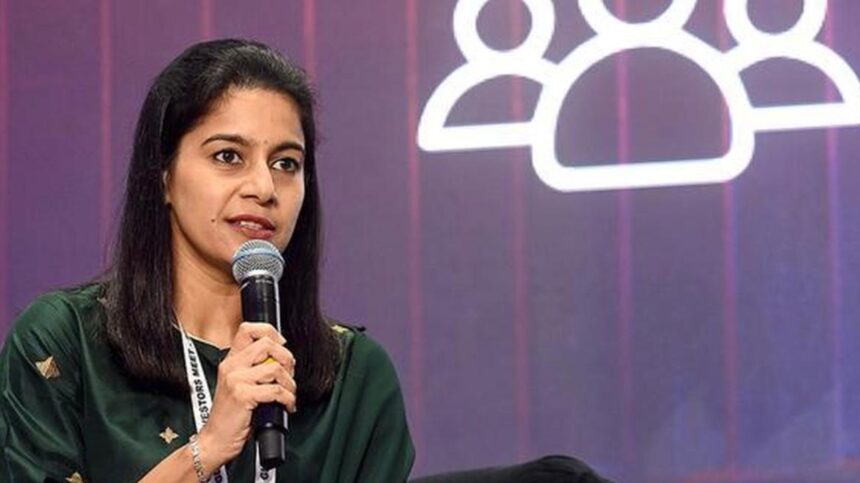
The daughter of TVS Holdings chairman Venu Srinivasan has reportedly initiated legal proceedings seeking a formal division of joint family assets, bringing ownership and succession arrangements within one of India’s prominent industrial families into focus.
Chennai: Lakshmi Venu, daughter of industrialist and TVS Holdings chairman Venu Srinivasan, has reportedly filed a partition suit before the Madras High Court seeking her lawful share of assets belonging to the Venu Srinivasan branch of the TVS family.
The legal proceedings follow a partition notice issued on November 16, 2026, and reportedly unsuccessful attempts to resolve differences over the division of family wealth through mutual discussions.
The dispute has drawn attention to ownership arrangements within one of India’s established business families, whose interests extend across automobile manufacturing, financial services and automotive component production.
See more of our coverage in your search results.
Add INDYASTORY on GoogleAccording to a statement attributed to Lakshmi Venu’s legal representatives, the decision to approach the court followed unsuccessful efforts to reach an amicable settlement with her father.
The matter now places questions concerning family asset ownership, inheritance rights and earlier business restructuring arrangements before the judiciary.
Lakshmi Venu Seeks Formal Division of Family Assets
At the centre of the dispute is Lakshmi Venu’s contention that assets belonging to the Venu Srinivasan branch of the TVS family have not been formally partitioned among eligible family members.
Her legal position reportedly distinguishes between the broader restructuring of the TVS family businesses and the internal distribution of assets within her immediate family.
The wider TVS family arrangement initiated in 2020 sought to reorganise ownership interests among different branches of the industrial family.
See more of our coverage in your search results.
Add INDYASTORY on GoogleHowever, Lakshmi Venu reportedly maintains that this arrangement did not constitute a separate partition of assets within the Venu Srinivasan branch.
The distinction could become an important issue in the legal proceedings, particularly when determining the ownership classification of assets and the rights of individual family members.
The precise relief sought in the petition, including any specific properties, shareholdings or financial interests, would need to be established from the court documents.
See more of our coverage in your search results.
Add INDYASTORY on GoogleMallika Srinivasan Expresses Support for Daughter
Industrialist Mallika Srinivasan, Lakshmi Venu’s mother, has reportedly expressed support for her daughter’s claim to an equitable share of family assets.
According to the supplied reporting, she emphasised that sons and daughters should be treated equally and expressed her belief that Lakshmi’s entitlement should not be inferior to that of her younger brother, Sudarshan Venu.
Mallika Srinivasan is a prominent figure in India’s manufacturing industry, recognised for her leadership at Tractors and Farm Equipment Limited, commonly known as TAFE.
Her reported intervention adds another dimension to the family dispute while drawing attention to the broader issue of gender equality in business family inheritance and succession arrangements.
However, statements expressing support for an individual’s inheritance claim do not determine the legal entitlement involved. That question remains subject to applicable law, ownership documents and judicial findings.
Which TVS Businesses Could Be Relevant to the Dispute?
The Venu Srinivasan branch of the TVS family has interests in several prominent Indian businesses operating across mobility, financial services and industrial manufacturing.
Companies associated with this branch include:
- TVS Holdings Limited.
- TVS Motor Company Limited.
- TVS Credit Services Limited.
- Sundaram-Clayton Limited.
TVS Motor Company is among India’s leading two-wheeler and three-wheeler manufacturers, with operations spanning domestic and international markets.
The company has expanded its presence across conventional motorcycles, scooters, electric mobility and premium vehicle segments.
TVS Credit Services operates in the consumer financing sector, while Sundaram-Clayton is associated with automotive component manufacturing.
The reported partition suit concerns family assets and ownership interests. It should not automatically be interpreted as a demand to divide the operating assets of these companies.
The distinction between corporate property and assets personally or jointly owned by family members will be important in understanding the potential scope of the litigation.
Sudarshan Venu’s Role in the TVS Group
Sudarshan Venu, the younger brother of Lakshmi Venu, has emerged as a prominent next-generation leader within the TVS business ecosystem.
According to the supplied report, he serves as Chairman and Managing Director of TVS Motor Company and was identified as a Significant Beneficial Owner in April 2025.
Significant Beneficial Ownership disclosures are intended to improve transparency regarding individuals who ultimately hold qualifying ownership interests, influence or control over corporate entities.
However, such a designation does not independently establish an individual’s final inheritance entitlement or ownership of all assets associated with a family business.
Determining inheritance rights requires examination of the relevant legal arrangements, asset classifications and ownership structures.
The ongoing dispute could therefore bring greater attention to the relationship between management succession, beneficial ownership and the distribution of family wealth.
Understanding the 2020 TVS Family Arrangement
The TVS Group traces its origins to the industrial enterprise established by T.V. Sundram Iyengar in 1911.
Over generations, the family developed a diversified business network spanning transportation, automobile manufacturing, automotive components and financial services.
As different branches expanded their business interests, the group undertook a restructuring initiative in 2020 aimed at reorganising ownership and management arrangements.
Such restructuring exercises are common among large, multigenerational business families seeking to simplify complex shareholding structures and establish greater operational independence.
However, a corporate restructuring arrangement does not necessarily settle every question concerning inheritance or the internal distribution of family assets.
Whether the earlier TVS family arrangement addressed the specific rights now being asserted by Lakshmi Venu will depend on the documents governing that arrangement and their legal interpretation.
What Indian Inheritance Law Says About Daughters’ Rights
The dispute also highlights the legal framework governing inheritance and the partition of joint family property in India.
The Hindu Succession (Amendment) Act, 2005, introduced significant changes to inheritance rights by recognising daughters as coparceners by birth in Mitakshara Hindu joint family property, with rights and liabilities equivalent to those of sons.
In its landmark 2020 judgment in Vineeta Sharma v. Rakesh Sharma, the Supreme Court reaffirmed that daughters possess equal coparcenary rights by birth, subject to applicable statutory conditions.
However, the application of these principles depends on the nature and legal classification of the property concerned.
A distinction must be made between:
- Joint Hindu family or coparcenary property.
- Individually owned or self-acquired assets.
- Shares held through companies, trusts or other legal structures.
- Assets governed by valid family settlements or other legally enforceable arrangements.
Consequently, the principle of equal inheritance rights cannot be applied mechanically to every asset associated with a family-controlled business.
The Madras High Court would need to consider the relevant ownership records, family arrangements and legal arguments before determining the merits of the claim.
Corporate Governance and Family Business Succession in Focus
India’s corporate landscape includes numerous enterprises established and controlled by business families across multiple generations.
Succession planning within such organisations often involves balancing several objectives, including continuity of management, equitable distribution of wealth, shareholder interests and long-term business stability.
Family ownership disputes can become particularly complex when business interests are held through interconnected companies, investment entities and trusts.
Transparent ownership structures and clearly documented succession arrangements can help reduce uncertainty and minimise the potential for prolonged litigation.
For publicly listed companies, these issues may also attract attention from institutional investors and minority shareholders.
Nevertheless, a personal dispute involving members of a promoter family does not automatically establish a disruption to corporate operations or financial performance.
Any material impact on listed companies would depend on the scope of the litigation, subsequent court orders and relevant corporate disclosures.
What the Dispute Could Mean for TVS Investors
Investors following companies associated with the Venu Srinivasan family may monitor developments concerning promoter shareholdings, management continuity and regulatory disclosures.
Potential areas of interest include changes in beneficial ownership, voting rights, share transfers and any court-directed restrictions affecting family-held securities.
At present, the supplied information does not establish that the reported lawsuit has affected the day-to-day operations of TVS Motor Company or other associated businesses.
Investors should distinguish between developments concerning personal family assets and matters directly affecting the operating performance of listed companies.
Official stock exchange disclosures and company announcements would provide a more reliable basis for assessing any material corporate consequences.
A Wider Debate Over Gender Equality in Business Families
The reported dispute reflects a broader discussion surrounding the participation of daughters in the ownership, leadership and succession of family-controlled enterprises.
Women have increasingly assumed senior leadership positions across India’s manufacturing, financial services, technology and consumer industries.
However, questions concerning the distribution of family wealth and ownership rights can remain separate from professional leadership responsibilities.
Equal treatment in inheritance, where provided by applicable law, and transparent succession planning are important considerations for multigenerational businesses.
The outcome of any individual dispute must nevertheless be determined through its specific legal and factual circumstances rather than broader assumptions about family business practices.
What Happens Next in the TVS Family Asset Dispute?
The next significant developments are expected to depend on proceedings before the Madras High Court, responses from the parties and any documents placed before the judiciary.
The court may be required to examine the classification of disputed assets, previous family arrangements, ownership records and the legal basis of Lakshmi Venu’s claim.
The available reporting does not establish that the court has issued a final ruling or determined the respective entitlements of the family members.
Until further details emerge, the dispute remains a contested legal matter.
Beyond its immediate implications for the family, the case highlights the importance of clearly defined ownership arrangements, succession planning and legal transparency within India’s large family-controlled business groups.