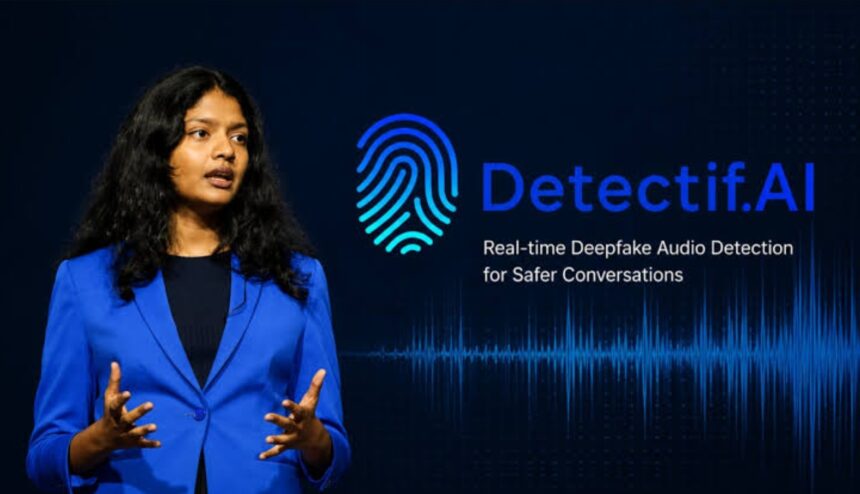
A deepfake scam targeting her grandfather helped 21-year-old entrepreneur Tarini Padmanabhuni turn a long-standing interest in artificial intelligence into a startup focused on one of technology’s fastest-growing security challenges: detecting AI-generated and manipulated audio.
Founded in 2025, DetectifAI is a San Francisco- and Bengaluru-based startup developing technology to verify human interactions and identify synthetic voices, manipulated audio and other forms of AI-generated media.
The company’s central proposition is real-time detection.
Instead of analysing suspicious content only after an incident has occurred, DetectifAI is working on technology designed to flag potentially manipulated or synthetic audio during live interactions.
See more of our coverage in your search results.
Add INDYASTORY on GoogleThat distinction could become increasingly important as generative AI makes voice cloning and synthetic media more accessible.
A Personal Experience Led to DetectifAI
Padmanabhuni says her interest in machine learning began early. She started studying the field in Class 6 and later pursued computer science, specialising in Cyber-Physical Systems at MIT Manipal.
But it was a personal experience that gave her work a sharper direction.
A deepfake scam targeting her grandfather made the risks associated with AI-generated voices more tangible.
“It became clear that this was not just a technical problem. AI-generated voices and synthetic media can affect families, financial institutions, customer support systems, identity verification and the entire idea of digital trust,” Padmanabhuni told YourStory.
See more of our coverage in your search results.
Add INDYASTORY on Google“That realisation eventually led me to build DetectifAI.”
The problem extends beyond individual scams.
As generative AI tools become more sophisticated, synthetic voices can potentially be used in phishing attempts, impersonation fraud, financial scams and misinformation campaigns. Voice-based systems are also widely used for customer authentication, making manipulated audio an emerging concern for organisations that depend on digital identity verification.
See more of our coverage in your search results.
Add INDYASTORY on GoogleDetectifAI is positioning itself around this growing trust problem.
Why Real-Time Deepfake Detection Matters
Many deepfake detection tools are designed to analyse audio or video after content has already been created or distributed.
DetectifAI is attempting to take a different approach.
The startup says its fraud detection models are designed to operate on-device and at the network edge, enabling suspicious audio to be flagged in real time without necessarily requiring a cloud round trip.
The potential advantage is speed.
A traditional detection system may examine a recording after a suspected fraud event has occurred. Real-time detection, by contrast, could potentially warn a user while a conversation is still taking place.
That could be particularly relevant in situations involving financial fraud.
Imagine receiving a call from what appears to be a family member, a bank representative or a colleague. If the voice has been generated or manipulated using AI, identifying that deception before a transaction or sensitive information exchange takes place could be far more valuable than detecting it after the damage has already occurred.
This is the problem DetectifAI is trying to address.
How DetectifAI Is Building Its Technology
The company’s technology focuses on identifying characteristics associated with synthetic and manipulated media.
According to the information provided, DetectifAI is developing systems that can analyse manipulated speech patterns and detect AI-generated audio. The company is also working on technology designed to identify deepfakes directly on mobile phones and computers.
Running detection closer to the device could offer practical advantages.
On-device and edge-based systems can potentially reduce latency, limit dependence on cloud infrastructure and allow detection to happen during a live interaction.
However, deepfake detection is also a constantly evolving technical challenge.
As AI voice-generation models improve, detection systems must continuously adapt. A model trained to identify one type of synthetic speech may become less effective as newer generation systems improve their realism.
That creates an ongoing technological contest between the development of synthetic media and the systems designed to identify it.
A Focus on BFSI and Healthcare
DetectifAI is particularly targeting the banking, financial services and insurance (BFSI) sector and healthcare.
Both industries increasingly rely on digital identity systems and voice-based interactions.
In financial services, synthetic voices could potentially be used for impersonation, fraudulent authentication or social-engineering attacks. Banks and fintech companies therefore have a growing interest in strengthening identity verification and fraud prevention.
Healthcare faces different but equally important challenges.
Digital consultations, patient communication and remote healthcare systems have increased the importance of secure identity verification. Verifying that an interaction involves the correct person can be essential when sensitive personal information is involved.
DetectifAI’s technology is being developed around these kinds of high-trust environments.
The company’s broader ambition, however, goes beyond enterprise customers.
Building a Layer of Trust for Digital Interactions
The long-term vision is to make digital communication more trustworthy.
Padmanabhuni says the company ultimately wants its technology to function as a recognisable layer of trust across digital interactions.
“Ideally, anyone with a mobile phone should have access to some level of protection against AI-generated deception,” she said.
The startup is exploring applications across financial institutions, KYC companies, telecom providers and mobile platforms.
The vision is ambitious.
Instead of deepfake detection being a specialised security tool used only after fraud occurs, DetectifAI wants trust verification to become part of everyday digital communication.
Padmanabhuni compared the long-term ambition to the role of an established technology standard in audio.
“In the long term, we want DetectifAI to become for audio trust what Dolby became for audio quality—a recognisable layer that helps people and organisations understand if the content or interaction they are engaging with can be trusted,” she said.
From Early Interest in AI to a Startup
Padmanabhuni’s work is focused on artificial intelligence, cybersecurity and deepfake detection.
She says she currently has five patents pending related to deepfake detection and has spent the past two years developing practical AI-based technologies aimed at identifying synthetic and manipulated media.
DetectifAI currently has a 10-member team, according to the information provided.
For a young startup, building technology in this category involves a difficult balancing act.
The detection must be accurate enough to identify genuine threats.
At the same time, false positives can create their own problems.
A system that incorrectly identifies authentic speech as synthetic could undermine trust in the technology. The challenge is particularly complex when a product is designed for live interactions, where decisions may need to be made quickly.
The quality of the underlying detection models, therefore, could become central to DetectifAI’s future.
Funding and the San Francisco Network
DetectifAI has raised a seed round from investors including Josh Constine, former TechCrunch Editor-at-Large, and Silicon Valley-based investor Manohar Kamath, according to the information provided.
The startup has not disclosed the funding amount.
Padmanabhuni has said that the company’s early funding helped her build a network. She also pointed to her participation in The Residency, a founder programme in San Francisco, as an important opportunity to develop relationships and create meaningful connections.
For deep-tech startups, access to networks can be almost as important as early capital.
Building AI and cybersecurity products requires technical talent, access to potential customers, industry expertise and, in many cases, significant experimentation before a product reaches large-scale commercial adoption.
DetectifAI’s cross-border presence in San Francisco and Bengaluru could provide access to both technology ecosystems.
The Growing Economics of Deepfake Detection
The emergence of companies such as DetectifAI reflects a broader market shift.
Generative AI has lowered the barriers to creating synthetic text, images, video and audio. While these technologies have legitimate applications across entertainment, education and business, they have also created new risks.
A convincing AI-generated voice can potentially be used to impersonate:
- Family members
- Business executives
- Customer-service representatives
- Bank employees
- Government officials
- Public figures
The threat becomes more serious when synthetic content is used to influence a person during a live interaction.
That is why real-time detection is becoming an important area of development.
According to a market estimate from Coherent Market Insights cited in the information provided, the global deepfake market could be valued at $7.44 billion in 2026 and reach $32.58 billion by 2033.
Market projections should be viewed as estimates rather than guaranteed outcomes, but the figures reflect growing commercial interest in technologies related to synthetic media.
The Challenge Ahead: Keeping Pace With AI
DetectifAI is entering a market with significant potential, but also a fundamental challenge.
Deepfake detection technology is only as useful as its ability to adapt.
AI-generated voices are becoming increasingly realistic. Improvements in speech synthesis, voice cloning and generative models mean that detection systems cannot remain static.
New types of synthetic audio may require new detection approaches.
This creates what could be described as an AI security arms race.
As generative systems improve their ability to imitate human voices, detection companies must improve their ability to identify subtle signals associated with manipulation.
For DetectifAI, this means that research and development will remain central to the business.
Its technology must not only work against known threats. It will increasingly need to adapt to new forms of AI-generated deception.
A Bigger Question About Digital Trust
The rise of deepfakes is ultimately forcing a broader rethink about trust on the internet.
For years, people relied on familiar signals to judge authenticity.
A photograph was evidence.
A video could verify an event.
A familiar voice could confirm a person’s identity.
Generative AI is weakening some of those assumptions.
As the line between authentic and synthetic content becomes harder to identify, verification may become a more important part of everyday digital life.
That creates an opportunity for companies working on trust infrastructure.
DetectifAI is betting that people and organisations will eventually need tools that do not simply analyse content after the fact but help them assess authenticity in real time.
What Comes Next for DetectifAI?
The company is still at an early stage.
Its immediate challenge will be translating technical capability into products that enterprises and consumers can use reliably.
For financial institutions, that could mean integrating detection technology into fraud-prevention and identity-verification systems.
For telecom and mobile companies, it could involve creating an additional layer of protection against AI-enabled scams.
For consumers, the longer-term ambition could be much broader: providing accessible protection against synthetic deception during everyday digital interactions.
The company will also need to demonstrate that its technology can remain effective as generative AI advances.
That may be the defining test.
The Race to Protect Digital Identity
DetectifAI’s story is part of a larger transformation taking place across the technology industry.
AI is making it easier to create realistic synthetic content.
At the same time, the need to verify what is real is becoming more urgent.
For Tarini Padmanabhuni, a personal experience involving her grandfather helped transform that challenge into a startup mission.
At 21, she is building a company around a question that may become increasingly important for the internet and digital communications:
When technology makes anyone’s voice possible to replicate, how do we know who is really speaking?
DetectifAI’s answer is to build the technology layer that helps identify AI-generated deception before a conversation turns into a costly mistake.
Whether it can turn that ambition into a widely adopted platform will depend on the performance of its technology, the speed of AI development and the willingness of enterprises and consumers to adopt new forms of digital trust infrastructure.
But as synthetic media becomes more sophisticated, the need for such technology is unlikely to disappear.