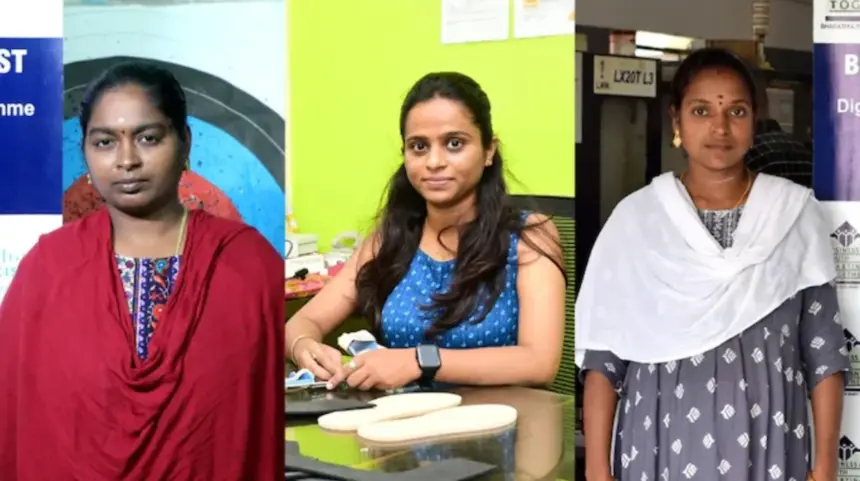
From a home-decor business started with ₹8,000 to factories producing industrial components and rehabilitation aids, three women entrepreneurs are demonstrating how practical ideas, financial discipline and access to mentorship can help build sustainable enterprises.
IndyaStory | Entrepreneurship & Small Business
India’s startup success stories are often associated with venture capital, billion-dollar valuations and technology companies headquartered in Bengaluru, Mumbai or Delhi.
But another part of the country’s entrepreneurial economy is developing through small factories, family-run businesses, regional manufacturing units and online stores.
See more of our coverage in your search results.
Add INDYASTORY on GoogleThese ventures may not attract headline-grabbing investments, yet they create employment, serve customers and open new economic opportunities.
For women entering entrepreneurship from modest financial backgrounds, the journey can involve additional difficulties, including limited access to capital, unfamiliar banking procedures, restricted business networks and the challenge of building customer trust.
The experiences of Thamarai Selvi in Chennai, Bharati in Tamil Nadu’s Villupuram district and Dr Tanvi Pande in Wardha, Maharashtra, illustrate how different entrepreneurial paths can emerge from everyday needs and personal circumstances.
Their businesses operate in entirely different sectors, but they share several characteristics: careful financial management, gradual expansion and a willingness to learn new skills.
Three Women Entrepreneurs, Three Different Business Models
| Entrepreneur | Location | Business | Industry |
|---|---|---|---|
| Thamarai Selvi | Chennai, Tamil Nadu | Heena Home Decors | Online retail and home decor |
| Bharati | Villupuram, Tamil Nadu | Sri Ganapathy Industries | Industrial component manufacturing |
| Dr Tanvi Pande | Wardha, Maharashtra | Shri Sai Physiotherapy and Rehabilitation Aids | Rehabilitation products manufacturing |
Each venture illustrates a different way of creating a business without relying on the conventional venture-capital startup model.
See more of our coverage in your search results.
Add INDYASTORY on GoogleThamarai Selvi: From an ₹8,000 Investment to a Growing Online Business
For Thamarai Selvi, entrepreneurship began during the COVID-19 pandemic, when uncertainty disrupted employment and business activity across India.
Rather than attempting to establish a large operation immediately, she explored a small retail opportunity using the internet.
After watching online videos about selling products through digital marketplaces, she began offering decorative items including clay lamps, products made from ice-cream sticks and banana-leaf-based items.
See more of our coverage in your search results.
Add INDYASTORY on GoogleHer starting investment was approximately ₹8,000.
That limited amount meant every purchasing and inventory decision mattered.
Working with her husband, Selvi sourced products from local retailers and wholesale suppliers. They gradually developed a catalogue of items that could be sold online.
The first month’s revenue was only around ₹1,500.
For many new business owners, such a modest beginning can be discouraging. But the couple continued operating, using the income generated by the venture to purchase additional products and develop the business.
Instead of taking early earnings out of the company, they prioritised reinvestment.
How digital marketplaces helped the business expand
As the business developed, Selvi began using platforms including Amazon and IndiaMART to reach customers.
Social media channels such as Instagram and Facebook also became part of the company’s marketing approach.
These platforms gave the venture access to potential buyers without requiring an extensive physical retail network.
For small businesses, online marketplaces can reduce certain barriers to market entry.
Entrepreneurs can display products, receive orders and reach customers outside their immediate neighbourhoods.
However, selling online also creates operational responsibilities, including product photography, inventory tracking, packaging, delivery coordination and handling returns.
Selvi’s experience demonstrates that an online store requires more than simply listing products for sale.
When nearly 30% of orders were returned
One of the business’s biggest difficulties was its high return rate.
At one stage, approximately 30% of orders were reportedly returned, frequently because items had been damaged.
For a small retailer selling decorative products, returns can be particularly expensive.
The business may lose money on packaging, delivery and replacement costs, while damaged products may no longer be suitable for resale.
Selvi and her husband examined return patterns and strengthened their quality-checking process.
The experience required them to treat customer complaints and delivery problems as sources of operational information.
It also highlighted an important principle of online retail: higher order volumes do not necessarily translate into better profits if product losses and fulfilment costs remain high.
Heena Home Decors reaches approximately 100 daily orders
Over time, the venture developed into Heena Home Decors, a growing retail business with a larger inventory and employees supporting its operations.
According to the supplied account, the business now processes approximately 100 orders per day.
Selvi also obtained mentorship and secured a bank loan in 2024, supporting the company’s development.
The venture reportedly recorded turnover of ₹56 lakh in its previous financial year.
Turnover represents business sales revenue, not net profit. The company’s profitability cannot be determined from that figure alone.
Nevertheless, the progression from an ₹8,000 initial investment to a business generating substantial annual sales illustrates the possibilities available to entrepreneurs who combine digital selling with disciplined operations.
Selvi’s journey also shows why managing returns, maintaining product quality and controlling cash flow are essential to long-term retail growth.
Bharati: Building an Industrial Manufacturing Business in Villupuram
While Selvi entered entrepreneurship through online retail, Bharati pursued a more capital-intensive opportunity in manufacturing.
Growing up in a family facing financial difficulties, Bharati worked towards completing a degree in computer science.
Her husband, Sivakumar, had experience working in a manufacturing company.
Together, they developed an ambition to establish their own industrial business.
However, the cost of setting up a manufacturing unit created a major obstacle.
Unlike some online retail ventures, industrial manufacturing typically requires machinery, production space, raw materials, skilled workers and adequate working capital before regular sales can begin.
These requirements make access to financing especially important.
Turning an ambition into Sri Ganapathy Industries
After receiving guidance and training through entrepreneurship-support programmes, Bharati secured a bank loan that helped the couple move forward with their plans.
In 2023, she established Sri Ganapathy Industries.
The company manufactures metal components used in heavy vehicles and industrial equipment.
Operating in this segment requires attention to manufacturing consistency, production schedules, material costs and customer specifications.
Even relatively small industrial suppliers can play an important role in larger manufacturing supply chains.
They may provide components to businesses that assemble vehicles, machinery or other equipment.
For a regional manufacturer, building dependable customer relationships is particularly important because repeat orders can provide greater predictability for production planning.
Using technology to manage factory finances
Bharati’s computer science education also provided a foundation for using digital tools in business management.
According to the supplied profile, she monitors revenue and expenses closely while using technology to support day-to-day operations.
This approach can be valuable in manufacturing, where the timing of raw material purchases, customer payments and payroll obligations can influence working capital.
Tracking expenses consistently helps entrepreneurs understand production costs and identify areas where resources may be used more efficiently.
Digital records can also make it easier to prepare financial information when applying for loans or discussing business performance with lenders.
However, technology alone cannot replace reliable customer demand, product quality or sound financial decisions.
Creating employment through local manufacturing
Since its establishment, Sri Ganapathy Industries has reportedly developed a regular order pipeline and provided employment to several workers.
The supplied account does not disclose audited revenue, production capacity or exact employee numbers.
Even without those figures, the venture offers an example of how entrepreneurship can contribute to regional economic activity.
Industrial businesses create opportunities not only for their own employees but potentially for transport providers, material suppliers, maintenance services and other supporting enterprises.
Bharati’s experience also reflects how access to training and appropriate financial support can help entrepreneurs enter industries that initially appear difficult to access.
Dr Tanvi Pande: From Physiotherapy to Rehabilitation Product Manufacturing
In Wardha, Maharashtra, Dr Tanvi Pande identified a business opportunity through her work with patients.
Trained as a physiotherapist, she spent years providing treatment through home visits.
During that time, she observed that some patients struggled to obtain suitable orthopaedic and rehabilitation products locally.
Patients recovering from injuries or managing mobility-related conditions may require specialised aids as part of their treatment and daily activities.
Depending on the product, these may include supportive footwear, splints and other assistive devices.
Limited local availability can create inconvenience, additional costs and delays in obtaining appropriate products.
Pande recognised the problem as an opportunity to establish a manufacturing venture serving patients closer to home.
Building Shri Sai Physiotherapy and Rehabilitation Aids
Transitioning from clinical work to manufacturing presented new challenges.
Although Pande understood patient requirements through her professional experience, setting up a production unit required business planning, financing and operational knowledge.
Securing financial support was initially difficult.
Bank documentation and lending requirements became significant obstacles during the early stages.
With mentorship and entrepreneurship training, she eventually secured funding and established Shri Sai Physiotherapy and Rehabilitation Aids.
The unit manufactures products including specialised footwear, splints and prosthetic or rehabilitation aids, according to the supplied account.
The products are intended to address needs associated with mobility support and rehabilitation.
Making rehabilitation products more accessible locally
The business serves a practical purpose beyond the sale of manufactured goods.
For patients requiring specialised products, access to a local supplier may reduce dependence on businesses located in distant cities.
Customised rehabilitation equipment can require careful assessment of an individual’s needs.
Inappropriate or poorly fitted aids may cause discomfort or fail to provide the intended support.
Consequently, manufacturing rehabilitation products involves both commercial considerations and attention to product suitability, safety and applicable regulatory requirements.
The supplied profile describes Pande’s venture as a distinctive local manufacturer in Wardha, although the claim that it is the district’s only such manufacturer requires independent confirmation.
The business has also reportedly generated employment opportunities for local residents.
Pande’s journey demonstrates how experience in a professional field can help an entrepreneur identify problems that are not being adequately addressed by existing suppliers.
Why Mentorship and Access to Credit Matter for Women Entrepreneurs
Although these three women work in different industries, their experiences reveal recurring business challenges.
Selvi needed capital to expand inventory and improve operations.
Bharati required financing to establish an industrial manufacturing unit.
Pande needed support to convert her professional knowledge into a product-based business.
In each case, financial access played an important role.
But funding was not the only factor.
Business training and mentorship helped them navigate unfamiliar processes and make operational decisions.
For first-generation entrepreneurs, guidance can be particularly valuable when dealing with banking requirements, accounting, pricing, market research and customer acquisition.
Access to finance is most useful when accompanied by a realistic business plan and an understanding of repayment obligations.
Loans can enable expansion, but they also create financial commitments that must be supported by sustainable business cash flows.
How Digital Tools Are Changing Small-Business Entrepreneurship
Digital technology has made several business activities more accessible to small enterprises.
An entrepreneur can now explore customer demand through online marketplaces, promote products using social media, maintain digital financial records and communicate with suppliers remotely.
These tools are especially useful for businesses that cannot afford extensive distribution or marketing infrastructure.
For Selvi, online platforms helped expand retail reach.
For Bharati, digital financial management supported operations in a manufacturing environment.
Pande’s experience illustrates a different advantage: identifying customer needs through professional knowledge and developing products to meet them.
The broader lesson is that digital adoption does not have to mean building a technology startup.
Conventional businesses can also benefit from using technology to improve their operations.
However, digital tools are not a substitute for product quality, reliable fulfilment, customer relationships or financial discipline.
The Economic Importance of Women-Led Small Businesses
Women-owned enterprises can contribute to local economic development in several ways.
They create opportunities for self-employment, generate demand for goods and services, and potentially provide jobs to others.
Their activities can also strengthen local supply chains and introduce products that respond to previously underserved customer needs.
The economic impact of an enterprise should not be measured solely by its valuation or the amount of venture capital it raises.
A business that consistently serves customers and provides stable employment can create substantial value for its community.
This is particularly relevant outside established startup centres, where traditional manufacturing, trade and service businesses can play important roles.
At the same time, the challenges faced by women entrepreneurs should not be reduced to questions of individual motivation.
Access to finance, market connections, training, infrastructure and supportive business networks can materially influence whether an enterprise survives and expands.
What Can Aspiring Entrepreneurs Learn From These Three Founders?
Their experiences offer practical lessons for people considering their own ventures.
Start with a clearly identified opportunity. Selvi explored online demand for decorative products, while Pande recognised gaps in the local availability of rehabilitation aids.
Understand the financial requirements of the business. The amount of capital needed varies significantly between online retail and industrial manufacturing.
Track operating costs carefully. Revenue growth is valuable only when the business can manage expenses, fulfilment and cash flow.
Learn from setbacks. Selvi’s experience with product returns shows why operational problems need to be investigated rather than ignored.
Seek appropriate guidance. Training and mentorship can help entrepreneurs understand lending processes, business planning and industry requirements.
Build around sustainable customer demand. The long-term success of a business depends on delivering products or services customers are willing and able to purchase.
These lessons do not guarantee commercial success, but they highlight practical considerations that can strengthen business planning.
Beyond Metro Startup Hubs: A Broader View of Indian Entrepreneurship
India’s entrepreneurial landscape is larger than the technology companies that dominate national business headlines.
It includes industrial suppliers, neighbourhood manufacturers, small retailers, healthcare-related product businesses and entrepreneurs who use online marketplaces to reach customers.
The journeys of Bharati in Villupuram and Dr Tanvi Pande in Wardha illustrate opportunities developing in smaller regional markets.
Thamarai Selvi’s experience in metropolitan Chennai demonstrates how a modestly funded household venture can also grow by making use of digital commerce.
Together, their stories highlight the diversity of business models through which women participate in India’s economy.
Their achievements should not obscure the challenges involved.
Building a company requires customers, capital, operational discipline and the ability to respond to changing market conditions.
For many founders, growth occurs gradually rather than through a single dramatic breakthrough.
Conclusion: Building Businesses That Create Local Opportunities
The journeys of Thamarai Selvi, Bharati and Dr Tanvi Pande offer three different perspectives on entrepreneurship in India.
Selvi used online marketplaces and disciplined reinvestment to develop a home-decor business from a small initial investment.
Bharati entered industrial manufacturing after overcoming financing barriers and securing support to establish a production unit.
Pande combined her physiotherapy experience with entrepreneurship to develop a business producing rehabilitation aids in Wardha.
None of these ventures follows the conventional narrative of a heavily funded technology startup.
Instead, their experiences demonstrate how practical business opportunities can emerge from existing skills, local needs and gradual investment.
The larger significance of these enterprises lies not only in their commercial achievements but also in their ability to create jobs, supply useful products and encourage broader participation in entrepreneurship.
As India seeks to expand economic opportunities, supporting women-led businesses across different industries and regions will remain an important part of building a more inclusive entrepreneurial ecosystem.