
India’s pet-care industry is changing.
What was once a fragmented market dominated by neighbourhood pet shops, independent veterinary clinics and a relatively limited selection of branded products is gradually evolving into a much broader consumer ecosystem.
Today’s pet parents are spending on far more than food.
Nutrition, medicines, veterinary consultations, grooming, accessories, diagnostics, insurance, boarding, at-home care and rapid delivery are becoming part of the larger pet-care economy. For startups, the opportunity is no longer limited to selling a bag of pet food online.
See more of our coverage in your search results.
Add INDYASTORY on GoogleThe bigger opportunity may lie in owning a larger share of a pet’s entire lifecycle.
That is the bet Supertails is making.
Founded in 2021 by Varun Sadana, Aman Tekriwal and Vineet Khanna, Supertails began as an online platform for pet products. Since then, it has expanded across ecommerce, pharmacy, teleconsultations, veterinary clinics, quick commerce and private-label products.
The company has spent its first few years building the pieces of a broader pet-care ecosystem.
Now comes the more difficult part: making those pieces financially sustainable.
See more of our coverage in your search results.
Add INDYASTORY on GoogleIndia’s Pet-Care Market Is Becoming a Bigger Consumer Opportunity
The pet-care market in India has been growing as consumer behaviour changes.
Pets are increasingly treated as family members rather than simply animals requiring basic food and occasional healthcare. That shift is changing how households allocate spending.
The trend gained momentum after the pandemic.
See more of our coverage in your search results.
Add INDYASTORY on GoogleLockdowns encouraged more people to seek companionship, while rising disposable incomes, smaller households and changing urban lifestyles created a growing base of consumers willing to spend more consistently on their pets.
As a result, spending is increasingly becoming recurring rather than occasional.
According to industry estimates cited in the information provided, India’s pet-care market could reach $7 billion to $8 billion by 2030, with healthcare and services potentially growing faster than traditional pet-food categories.
The opportunity has attracted businesses across the value chain.
Companies such as Drools, Heads Up For Tails, Vetic, PetKonnect and JustDogs have developed businesses around different parts of the market. Larger ecommerce platforms, including Amazon and Flipkart, have also expanded their pet-product offerings.
The market is becoming more competitive.
But it remains fragmented.
And Supertails believes connecting the different parts of the ecosystem could become its biggest opportunity.
From Selling Pet Food to Building a Pet-Care Platform
Supertails entered the market through ecommerce.
The founders identified a fragmented customer journey.
A pet parent might buy food from one retailer, medicines from another, consult a veterinarian separately and rely on a local shop for accessories or emergency purchases.
Supertails began by trying to bring more of those transactions onto a single platform.
But the company did not enter every category immediately.
Pet food became the starting point because it offered an opportunity to build a recurring relationship with customers. Accessories followed, before the platform expanded into pharmacy and teleconsultations.
The next major step was healthcare.
More recently, Supertails has also entered quick commerce.
The strategy has transformed the company from a relatively straightforward ecommerce business into a multi-layered pet-care platform.
The question now is whether all those layers can create an economic advantage.
The Growth Numbers Are Impressive, but Scale Alone Is Not Enough
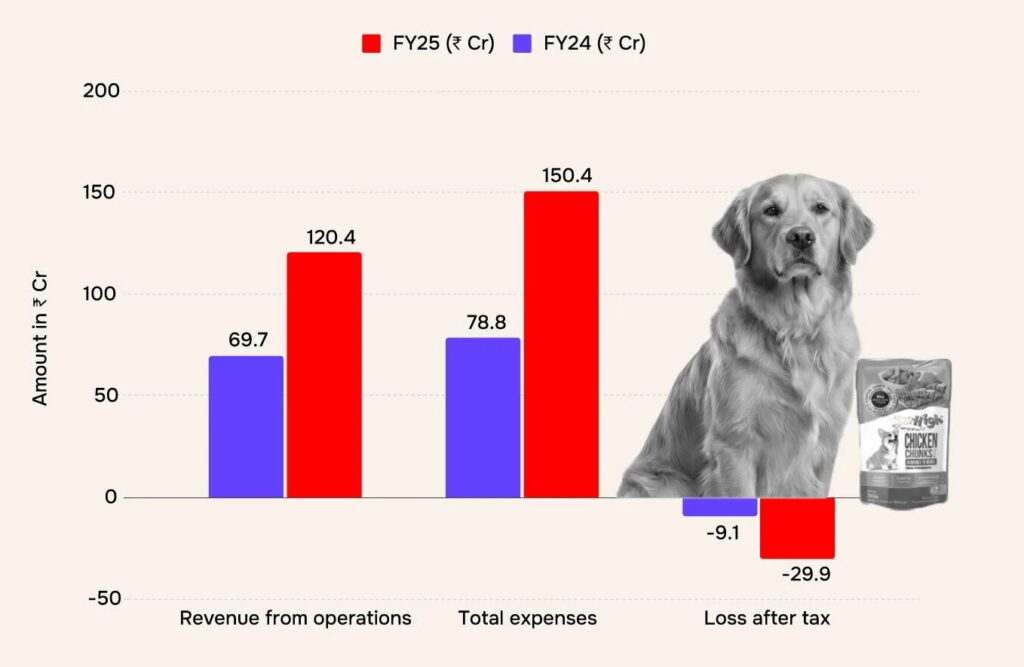
According to the information provided, Supertails’ operating revenue increased from approximately ₹109 crore in FY25 to more than ₹200 crore in FY26.
The startup expects revenue in the range of ₹350 crore to ₹400 crore during the current financial year and says it now serves close to one million pet parents.
The company has also reportedly kept losses broadly stable despite investments in new infrastructure.
Those investments include veterinary clinics, delivery infrastructure and technology.
But this is where Supertails’ next phase begins.
Growing revenue is one challenge.
Creating a profitable and durable business is another.
“We’ve entered a phase where this is no longer just about growth. It’s about building a business where the unit economics and profitability make complete sense,” cofounder Vineet Khanna said.
That statement reflects a broader shift in the startup’s strategy.
The company is moving from building the ecosystem to improving the economics of the ecosystem.
Supertails’ New Focus: Make the Existing Infrastructure Work Harder
For several years, the startup playbook was relatively familiar.
Acquire customers.
Expand the product assortment.
Enter new markets.
Increase revenue.
Supertails is now reaching a stage where opening another vertical or expanding into another city may not necessarily create the most value.
The company has already invested in infrastructure.
It has clinics.
It has delivery capabilities.
It has customer and pet data.
It has private-label products.
The next challenge is increasing the productivity of these existing assets.
Three major pillars appear to define this strategy:
- Expanding customer relationships across multiple pet-care categories
- Using healthcare to deepen engagement and improve retention
- Growing private-label products to improve margins
The effectiveness of this combination could determine Supertails’ financial future.
Healthcare Could Become the Company’s Engagement Engine
One of the most important additions to the Supertails ecosystem has been veterinary healthcare.
The company reportedly began opening physical clinics around 18 months ago after finding that teleconsultations could not solve every pet-health requirement.
It now operates 12 clinics in Bengaluru and employs more than 110 veterinarians, according to the information provided.
Healthcare is strategically different from ecommerce.
A bag of pet food creates a transaction.
A veterinary consultation can create a relationship.
A doctor may identify a health issue, recommend a diet, prescribe medicines or suggest follow-up treatment. That can potentially connect healthcare, pharmacy and commerce.
Supertails is trying to use those interactions to build a more complete understanding of the pet.
The company reportedly assigns new customers a “Super Companion”, a pet relationship manager who interacts with pet parents.
Purchase history, veterinary records and consultation information can then contribute to a more detailed pet profile.
This could allow the company to move beyond understanding the customer as a buyer.
Instead, it can potentially understand the needs of the animal itself.
Why Understanding the Pet Could Be Commercially Important
An eight-month-old cat and a 12-year-old dog do not have the same needs.
A puppy going through a vaccination cycle creates different requirements from an ageing pet requiring specialised food and medication.
A dog with allergies may need different products from a healthy pet of the same age.
This is where Supertails sees value in combining commerce with healthcare data.
The company can potentially make more relevant recommendations based on the pet’s life stage and medical requirements.
With AI becoming increasingly important across consumer platforms, Supertails is also working on recommendation capabilities aimed at better understanding individual pets and potentially improving customer retention.
The commercial logic is straightforward.
Better recommendations could increase relevance.
Greater relevance could improve repeat purchases.
Higher repeat purchases could increase customer lifetime value.
But that logic depends on execution.
The company must prove that more data and recommendations genuinely lead to stronger retention rather than simply adding another layer of technology.
Private Labels Could Bring Higher Margins
The third major piece of Supertails’ strategy is private-label products.
The opportunity reportedly emerged through healthcare interactions.
Veterinarians were prescribing specialised diets, while customers were often dependent on expensive imported products or faced limited availability.
Supertails identified an opportunity between premium international brands and lower-priced domestic options.
That led to Henlo, the company’s premium pet-food brand developed for the Indian market.
Private labels are strategically important because they offer something a marketplace business often cannot.
Greater control over economics.
When a company sells third-party brands, its margins are usually determined by the commercial terms it negotiates with suppliers.
A private-label product can potentially provide better gross margins, stronger product differentiation and greater control over pricing.
But private labels also create new responsibilities.
The company must develop products, manage quality, build consumer trust and create sufficient demand.
For Supertails, the success of Henlo could become an important test of whether its ecosystem can generate higher-value transactions.
Quick Commerce Adds Frequency, but Also Raises Questions
Supertails has also expanded into faster delivery.
According to the information provided, the company has built a network of 45 partner-operated dark stores across three cities.
Rather than owning and operating all of the infrastructure itself, the company manages areas such as inventory, technology and customer experience while relying on third-party partners for operations.
The goal is to meet changing consumer expectations.
Pet parents may increasingly expect food, medicines, toys and other essential products to arrive quickly.
Supertails says its quick-commerce business is growing at double-digit month-on-month rates, with retention and repeat purchases improving.
The company believes the model could become more efficient as demand increases because of shorter delivery distances, limited returns and higher infrastructure utilisation.
However, there is an important question.
Does quick commerce create additional purchases?
Or does it simply move existing ecommerce orders into a more expensive delivery channel?
The answer will matter significantly to the business model.
The Ecosystem Flywheel Supertails Is Trying to Build
The real value of Supertails may not come from any one vertical.
It may come from how the different verticals interact.
A customer could enter through pet food.
They might later consult a veterinarian.
The consultation could lead to a recommendation for specialised nutrition.
The customer could purchase that product through Supertails.
Later, they might return for medicines, accessories or another consultation.
This is the ecosystem flywheel the startup is attempting to create.
Ecommerce can provide frequency.
Healthcare can deepen trust and engagement.
Private labels can potentially improve margins.
Quick commerce can increase convenience.
Data can make recommendations more relevant.
If these components work together, Supertails could potentially increase customer lifetime value while reducing the need to repeatedly acquire the same customers.
That is the strategic promise.
But making the economics work will require each part of the system to perform.
Clinics and Dark Stores Must Become Assets, Not Cost Centres
Supertails has already invested in infrastructure across healthcare and delivery.
Those investments could become competitive advantages.
They could also become expensive fixed costs.
The difference depends on utilisation.
A clinic becomes more financially efficient when more patients and services flow through it.
A dark store becomes more productive when order density increases.
Private labels become more meaningful when enough customers repeatedly buy them.
This means Supertails’ next growth metrics may look different from its earlier ones.
Revenue growth will remain important.
But investors and analysts may increasingly focus on:
- Customer retention
- Purchase frequency
- Customer lifetime value
- Contribution margins
- Clinic utilisation
- Dark-store productivity
- Private-label adoption
- Cash burn
- Path to profitability
The startup’s ability to improve these metrics will likely determine whether its ecosystem becomes financially sustainable.
Why Geographic Expansion Is No Longer the Only Priority
Supertails is reportedly not pursuing aggressive expansion into new cities at the same pace as before.
That could reflect a more disciplined approach to growth.
New cities require infrastructure, customer acquisition and operational investment.
If the company can improve utilisation in its existing markets, the economics may become stronger before it expands further.
At the same time, categories such as insurance, boarding and at-home care remain possible opportunities for the future.
The temptation for a platform business is to keep adding more services.
But Supertails’ current challenge is different.
It needs to ensure that the categories it has already built generate stronger returns.
More verticals do not automatically mean a better business.
Integration matters more.
Supertails Has to Make the Numbers Work
Supertails has already demonstrated that there is demand for a broader pet-care platform.
The company has expanded rapidly, built infrastructure and established relationships with nearly one million pet parents, according to the figures provided.
The next phase will be more demanding.
The company now needs to prove that growth can translate into sustainable economics.
The test will come down to three areas.
1. Customer Retention and Frequency
The more categories a customer uses, the greater the potential value of that relationship.
A pet parent who only buys food represents one type of customer.
A customer who purchases food, medicines, healthcare services and private-label products represents a much deeper relationship.
2. Infrastructure Utilisation
Clinics and delivery networks must generate sufficient demand to justify their operating costs.
The focus is shifting from simply building infrastructure to making that infrastructure more productive.
3. Private-Label Margins
Owned brands could allow Supertails to capture more value from its existing customer base.
But private labels must generate sufficient volume, repeat purchases and customer trust.
The IPO Ambition Adds Another Layer of Pressure
Supertails has also set its sights on long-term public-market ambitions.
The company is targeting financial sustainability over the next 24 to 36 months, according to the information provided, while also holding a longer-term ambition of going public.
That raises the stakes.
Public-market investors can value growth, but they also demand clarity around profitability, margins and cash flows.
For Supertails, building a large customer base will not be enough.
The company must demonstrate that its ecosystem can generate predictable and improving financial performance.
That means the next few years may be less about dramatic expansion and more about operational discipline.
Supertails’ Next Act
Supertails has spent its first five years building.
It built an ecommerce platform.
It expanded into healthcare.
It launched a private-label brand.
It opened veterinary clinics.
It developed faster delivery capabilities.
The next stage will require a different kind of execution.
The company wants to become one of India’s leading specialised pet-care platforms. But market leadership alone does not guarantee attractive economics.
The real test is whether every part of the ecosystem can strengthen the others.
A clinic should deepen customer engagement.
That engagement should improve recommendations.
Recommendations should increase relevant purchases.
Commerce should create recurring transactions.
Private labels should improve margins.
Quick commerce should increase convenience without destroying unit economics.
If this system works, Supertails could build a durable and differentiated pet-care business.
If it does not, the company risks becoming a collection of expensive verticals without sufficient economic integration.
For now, Supertails has succeeded in building the ecosystem.
Its next challenge is more difficult.
It has to make every cog in the wheel work together—and make the numbers work too.