Building a consumer brand in India’s home appliances market is rarely easy.
The sector is dominated by established names, consumers tend to hold on to products for years, and earning trust can take far longer than launching a new product. For Atomberg Technologies, these challenges were particularly significant when the company began its journey.
Today, however, Atomberg has emerged as one of India’s notable direct-to-consumer home appliance brands, building a business that it has said grew from virtually zero to nearly $100 million in annual revenue run rate (ARR).
Its journey was far from overnight.
See more of our coverage in your search results.
Add INDYASTORY on GoogleAccording to cofounder Sibabrata, also known as Shibam Das, the company built its operations in a capital-efficient manner, but meaningful scale took time.
“Our operations are extremely capital-efficient. But it was slow growth, and we could scale up only after 2018,” Das told The CapTop.
The company now aims to cross ₹1,000 crore in total revenue in the current financial year, according to the information provided, as it continues to expand beyond its core fan business.
The Fan That Raised More Questions Than Confidence
In 2018, Atomberg’s sales team reportedly had concerns when the company prepared to launch a new model called Renesa.
The fan featured a compact motor design that looked different from the conventional ceiling fans consumers were accustomed to.
See more of our coverage in your search results.
Add INDYASTORY on GoogleThe questions were straightforward.
Was the motor too small?
Would the fan deliver enough air?
See more of our coverage in your search results.
Add INDYASTORY on GoogleWould customers buy it?
“Why not?” was reportedly the response from Atomberg cofounders Manoj Meena and Shibam Das.
The answer reflected the founders’ confidence in the product and their willingness to challenge established assumptions in the market.
Experimentation can be particularly risky in the fan category. Consumers do not buy ceiling fans frequently, and the replacement cycle can stretch between several years. That means a product mistake can be costly for both a consumer and a brand.
Yet Renesa went on to become a major part of Atomberg’s growth story.
According to the figures provided, the company sold around 3 million units of the energy-efficient model over four years.
From B2B Beginnings to a Consumer Brand
Although Atomberg Technologies was incorporated in 2012, its operational journey began in 2015.
The company initially worked with a limited number of B2B clients, including organisations such as the Tata Group, Infosys and Indian Railways, according to the information provided.
The business later moved into the consumer market.
Within about a year, Atomberg entered the B2C space through major ecommerce marketplaces, including Amazon and Flipkart. The company subsequently expanded into offline retail in 2018.
This transition was critical.
Selling products to businesses and institutions is fundamentally different from building a consumer-facing brand. B2C companies must win on product performance, pricing, branding, distribution and customer trust.
For Atomberg, the challenge was even greater because it was competing in a market dominated by long-established players.
Taking On India’s Legacy Fan Brands
India’s fan market already had powerful and recognisable companies.
Brands such as Havells, Crompton and Usha had long-established consumer relationships, extensive distribution networks and significant market presence.
Atomberg needed to find a way to stand apart.
The company’s answer was technology.
Its growth became closely associated with Brushless Direct Current (BLDC) motor technology. Compared with traditional induction-motor fans, BLDC fans are designed to consume less electricity.
The technology helped Atomberg present consumers with a different value proposition.
The upfront price could be higher, but the company argued that lower electricity consumption could improve the product’s long-term value.
This became increasingly relevant as energy efficiency gained greater attention among Indian consumers and regulators.
Why Energy Efficiency Became Atomberg’s Entry Point
A ceiling fan may appear to be a simple product, but it is also one of the most widely used electrical appliances in Indian homes.
Small improvements in energy consumption can therefore become meaningful over the product’s lifetime.
Atomberg used this opportunity to build a technology-led identity.
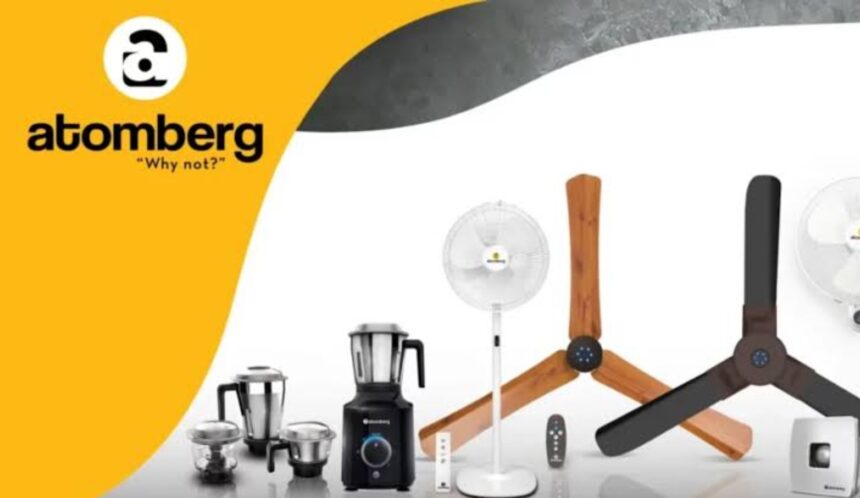
Its products combined energy-efficient motors with features designed for a changing consumer market. The company has launched more than 20 models across categories including:
- Ceiling fans
- Wall fans
- Exhaust fans
- Pedestal fans
The Renesa model, according to the information provided, comes with a five-star BEE energy rating and has become one of the company’s important products.
Atomberg’s strategy was not simply to sell a conventional appliance under a new brand name.
It attempted to convince consumers that a familiar product could be re-engineered.
Growth Did Not Come Quickly
Atomberg’s journey also highlights how difficult it can be to build a hardware and consumer appliance business.
The company did not scale instantly.
After entering the ceiling fan market in 2015, Atomberg reportedly needed years to reach significant sales volumes. Growth accelerated only after 2018.
According to the figures provided, Atomberg generated operating revenue of approximately ₹358 crore in FY22, compared with around ₹143 crore in the previous financial year.
That represented a significant increase in operating revenue.
The company’s marketing and advertising spending also increased during that period, reflecting the investment required to build awareness in a competitive consumer market.
According to the reported numbers, advertising and marketing expenditure increased from around ₹13.6 crore in FY21 to ₹37.8 crore in FY22.
The numbers underline a basic reality of building a consumer brand: a strong product is important, but customers must also know the product exists.
Building a Capital-Efficient Consumer Business
Atomberg has positioned its growth story around capital efficiency.
According to the information provided, the company built its business from zero to nearly $100 million ARR while maintaining a focus on sustainable growth.
This is notable because consumer hardware businesses can be capital-intensive.
Companies must invest in:
- Product development
- Manufacturing
- Supply chains
- Inventory
- Distribution
- Marketing
- After-sales service
A fast-growing company can generate impressive sales but still struggle to build a sustainable business if costs rise faster than revenue.
Das has indicated that Atomberg’s long-term objective is to achieve organisational-level profitability without sacrificing growth.
That balancing act may define the company’s next phase.
Expanding Beyond Fans
Atomberg’s ambitions now go beyond ceiling fans.
The company has begun expanding into other areas of the home appliance market, including products such as mixer grinders. According to the information provided, its newer products are available through major ecommerce platforms and selected offline retail networks.
The company has also expanded its physical presence.
Its fan products are available through thousands of offline retail stores, demonstrating how its strategy has evolved from an online-first consumer brand to a broader omnichannel business.
This transition is significant.
Ecommerce helped newer brands enter markets without immediately building expensive physical distribution networks. But offline retail remains important in India’s home appliance sector, where consumers often prefer to see products before making a purchase.
Atomberg’s ability to operate across both online and offline channels could become increasingly important as it enters more categories.
From a Single Product Category to a Home Appliance Platform
The company’s biggest challenge may now be expansion.
Building a successful fan business does not automatically mean a company can become successful in every home appliance category.
Different products have different consumer expectations.
A customer buying a fan may prioritise electricity consumption and airflow. Someone purchasing a mixer grinder may focus on motor performance, durability and ease of cleaning.
A company expanding across categories must therefore build expertise beyond its original product.
Atomberg’s future success may depend on whether it can replicate its original formula:
Identify a familiar consumer product, find a meaningful problem and use technology to create a better solution.
That approach helped it establish a differentiated position in fans.
The question is whether it can do the same elsewhere.
The Journey Was Not Without Setbacks
Looking back at Atomberg’s growth, Das has spoken about the difficult periods the company faced.
“Everything looks very fancy now, but the journey was very difficult. We went through so many near-death experiences that we are immune to these things,” Das told The CapTop.
The comment captures a side of startup building that is often overlooked once companies begin achieving scale.
Behind the revenue numbers are years of experimentation, failed assumptions, supply-chain challenges, cash-flow pressures and intense competition.
For Atomberg, moving from the B2B market into consumer appliances required the company to rethink how it built products, marketed them and reached customers.
Its journey also demonstrates that sustainable growth in consumer hardware often requires patience.
What Comes Next for Atomberg?
Atomberg’s story is now entering a new chapter.
The company has already demonstrated that a startup can challenge established brands in a traditional Indian appliance category.
But the next challenge is considerably more complex.
Can Atomberg become a multi-category home appliance brand?
Can its technology-led approach work beyond fans?
Can it maintain capital efficiency while scaling into new categories?
And can it build long-term profitability while continuing to grow?
The answers will shape the company’s future.
From Zero to Nearly $100 Mn ARR
Atomberg’s rise from a small technology-focused business to a consumer brand approaching a reported $100 million annual revenue run rate is a reminder that large markets can still be disrupted.
The company’s strategy was based on a relatively straightforward idea: even products that have existed for decades can be improved.
In Atomberg’s case, the ceiling fan became the starting point.
The company’s founders were willing to challenge assumptions, experiment with technology and take on established competitors. That willingness eventually helped Atomberg move from a slow-growth startup into a recognisable consumer brand.
Now, the company faces its biggest test yet.
Building a successful fan business was difficult.
Building a successful home appliance platform could be even harder.
But if Atomberg can repeat the product innovation, distribution discipline and consumer understanding that helped it grow its fan business, its journey from zero to nearly $100 million ARR may prove to be only the beginning.