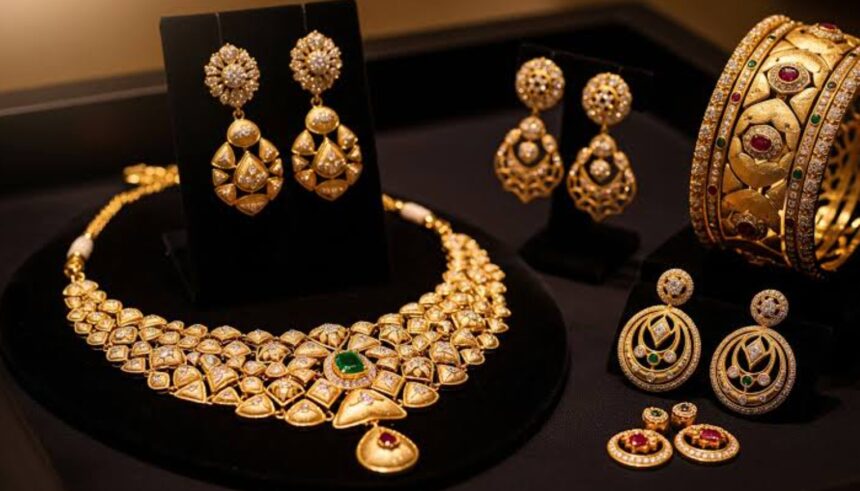
Deepa Jewellers is changing an important part of its business model by bringing a portion of its jewellery manufacturing in-house. The recently listed jewellery company has historically relied largely on an outsourced network of third-party karigars, while retaining control over design, gold procurement, product specifications, quality checks and customer relationships.
The move comes after a sharp improvement in the company’s financial performance. Deepa Jewellers reported revenue of Rs 1,927 crore in FY26, up from Rs 1,397 crore in FY25, while profit after tax (PAT) increased substantially during the same period.
With a market capitalisation of around Rs 1,812.90 crore, the company’s shares were trading at approximately Rs 188.60 on Friday, up 8.86% from the previous close of Rs 173.25.
Deepa Jewellers Built a Rs 1,927 Crore Business Without a Large Manufacturing Base
Deepa Jewellers follows an asset-light operating model. Instead of owning most of its manufacturing capacity, the company works with external karigars who manufacture jewellery according to its specifications.
See more of our coverage in your search results.
Add INDYASTORY on GoogleThe approach has allowed Deepa to scale without taking on the full fixed-cost burden associated with running a large manufacturing facility.
Its financial performance has also improved significantly. Revenue rose from approximately Rs 1,397 crore in FY25 to Rs 1,927 crore in FY26, representing growth of about 38% year-on-year.
PAT increased from around Rs 41 crore to Rs 105 crore, a rise of roughly 158%.
As a result, PAT margin expanded from approximately 2.9% in FY25 to about 5.4% in FY26.
This is important because the company’s decision to invest in manufacturing is coming after a period of stronger profitability. The shift therefore appears to be aimed at improving operating efficiency and capturing more value from production rather than simply fixing a weak outsourced model.
See more of our coverage in your search results.
Add INDYASTORY on GoogleWhy Is Deepa Jewellers Bringing Production In-House?
Deepa’s outsourced manufacturing network increased its processing capacity from around 2,155 kg annually in FY24 to 2,925 kg in FY26.
During FY26, the company sold approximately 1,644 kg of gold jewellery and processed another 757 kg through job work. Combined, that represents roughly 2,401 kg, or about 82% of the stated outsourced processing capacity.
That suggests the new manufacturing facility is not simply about adding more production capacity.
See more of our coverage in your search results.
Add INDYASTORY on GoogleThe bigger question is whether producing some jewellery internally can improve the economics of each unit manufactured.
Three areas will be particularly important:
- Lower manufacturing costs: Bringing selected processes inside could reduce dependence on third-party making charges.
- Better gold recovery: Even small improvements in wastage and recovery can have a meaningful impact at high jewellery volumes.
- Faster production: Greater control over manufacturing schedules could help shorten the time between design development, production and delivery.
In other words, the success of the strategy will depend less on how much the company can manufacture and more on whether it can manufacture more efficiently.
Hyderabad Facility Could Become an Important Profitability Lever
Deepa Jewellers is establishing a 6,696 sq ft manufacturing facility in Hyderabad.
The planned facility includes technology such as a real-wax 3D printer, vacuum-pressure casting machine and induction-melting furnace. These capabilities indicate an effort to introduce more technology into the production process rather than simply replicate traditional manufacturing operations.
As of March 2026, approximately Rs 2.28 crore had been invested in the facility through internal accruals. The plant was targeted to become operational during the first half of FY27.
The economics could become increasingly attractive as utilisation improves.
Deepa currently supplies gold, alloys and stones to external manufacturing partners, who convert these inputs into finished jewellery. If certain production activities can be performed internally at a lower effective cost, the resulting savings could support margins.
Gold Recovery Could Matter as Much as Making Costs
Gold is the primary raw material in the business, making recovery and wastage critical variables.
Deepa sold approximately 1,644 kg of gold jewellery in FY26. At that scale, even a relatively small improvement in gold recovery can have a material financial impact.
An in-house facility could provide greater control over production processes and recovery rates. However, the actual benefit will depend on the technology deployed, manufacturing discipline and utilisation of the plant.
The company will therefore need to demonstrate that its internal production generates measurable savings rather than simply shifting costs from external vendors to its own balance sheet.
Faster Turnaround Could Help Deepa Expand Its Customer Base
Jewellery retailers operate around wedding seasons, festivals, changing fashion preferences and new product launches. Speed can therefore be an important part of a supplier’s value proposition.
An in-house manufacturing operation could give Deepa greater control over production schedules and replenishment.
The company already serves 373 customers across 16 product categories. If manufacturing turnaround improves, Deepa could potentially respond faster to customer requirements, replenish popular designs more quickly and handle larger or more time-sensitive orders.
Technology such as 3D printing and modern casting equipment may also help with product development and more intricate designs.
However, this advantage comes with an important trade-off.
A factory introduces fixed expenses, including employee costs, depreciation, utilities, maintenance and other operating expenses. If the facility operates below an efficient utilisation level, these costs could reduce or eliminate the savings generated by lower outsourcing expenses.
A Hybrid Manufacturing Model Could Be Key
Deepa does not necessarily need to abandon its existing karigar network.
A hybrid approach could allow the company to retain third-party manufacturers for flexible or variable production while moving selected designs and processes in-house when the economics or quality-control benefits are stronger.
Such a structure could preserve the flexibility that helped the company grow while allowing Deepa to capture more of the manufacturing value chain.
For investors, this makes capital efficiency and margin expansion more relevant than simply tracking manufacturing capacity.
If the new plant generates higher margins without requiring disproportionately high capital investment, it could strengthen the company’s economics. If fixed costs rise faster than the savings from internal manufacturing, the benefits could be more limited.
Customer and Geographic Concentration Remain Important Risks
The manufacturing transition does not remove Deepa’s existing business risks.
Around 94.37% of FY26 revenue came from South India, while the company’s top 10 customers accounted for approximately 64.67% of sales.
That level of geographic and customer concentration means revenue growth remains dependent on a relatively concentrated market and customer base.
A more efficient manufacturing operation could improve Deepa’s competitiveness, but it does not directly eliminate concentration risk.
Investors will therefore need to evaluate the manufacturing strategy alongside customer diversification, geographic expansion, margins and capital deployment.
What Investors Should Watch Going Forward
Deepa Jewellers has already demonstrated that it can build a sizeable business using an outsourced manufacturing model. The next phase will test whether greater control over production can translate into better financial performance.
The Bottom Line
Deepa Jewellers’ move into in-house manufacturing comes at an interesting point in its growth story. The company has grown revenue to Rs 1,927 crore and significantly improved its PAT, while its existing outsourced model has continued to scale.
The Hyderabad facility could provide another avenue for improving margins through lower making costs, better gold recovery, greater quality control and faster turnaround.
But the outcome will ultimately depend on execution. A factory can create operating leverage when utilisation is high, but it can also introduce fixed costs and capital requirements that an asset-light model avoids.