Lumino Industries combines electrical manufacturing with power infrastructure execution and enters the public market with a ₹700 crore IPO. The company has delivered strong growth, healthy margins and built a sizeable order book, but its sharp rise in borrowings makes balance-sheet risk the most important issue for investors to examine.
Lumino Industries is seeking to raise ₹700 crore through its initial public offering at a price band of ₹78 to ₹82 per share. At the upper end of the price band, the company is expected to command a post-issue market capitalisation of about ₹2,497 crore.
The IPO combines a ₹500 crore fresh issue with a ₹200 crore offer for sale (OFS). While the company’s growth record, profitability and order pipeline present a compelling business case, the balance sheet tells a more complicated story.
Lumino’s borrowings stood at ₹1,856.78 crore as of July 31, 2026, a figure that has become central to the investment debate. The key question is whether the company’s operating strength, order book and expected growth opportunities are sufficient to offset concerns about leverage and heavy working-capital requirements.
See more of our coverage in your search results.
Add INDYASTORY on GoogleFor investors evaluating the IPO, Lumino represents a clear balance between strong business fundamentals and significant financial risk.
What Does Lumino Industries Do?
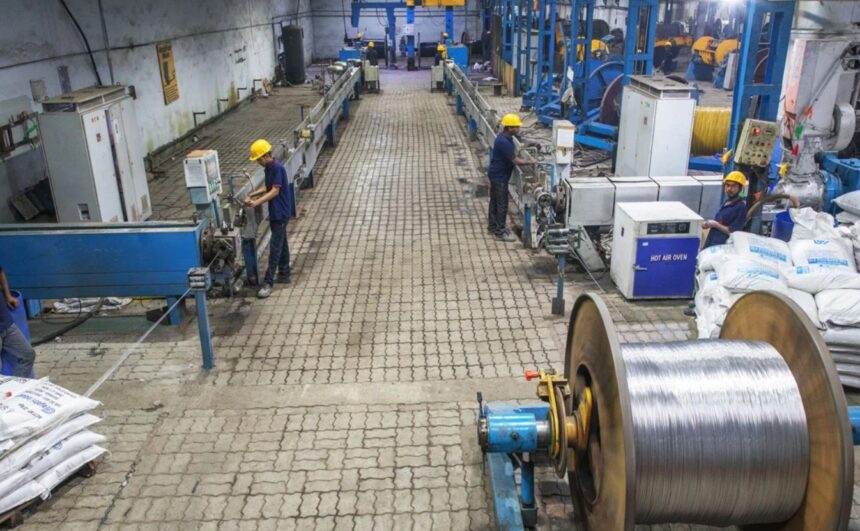
Lumino Industries operates across two connected parts of India’s power and electrical infrastructure ecosystem.
The first is its manufacturing business, which produces products such as:
- Power cables
- Aluminium conductors
- Household electrical wires
These products are marketed under the Lumicon brand and accounted for approximately 70% of the company’s FY26 revenue.
The second part of the business is Engineering, Procurement and Construction (EPC). Through this division, Lumino undertakes projects involving:
See more of our coverage in your search results.
Add INDYASTORY on Google- Power transmission infrastructure
- Substations
- Solar projects
- Other electrical infrastructure
The EPC division contributed the remaining 30% of FY26 revenue.
The combination of manufacturing and EPC provides Lumino with an integrated operating model. In some cases, the company uses products manufactured internally for its own infrastructure projects.
Approximately 23% of the products used in Lumino’s EPC projects during FY26 were produced in-house. This integration can potentially improve control over product availability, quality and project scheduling, although it does not eliminate the company’s exposure to raw-material prices and project execution risks.
See more of our coverage in your search results.
Add INDYASTORY on GoogleManufacturing Capacity and Business Infrastructure
Lumino operates two manufacturing facilities in West Bengal with a combined aluminium manufacturing capacity of 40,000 tonnes per year.
The company is also developing additional capacity that is expected to increase total capacity to approximately 50,980 tonnes annually.
As of March 31, 2026, Lumino reported an order book of ₹3,149.88 crore.
This represents a significant pipeline of confirmed projects and business waiting to be executed. The order book is spread across the company’s manufacturing and EPC activities, reducing dependence on a single business line.
However, an order book should not automatically be treated as guaranteed future profit. Revenue recognition and profitability can be affected by project delays, cost increases, approvals, changes in customer requirements and execution challenges.
Lumino Industries IPO: Key Details
| Particular | Details |
|---|---|
| IPO Size | ₹700 crore |
| Fresh Issue | ₹500 crore |
| Offer for Sale | ₹200 crore |
| Price Band | ₹78–₹82 per share |
| Estimated Post-IPO Market Capitalisation | ₹2,497 crore |
| FY26 Revenue | ₹2,041 crore |
| FY26 EBITDA | ₹238.95 crore |
| FY26 EBITDA Margin | 11.71% |
| Order Book | ₹3,149.88 crore |
| Borrowings as of July 31, 2026 | ₹1,856.78 crore |
Growth Opportunity: Why the Sector Looks Attractive
Lumino operates in sectors expected to benefit from continued investment in India’s electricity infrastructure.
India’s power transmission and distribution network requires significant expansion and modernisation to support rising electricity demand, urbanisation, industrial growth and the expansion of renewable energy.
Government programmes and infrastructure initiatives related to grid modernisation, distribution improvement and renewable energy integration are expected to create demand for equipment and project execution services.
The wires and cables industry is also positioned to benefit from infrastructure investment, industrial development and the broader electrification of the economy.
Lumino’s business model allows it to participate in both areas. It can manufacture products required for electrical infrastructure while also competing for projects that install and develop that infrastructure.
However, a favourable industry outlook does not guarantee that every company will grow at the same rate.
Lumino remains smaller than established infrastructure and electrical-sector companies such as KEC International and Kalpataru Projects. Its future growth will therefore depend on its ability to execute projects efficiently, secure new contracts and manage its working capital.
What Makes Lumino Industries Financially Attractive?
One of Lumino’s strongest points is its recent operating performance.
Revenue grew at a compound annual growth rate of approximately 20.4% between FY24 and FY26. Profit grew faster, at approximately 35.9% during the same period.
The company’s FY26 EBITDA margin of 11.71% was higher than most of the listed peers in the comparison provided.
Its Return on Equity (RoE) of 24.62% in FY26 was also the highest among the supplied peer group.
These numbers suggest that Lumino has not simply expanded revenue. Its profitability and returns have also been strong.
The company also benefits from a sizeable order book. At ₹3,149.88 crore, the order pipeline was approximately 1.54 times its FY26 revenue of ₹2,041 crore.
That provides visibility into future business activity, although actual execution and profitability remain dependent on multiple factors.
Government and Customer Concentration Risks
Despite the strong growth profile, Lumino has customer concentration risks that investors should consider carefully.
Government customers accounted for approximately 53% of FY26 revenue.
In addition, the company’s top 10 customers contributed 46.52% of revenue.
While the concentration has improved compared with previous periods, the company remains dependent on a relatively limited number of major customers and government-linked projects.
This can create risks related to:
- Delayed project approvals
- Slower government spending
- Payment delays
- Changes in infrastructure priorities
- Customer-specific contract risks
For an EPC company, delayed customer payments can be particularly important because project costs often need to be funded before the company receives the full payment.
Working Capital: The Issue Behind the Debt
Working capital is one of the most important parts of the Lumino investment story.
The company reported net working capital of approximately ₹716.72 crore in FY26, equivalent to around 35% of annual revenue.
Its working-capital cycle stretched to 86 days.
In simple terms, a significant amount of the company’s money is tied up in:
- Inventory
- Materials
- Work under execution
- Receivables from customers
This means a company can report strong accounting profits while still needing substantial cash to keep operations running.
For a growing EPC and manufacturing company, expansion can increase the need for working capital. More projects and higher sales may require more inventory, more raw materials and more financing before customer payments are received.
This dynamic helps explain why strong revenue and profit growth can coexist with rising borrowings.
The Biggest Concern: Borrowings Have Risen Sharply
The most important risk in the Lumino IPO is its debt.
Borrowings increased from approximately ₹384.16 crore at the end of FY26 to ₹1,856.78 crore as of July 31, 2026.
Using the FY26 EBITDA of ₹238.95 crore as a reference, this represents borrowings of approximately 7.77 times EBITDA.
The company intends to use around ₹337 crore from the IPO proceeds to repay debt.
Even after such repayment, estimated borrowings could remain around ₹1,519.78 crore, equivalent to approximately 6.36 times FY26 EBITDA, based on the figures provided.
These calculations highlight the core investment concern.
The IPO can reduce financial pressure, but it may not completely eliminate the company’s leverage risk.
Investors will need to monitor whether future operating cash flow improves sufficiently to support business growth while reducing the debt burden.
Project Execution and Raw Material Risks
Lumino’s EPC business creates additional operational risks.
Infrastructure projects can have long execution timelines. Some projects may take 24 to 30 months to complete.
Long project periods can increase exposure to:
- Cost overruns
- Delays
- Changes in material prices
- Labour costs
- Regulatory approvals
- Customer-related delays
The company reported ₹23.62 crore in project cost overruns during FY25.
Lumino is also exposed to fluctuations in raw-material prices, particularly for commodities such as:
- Aluminium
- Copper
- Steel
Sharp movements in commodity prices can affect manufacturing costs and project profitability if price increases cannot be fully passed on to customers.
Geographic Concentration Is Another Risk
The company has significant geographic concentration.
Its two factories and all four warehouses are located in Howrah, West Bengal.
This concentration may improve operational efficiency, but it also creates location-related risks.
A regional disruption involving logistics, infrastructure, labour, natural events or other operational challenges could affect a substantial part of the company’s manufacturing and distribution network.
Geographic diversification could become increasingly important as the company expands.
Is Lumino Industries IPO Valuation Attractive?
At the upper price of ₹82 per share, Lumino is valued at approximately 15.61 times its FY26 earnings.
Based on the peer comparison provided, this appears lower than valuation multiples for companies such as:
- KEC International: approximately 19.81 times
- Kalpataru Projects: approximately 22.13 times
Some larger electrical-sector companies, including KEI Industries and Apar Industries, trade at significantly higher multiples.
However, a lower valuation should always be examined in context.
Lumino is smaller than several established competitors and carries significantly higher leverage.
Part of the valuation discount may therefore reflect the financial and execution risks associated with the business.
The company’s estimated post-IPO book value is approximately ₹40.37 per share, which implies a price-to-book multiple of around 2.03 times at the upper price band.
On several valuation measures, the IPO appears reasonably priced relative to the growth and profitability numbers provided.
But the balance-sheet risk remains the key counterargument.
Lumino Industries IPO: Strengths and Risks at a Glance
Key Strengths
- Strong revenue growth between FY24 and FY26
- Faster profit growth
- Healthy EBITDA margin
- Strong FY26 RoE
- Large ₹3,149.88 crore order book
- Integrated manufacturing and EPC business model
- Exposure to India’s growing power infrastructure sector
- Relatively lower valuation compared with some listed peers
Key Risks
- Sharp rise in borrowings
- High working-capital requirements
- 86-day working-capital cycle
- Government customer dependence
- Customer concentration
- EPC execution and cost-overrun risks
- Commodity price exposure
- Geographic concentration in West Bengal
Lumino Industries IPO Review: The Bottom Line
Lumino Industries presents investors with a genuine trade-off.
On the positive side, the company has delivered strong revenue and profit growth, maintains healthy operating margins and has built a sizeable order book. Its integrated manufacturing-plus-EPC model gives it exposure to India’s expanding electricity and infrastructure ecosystem.
The IPO valuation also appears relatively moderate when compared with several established peers.
However, the debt position cannot be ignored.
Borrowings of ₹1,856.78 crore as of July 31, 2026, combined with significant working-capital requirements, create substantial financial risk. Even after the planned debt repayment using IPO proceeds, the company could continue to operate with considerable leverage.
The most important question after the IPO will not simply be whether Lumino continues to grow revenue and profits. It will be whether the company can convert those profits into sustainable operating cash flow and gradually strengthen its balance sheet.
In simple terms: Lumino has a strong operating business and a potentially attractive valuation, but the debt burden remains the central issue investors must assess.
Investors considering the IPO should carefully read the company’s official offer documents, financial statements, risk factors and use of proceeds before making an investment decision.