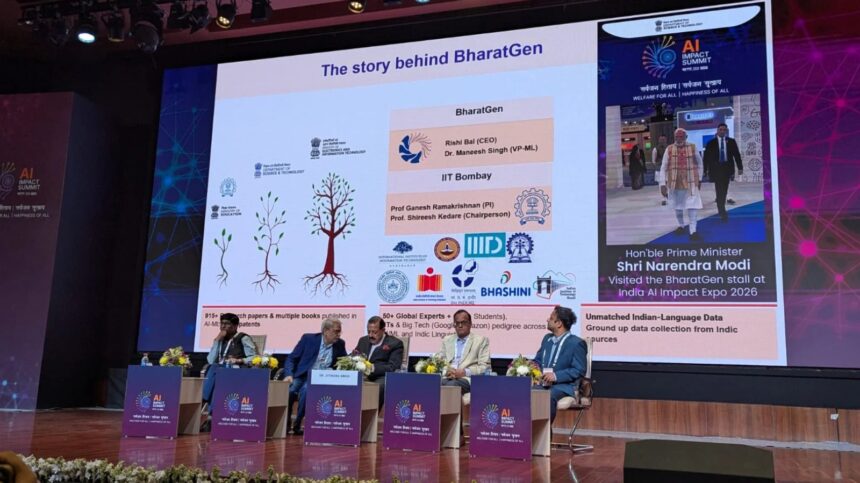
The central message from the India AI Impact Summit was less about the latest artificial intelligence models and more about how AI can reach people who are often left out of major technology shifts.
Discussions at the summit focused on a broader question: how can AI move beyond research laboratories, large corporations and wealthy markets to become useful in everyday settings such as agriculture, healthcare and education?
Speakers including Google’s James Manyika, Networks for Humanity co-founder Nandan Nilekani, World Bank Group’s Sangbu Kim, Biocon Group chairperson Kiran Mazumdar-Shaw and Wadhwani AI founder Sunil Wadhwani highlighted a common theme — AI’s impact will depend not only on technological progress but also on the infrastructure used to distribute it.
Open networks, digital public infrastructure (DPI), affordable AI inference and agent-based interfaces emerged as key components of that approach.
See more of our coverage in your search results.
Add INDYASTORY on GoogleGoogle Says AI Access Is Becoming a Distribution Challenge
James Manyika, President of Research, Labs, Technology and Society at Google and Alphabet, described AI as both a major opportunity and a challenge of making that opportunity broadly accessible.
“At Google, we believe that access to AI is essential for unlocking opportunities and expanding the innovation capacity for people everywhere,” Manyika said.
He pointed to Google’s AlphaFold system as an example of AI’s potential to influence scientific research beyond the technology sector. According to Manyika, the protein-structure prediction system is now used by more than 3 million researchers across over 190 countries.
India, he noted, is the fourth-largest user of the AlphaFold protein database, with applications ranging from research into neglected diseases to efforts related to crop resilience.
But widespread access to digital technology does not automatically guarantee equal access to AI.
See more of our coverage in your search results.
Add INDYASTORY on GoogleManyika warned that the existing digital divide must not evolve into an AI divide. In his view, digital public infrastructure and open networks can provide the underlying coordination layer needed to connect AI capabilities with real-world services and users.
Nandan Nilekani Highlights the Economics of AI Agents
Nandan Nilekani, Co-Founder and Patron of Networks for Humanity, focused on the question of how quickly AI can be deployed productively at population scale.
“If AI is a general-purpose technology, what is the fastest way of diffusing the use of AI in a productive way for people?” Nilekani asked, stressing that technology ultimately needs to improve people’s lives.
See more of our coverage in your search results.
Add INDYASTORY on GoogleHe drew on India’s experience with open networks in areas such as digital payments to argue that open architectures can allow multiple innovators to build services on top of common infrastructure.
AI agents could make those systems easier for ordinary users to navigate.
“The real power of agents is in removing complexity for the user,” Nilekani said.
For a farmer or a small electricity producer, for example, an AI agent could potentially allow transactions to take place in the user’s preferred language while handling the technical processes in the background.
That could make complex digital systems more accessible without requiring every user to understand how the underlying infrastructure works.
Lower AI Inference Costs Could Determine Adoption
Nilekani also highlighted another barrier to mass AI adoption: the cost of running AI models.
“The cost of AI inference has to drop dramatically,” he said.
Inference refers to the computational process required when an AI model generates an output after receiving an input. If every interaction carries a high cost, deploying AI to millions of people could become economically difficult, particularly in lower-income markets.
Nilekani’s argument is that inexpensive inference and agentic interfaces need to develop together.
Lower computing costs could make frequent AI interactions more affordable, while agents could hide much of the technical complexity from users.
Agriculture Shows How Open AI Infrastructure Could Work
Sangbu Kim, Vice President for Digital and AI at the World Bank Group, pointed to agriculture as an example of how this model can be applied in practice.
Discussing the AgriConnect initiative in Uttar Pradesh, Kim described it as a farmer-focused approach built around an open stack and open network.
The underlying idea represents a shift away from systems designed primarily around suppliers and towards infrastructure designed around the needs of users.
Open standards can play an important role in that transition by allowing different services and technologies to work together without forcing users into isolated technology ecosystems.
The World Bank is also examining similar approaches in healthcare and education across different countries.
Kim cited projects in Kenya and Nigeria as examples of AI being applied to development challenges. In Kenya, AI-powered mathematics tutoring has been used to accelerate learning outcomes, while in Nigeria, AI-enabled handheld ultrasound technology is being used in efforts aimed at improving maternal and infant healthcare.
The larger challenge, he suggested, is figuring out how successful applications can be standardised and adapted for use across multiple developing economies.
Healthcare Could Become a Major AI Test Case
Healthcare presents an even more complex opportunity because AI systems can potentially work with large amounts of clinical, demographic and biological information.
Kiran Mazumdar-Shaw, Chairperson of Biocon Group, argued that India has several of the ingredients needed to develop a large-scale digital health ecosystem.
India is generating substantial amounts of phenotypic, genomic, demographic and radiological data, alongside information about treatments and patient outcomes.
With appropriate consent mechanisms, security measures and data-sharing frameworks, such information could potentially support AI systems capable of identifying health risks across populations and helping develop more responsive insurance models.
Mazumdar-Shaw said the broader goal should be sustainable and scalable universal healthcare, with AI helping move healthcare systems towards greater emphasis on prediction and prevention.
She also argued that the relationship between biology and AI could extend beyond healthcare applications.
“Biology works through distributed data centres,” she said, noting that living systems process information with far lower energy requirements than conventional data centres.
In her view, the convergence of biological intelligence and artificial intelligence could become an important area of future technological development.
“The future is going to be about the convergence of biological intelligence and AI,” she said.
Digital Public Infrastructure Can Help AI Reach Millions
Sunil Wadhwani, Founder of Wadhwani AI, provided examples of how India’s digital public infrastructure can support AI deployment.
According to Wadhwani, DPI serves two major functions.
The first is providing access to data and the pipelines needed to work with that data. The second is providing distribution mechanisms that can help deliver AI-powered services once the models are developed.
One example comes from tuberculosis care.
Wadhwani AI used access to the government’s Nikshay patient-management system to develop AI applications aimed at identifying TB risk from cough sounds, automating certain laboratory workflows and predicting which patients may be at risk of discontinuing treatment.
Wadhwani said these applications have contributed to improved detection rates.
Education provides another example. The organisation developed a system capable of assessing children’s reading proficiency in their mother tongue within seconds and producing a personalised remediation plan.
Pilot programmes subsequently led to statewide mandates covering millions of students, according to Wadhwani.
The underlying point is that AI models alone are not enough. Without existing digital infrastructure to provide data and distribute services, deploying such systems at population scale could be significantly more expensive and slower.
Can India’s AI Infrastructure Become a Global South Blueprint?
The discussions at the summit converged around a common proposition: the success of AI should not be measured only by the size or sophistication of the models being developed.
Nilekani argued for rapid and broad diffusion of AI applications. Mazumdar-Shaw focused on using AI to build more predictive and preventive healthcare systems. Kim highlighted the need to identify scalable models that developing countries can adapt, while Wadhwani pointed to demand from governments across Africa and Asia for solutions developed in India.
Together, these perspectives suggest a different way of looking at India’s AI ambitions.
Instead of competing solely to build the world’s largest AI models, India could seek to demonstrate how open networks and digital public infrastructure can make AI services accessible at population scale.
If those systems can combine affordable computing, interoperable infrastructure, reliable data, appropriate safeguards and user-friendly AI agents, they could offer a model for countries facing similar development challenges.
The bigger experiment, therefore, is not simply whether AI can become more powerful. It is whether the infrastructure surrounding AI can make its benefits widely available across the Global South.