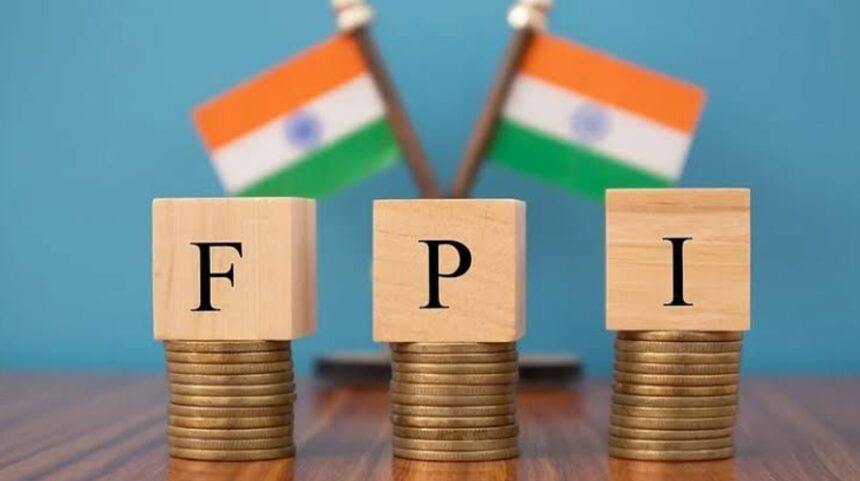
Foreign portfolio investors (FPIs) continued their return to Indian equities in August, recording a second consecutive month of net buying and investing Rs 30,919 crore in the domestic stock market.
The fresh inflow follows an estimated net investment of around Rs 20,200 crore in July, suggesting an improvement in foreign investor sentiment after a prolonged period of selling earlier in the year.
The two-month buying streak marks a significant shift in market behaviour. Between March and June, foreign investors had remained net sellers for four consecutive months, putting pressure on Indian equities and raising concerns about the outlook for overseas capital flows.
The August data now points to a gradual rebuilding of confidence in the Indian market, although foreign portfolio investors remain net sellers overall for 2026 so far.
See more of our coverage in your search results.
Add INDYASTORY on GoogleForeign investors turn buyers for the second straight month
FPIs invested a net Rs 30,919 crore in Indian equities during August, extending the buying momentum seen in July.
Foreign investors had invested around Rs 20,200 crore in the previous month, meaning the August inflow represented another step forward in the recovery of overseas investment interest.
For the stock market, sustained FPI buying is closely watched because foreign investors remain an important source of capital and can influence liquidity, market sentiment and the performance of major listed companies.
The return of net buying for two consecutive months does not necessarily signal the end of volatility, but it does indicate that global investors may be reassessing their earlier cautious approach towards Indian equities.
March saw massive foreign investor selling
The latest improvement in FPI flows is particularly notable when compared with the heavy selling seen earlier in the year.
See more of our coverage in your search results.
Add INDYASTORY on GoogleForeign portfolio investors were net sellers in the Indian stock market for four consecutive months between March and June.
March was especially significant, with foreign investors reportedly recording net sales of around Rs 1.17 lakh crore.
The sustained withdrawal of overseas capital during that period reflected a combination of domestic and global concerns, including changing expectations around interest rates, valuations, global asset allocation and market uncertainty.
See more of our coverage in your search results.
Add INDYASTORY on GoogleThe return of net inflows in July and August therefore represents an important reversal in the recent trend.
What is driving renewed FPI interest in India?
Several factors appear to be contributing to the improving outlook among foreign investors.
One of the factors cited is relative stability in the Indian rupee. Currency movements are an important consideration for foreign portfolio investors because returns can be affected not only by changes in stock prices but also by exchange-rate fluctuations when investments are converted back into foreign currencies.
Improvement in the earnings performance of Indian companies has also supported market sentiment.
Stronger or more resilient corporate results can improve the investment case for equities, particularly when investors are assessing whether market valuations are justified by earnings growth.
The June-quarter performance of domestic companies has helped ease concerns about the possibility of a major slowdown in the Indian economy.
As a result, investors appear to be taking a more constructive view of India’s growth prospects.
Global investment trends could benefit Indian markets
Changing global investment preferences are another factor that may support capital flows into India.
A significant share of global market attention in recent years has been focused on high-growth sectors such as artificial intelligence and semiconductors. If international investors begin shifting some capital away from heavily concentrated technology themes and towards other markets and sectors, India could potentially benefit from broader global diversification.
This does not mean that investment in technology-linked themes will disappear. Rather, portfolio managers may look to rebalance allocations across different regions and industries depending on valuations, growth expectations and risk.
India’s large domestic market, expanding corporate ecosystem and broad range of listed companies could make it an attractive destination when global investors seek exposure beyond a limited number of major technology sectors.
Expectations of US rate cuts support risk appetite
Expectations regarding future monetary policy in the United States are also an important factor for global capital markets.
The prospect of interest-rate cuts by the US Federal Reserve can influence investment flows into emerging markets, including India.
Lower US interest rates can, in some circumstances, reduce the relative attractiveness of fixed-income assets and encourage investors to consider equities and other risk assets.
However, FPI flows are influenced by many factors and are not determined by US interest rates alone. Currency movements, inflation, bond yields, geopolitical developments and domestic economic conditions can all affect how global investors allocate capital.
For India, the combination of expectations around the US Federal Reserve and improving domestic corporate performance has helped strengthen investor sentiment.
Indian economic growth remains in focus
Another reason for improving confidence is the perception that fears of a sharp economic slowdown have eased.
Corporate results for the June quarter have offered investors additional insight into the health of the domestic economy and business environment.
If companies continue to demonstrate earnings resilience, foreign investors may find greater comfort in India’s longer-term growth outlook.
However, market participants will continue to closely track future quarterly results, consumer demand, private investment, inflation and broader economic indicators.
Foreign investment can change direction quickly when global or domestic conditions shift, which means the recent inflows should be viewed as an improvement in sentiment rather than a guarantee of sustained buying.
Despite recent inflows, FPIs remain net sellers in 2026
The recent recovery in monthly investment figures does not erase the scale of the earlier outflows.
According to the figures cited in the report, foreign portfolio investors have withdrawn a net Rs 2.23 lakh crore from Indian equities so far in 2026.
That is higher than the approximately Rs 1.66 lakh crore cited for the entire year 2025.
The comparison highlights the magnitude of the selling pressure experienced earlier this year.
Even with July and August bringing substantial net inflows, foreign investor activity for the year remains negative on a cumulative basis.
This makes the coming months particularly important. Continued inflows could help narrow the gap created by earlier withdrawals, while a return to risk aversion could once again reverse the recent improvement.
Key risks that could influence FPI flows
The direction of foreign portfolio investment in the coming months will depend on a number of domestic and global developments.
Among the major factors investors are expected to monitor are:
- Developments in the Middle East: Geopolitical tensions can increase uncertainty across global financial markets.
- Crude oil prices: India is a major oil importer, making energy prices important for inflation, the trade balance and corporate costs.
- US bond yields: Higher yields can influence the attractiveness of US assets relative to emerging-market investments.
- Federal Reserve decisions: Interest-rate policy in the United States remains a major influence on global liquidity and capital flows.
- India’s GDP growth: Economic expansion will remain an important indicator of the outlook for corporate earnings.
- Inflation data: Persistent or rising inflation could influence interest-rate expectations and consumer demand.
- Currency movements: The stability of the rupee remains important for foreign investors calculating overall returns.
These factors could determine whether the current recovery in FPI confidence develops into a longer period of sustained investment.
What the August inflow means for the Indian market
The Rs 30,919 crore net investment in August is a positive development for the Indian equity market, particularly because it follows another month of significant foreign buying.
The trend suggests that global investors are beginning to reassess India after the heavy selling seen earlier in 2026.
At the same time, the broader picture remains mixed.
FPIs have still withdrawn a substantial net amount from Indian equities during the year, showing that investor confidence has not fully recovered from the pressures that led to earlier outflows.
The recent inflows are therefore best viewed as an improvement in sentiment rather than a definitive shift in the long-term investment cycle.
For Indian markets, the next few months will provide a clearer indication of whether foreign investors are returning in a sustained manner.
If domestic corporate earnings remain resilient, the rupee remains relatively stable and global financial conditions become more favourable, India could continue to attract overseas capital.
But developments in crude oil markets, geopolitics, US monetary policy and global bond yields could still alter the direction of capital flows.
For now, August has provided the Indian stock market with an important positive signal: foreign investors have been net buyers for a second consecutive month, with Rs 30,919 crore flowing into equities.
After four months of sustained selling earlier in the year, the latest trend suggests that FPI confidence in the Indian market may be gradually rebuilding — although the durability of that recovery will depend on both domestic economic performance and global market conditions.