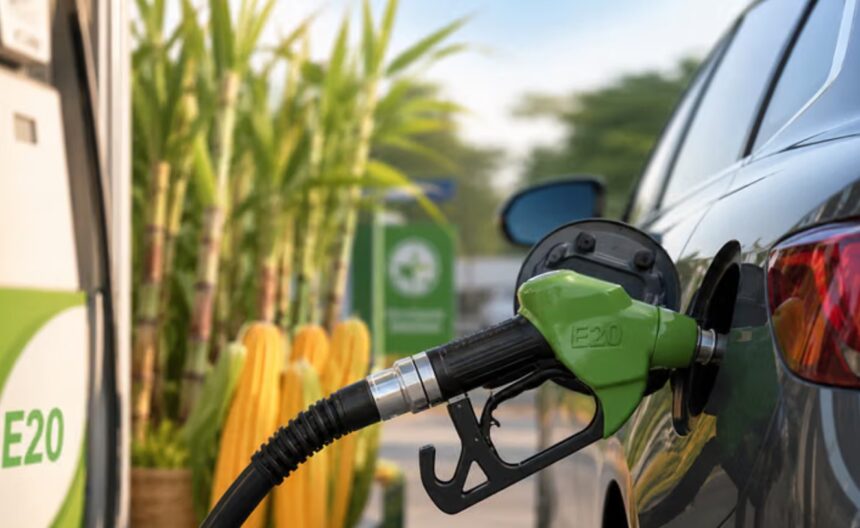
A new citizen-driven campaign calling itself the E20 Janta Party has entered India’s fuel policy debate, urging the government to give motorists the option of purchasing 100% petrol alongside E20 ethanol-blended fuel.
The campaign says its demand is centered on consumer choice rather than opposition to ethanol blending, arguing that motorists should be free to decide which fuel best suits their vehicles after having access to transparent information about performance, efficiency and long-term ownership costs.
The issue has quickly attracted attention from transport associations, automotive enthusiasts and sections of the political spectrum, making fuel choice one of the country’s emerging public policy discussions.
What Is the E20 Janta Party Demanding?
According to the campaign’s public statement, its primary demand is straightforward: fuel stations should offer 100% petrol as an alternative to E20, allowing consumers to make informed purchasing decisions.
See more of our coverage in your search results.
Add INDYASTORY on GoogleThe campaign is also seeking:
- Availability of 100% petrol alongside E20 fuel.
- Clear fuel labelling at every retail outlet.
- Public disclosure of cost-benefit data for ethanol-blended fuels.
- Independent scientific studies on mileage, emissions, engine durability and maintenance costs.
- Publication of research findings in a transparent and accessible manner.
The group says it is not seeking the withdrawal of E20 and is not asking for financial subsidies, but instead wants greater transparency and market choice.
“Consumers should have the freedom to choose the fuel that best suits their vehicle,” the campaign said in its public communication.
Why the Issue Is Receiving Attention
India’s ethanol blending programme has expanded rapidly over the past few years as part of broader efforts to reduce dependence on imported crude oil, improve energy security and support domestic ethanol production.
While many newer vehicles are designed or certified for E20 compatibility, some motorists and transport operators continue to raise questions regarding:
- Fuel efficiency
- Long-term engine wear
- Maintenance expenses
- Suitability for older vehicles
- Real-world operating costs
Automobile manufacturers generally recommend following vehicle-specific fuel compatibility guidelines, while government agencies maintain that E20 has undergone scientific evaluation.
See more of our coverage in your search results.
Add INDYASTORY on GooglePlanned Vehicle Protests Add Momentum
The discussion is no longer confined to online platforms.
Political commentator Tehseen Poonawalla has announced a proposed “Gaadi March” on July 31, highlighting concerns surrounding the E20 policy.
Separately, the Delhi Taxi and Tourist Transporters and Tour Operators Association has announced plans for a march to Parliament on August 4, requesting an independent scientific review of the ethanol blending programme.
See more of our coverage in your search results.
Add INDYASTORY on GoogleThe association says commercial vehicle operators are seeking additional clarity regarding:
- Fuel economy
- Maintenance costs
- Engine performance
- Impact on high-mileage vehicles
Industry observers note that commercial transport operators often pay close attention to even small differences in operating costs because of the large distances their vehicles cover annually.
Government Maintains Support for E20
The Union government has consistently defended the E20 programme, describing ethanol blending as an important component of India’s clean energy transition.
In responses placed before Parliament, the Centre has stated that:
- There are currently no plans to restore ethanol-free petrol nationwide.
- E20 has undergone scientific evaluation.
- No verified evidence has established widespread engine damage directly caused by E20.
- There is presently no proposal to increase mandatory blending beyond 20%.
Government agencies have also highlighted potential long-term benefits associated with ethanol blending, including lower fossil fuel dependence and support for domestic agricultural supply chains.
Political Debate Continues
The issue has also begun attracting political attention.
Shiv Sena (UBT) chief Uddhav Thackeray recently indicated that fuel policy could become one of the issues his party intends to raise following earlier public protests over unrelated national matters.
Political analysts say consumer fuel policy has increasingly become an area where economic concerns intersect with public interest discussions.
Consumer Choice Becomes the Central Theme
Unlike campaigns seeking the withdrawal of ethanol-blended fuel, the E20 Janta Party says its focus is on expanding options rather than limiting them.
Supporters argue that consumers should be able to compare different fuel choices based on transparent information, while critics of restoring 100% petrol point to India’s long-term energy diversification strategy and investments in ethanol infrastructure.
As the debate evolves, experts say future discussions are likely to focus on scientific evidence, vehicle compatibility, consumer awareness and the practical implications for fuel retailers.
What Happens Next?
The coming weeks could prove significant as planned vehicle marches, industry responses and public discussions continue.
Whether the campaign develops into a larger nationwide movement remains uncertain. However, it has already broadened India’s conversation on ethanol blending by placing consumer choice and transparency at the center of the debate.
Any future policy changes would ultimately depend on government decisions, scientific evidence, industry consultation and regulatory review.