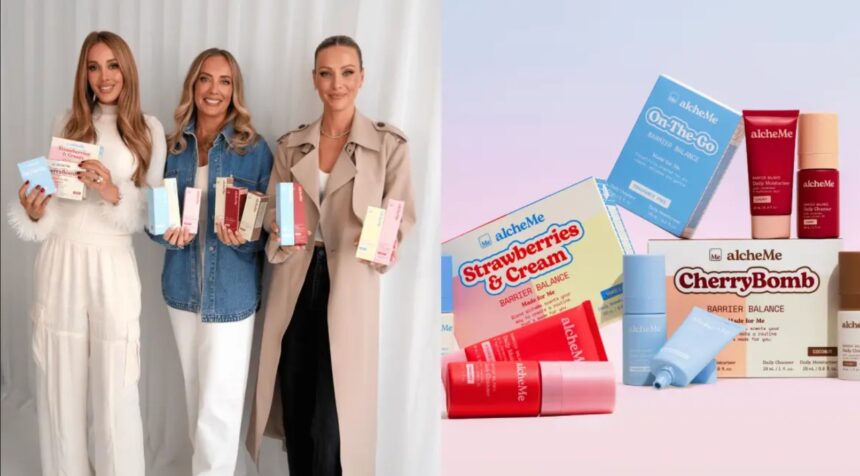
Australian media personality and entrepreneur Rebecca Judd has taken a sweat-equity stake in Australian tween and teen skincare brand AlcheMe, joining the business as a co-owner and strategic advisor as the company prepares for international expansion.
Founded by Australian mothers Jacqui Dixon and Jess Johnson, AlcheMe was created to address what the founders saw as a growing gap in the beauty market: skincare products specifically designed for younger consumers.
The company targets tweens and teenagers between the ages of 9 and 17, with a product range focused on gentle, barrier-supporting skincare. Judd’s involvement comes as the young brand looks to strengthen its presence in Australia and take its first steps into the US market.
Rebecca Judd Takes a Sweat-Equity Stake in AlcheMe
According to co-founder Jacqui Dixon, Judd’s ownership stake is structured as sweat equity, meaning her involvement is linked to the work, expertise and time she contributes to the business rather than functioning as a traditional paid endorsement arrangement.
See more of our coverage in your search results.
Add INDYASTORY on GoogleDixon said Judd will work with the company on several strategic areas, including brand direction, retail strategy, marketing and growth.
“Her stake reflects the work, expertise and time she’s putting into the business,” Dixon said, explaining that Judd will contribute directly to important business decisions.
Judd’s responsibilities are expected to include:
- Brand strategy
- Content collaboration
- Retail relationships
- Marketing support
- Growth planning
- Strategic expansion into new markets
The arrangement marks a deeper commercial relationship than a conventional celebrity partnership. Rather than simply appearing in promotional campaigns, Judd is becoming part of the ownership structure of the business.
Why Rebecca Judd Said Yes to AlcheMe
Judd said her involvement with AlcheMe developed naturally because of her long-standing friendship with Dixon.
See more of our coverage in your search results.
Add INDYASTORY on GoogleShe explained that she had watched the idea take shape from its early stages, before the company had become an established consumer brand.
“When it turned into something real, being asked to come on as a co-owner didn’t feel like a brand deal; it felt like the next step in a conversation we’d already been having,” Judd said.
As a mother of four, including a tween daughter, Judd said she understood the consumer problem the founders were trying to solve.
See more of our coverage in your search results.
Add INDYASTORY on Google“I have a tween daughter myself, so I know exactly the problem they’re solving and that’s what made it a very easy yes,” she said.
Her involvement could potentially give AlcheMe greater visibility as the company seeks to expand its reach among parents and younger consumers.
A Brand Built Specifically for Tween and Teen Skin
AlcheMe was founded by Dixon and Johnson after the pair experienced difficulty finding age-appropriate skincare options for their own children.
The founders identified what they viewed as a growing disconnect between the popularity of skincare among young people and the availability of products specifically designed for younger skin.
The beauty industry has seen increased interest in skincare among tweens and teenagers, driven in part by social media, beauty trends and exposure to adult-focused products.
However, the founders argue that young consumers do not necessarily need complex multi-step skincare routines or products designed for adult concerns.
Johnson said the issue is not where young people buy skincare but whether the products they select are appropriate for their age and skin needs.
“The issue is what’s ending up in the basket,” she said.
The founders have emphasised that AlcheMe was designed around a simpler approach to skincare.
Why AlcheMe Is Starting With a Two-Step Routine
Rather than launching with an extensive catalogue of serums, treatments and active ingredients, AlcheMe began with two fundamental skincare categories: cleansers and moisturisers.
Dixon said the company intentionally chose a simple routine.
“We deliberately started with just cleansers and moisturisers – a simple, two-step routine – because we wanted to get that right before we did anything else,” she said.
The strategy reflects a broader business decision as well as the brand’s positioning.
Instead of attempting to enter every beauty category immediately, the founders are focusing on building a clear identity around simple, age-appropriate skincare.
The company plans to consider expanding its product range over time but says it does not want to rush the process.
“We’ve got loads of ideas for where the range goes next, but we’re not trying to launch everything at once,” Dixon said.
AlcheMe’s Product Range and Formulation Approach
AlcheMe’s products are made in Australia and dermatologically tested, according to the company.
The range focuses on:
- Gentle formulations
- pH-balanced skincare
- Barrier-supporting products
- Sensitive and breakout-prone skin
- Simple daily skincare routines
The product lineup includes cleansers, moisturisers and skincare bundles.
Consumers can choose from several fragrance options, including:
- Fragrance-free
- Vanilla
- Coconut
- Strawberry
- Cherry
The company says the products are intended to help young people establish straightforward skincare habits without introducing unnecessarily complicated routines.
The brand’s positioning sits between the growing beauty interests of younger consumers and parents’ desire for products designed specifically for their children’s age group.
The Growing Debate Around Tween Skincare
The rise of tween skincare has become an increasingly visible topic within the beauty industry.
Social media platforms have introduced younger audiences to skincare trends traditionally associated with adults. Products designed to address concerns such as fine lines, ageing and advanced skin treatments have become highly visible online.
Johnson stressed that AlcheMe is not criticising major beauty retailers such as Mecca and Sephora.
Instead, she said the founders are focused on the products young consumers ultimately choose.
“A 10- or 12-year-old’s skin barrier is still developing; it doesn’t need the same ingredients as an adult’s,” Dixon said.
“That’s really the whole reason AlcheMe exists: so tweens have something in their routine that was actually formulated for their skin, not borrowed from the adult aisle.”
This approach forms the core of AlcheMe’s brand identity.
The company is positioning itself as a specialised option for a generation of younger consumers who are increasingly interested in beauty and skincare but may not require adult-oriented product routines.
Strawberries & Cream Bundle Emerges as a Bestseller
The company’s Strawberries & Cream Bundle has emerged as its bestselling offering, according to the founders.
Dixon said the popularity of the bundle has revealed something about how customers interact with the brand.
Rather than purchasing a single item, many customers are choosing to build a simple routine from the beginning.
That purchasing behaviour aligns with AlcheMe’s two-step approach.
The company is using bundles to make the process of selecting a cleanser and moisturiser more straightforward for young consumers and parents.
AlcheMe Prepares for US Expansion
AlcheMe is now preparing for its next stage of growth.
The company has confirmed plans to begin expanding into the United States, with Dixon describing the move as imminent.
“We’re taking our first steps into the US,” she said.
The next two years will be focused on scaling the brand, expanding its market presence and exploring new retail opportunities.
Judd’s involvement is expected to be particularly relevant as AlcheMe begins conversations with potential retail partners.
The founders want the business to move beyond being exclusively a direct-to-consumer, or DTC, brand.
“We’re starting to have retail conversations, so AlcheMe isn’t just a DTC brand, it’s on the shelf where parents are already shopping,” Dixon said.
Celebrity Partnerships Are Evolving Into Ownership Stakes
Judd’s decision to join AlcheMe as a co-owner also reflects a wider shift in how public figures work with emerging consumer brands.
Traditional celebrity endorsements generally involve a public figure being paid to promote a product or appear in advertising campaigns.
Equity partnerships create a different relationship.
A person who holds an ownership stake has a direct financial interest in the long-term growth of the company.
For startups, these arrangements can provide access to brand-building experience, industry relationships, marketing expertise and audience reach.
For the public figure, equity can offer participation in the potential long-term value created by the company.
In AlcheMe’s case, Dixon said Judd’s role will involve direct strategic input rather than simply promotional activity.
What Comes Next for AlcheMe?
The founders have outlined several priorities for the company’s next phase.
These include:
- Expanding into the US
- Exploring retail partnerships
- Growing the product range
- Entering additional markets
- Maintaining the brand’s focus on age-specific skincare
Johnson said the company intends to remain focused on the principles that shaped AlcheMe from the beginning.
The goal is to provide products developed for the specific needs of tweens and teenagers while allowing consumers to choose routines that work for them.
As the beauty industry continues to pay greater attention to younger consumers, specialised brands are likely to face both opportunities and scrutiny.
For AlcheMe, the challenge will be to grow internationally while maintaining the simplicity and age-focused approach that helped define its early identity.
With Rebecca Judd now joining as a co-owner and strategic advisor, the Australian startup is preparing to take its first major steps beyond its domestic market.
The next chapter for AlcheMe will focus on whether its specialised approach to tween and teen skincare can translate into a larger international consumer brand.