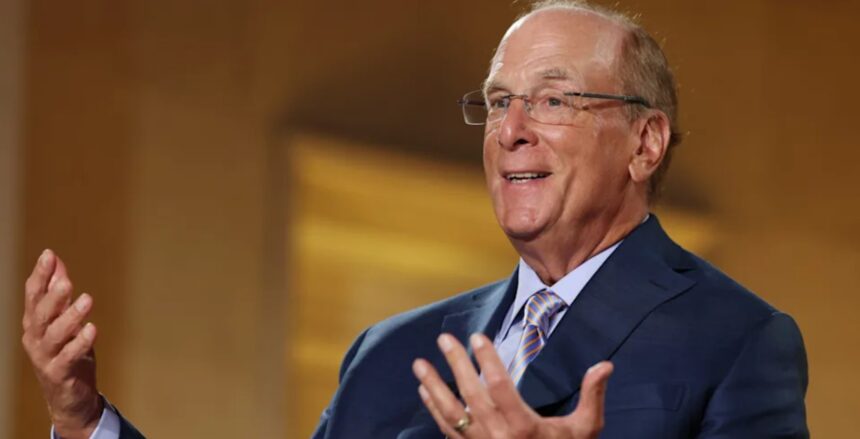
BlackRock CEO Larry Fink says Americans need greater exposure to investments if they are to participate in the wealth created by artificial intelligence, but his warning does not mean households should abandon emergency savings or cash altogether.
BlackRock Chairman and CEO Larry Fink has delivered a blunt message to Americans who keep most of their money in bank accounts: holding too much cash for too long could mean missing out on the economic growth generated by investments.
Speaking at the Milken Institute Global Conference in May 2026, Fink argued that keeping money in a bank account can be “one of the worst financial decisions of a lifetime.”
His broader argument was not simply about savings accounts. Fink was discussing a much larger economic question: who will own the assets that benefit from the enormous investment being made in artificial intelligence?
See more of our coverage in your search results.
Add INDYASTORY on GoogleAs AI changes productivity, corporate profits and the value of businesses, Fink believes people who rely primarily on wages could find themselves increasingly separated from those who own financial assets.
That makes his comments particularly relevant at a time when households are trying to balance financial security, inflation, market volatility and the potential for long-term wealth creation.
But there is an important distinction that can easily get lost in the headline.
Fink is not saying Americans should empty their bank accounts and put their emergency money into stocks.
Cash has a legitimate role in a household financial plan. The real issue is whether money intended for long-term wealth building is sitting in cash indefinitely when it could potentially be invested.
See more of our coverage in your search results.
Add INDYASTORY on GoogleFink’s Bigger Warning Is About Ownership
The BlackRock CEO’s argument goes beyond the traditional debate over savings-account interest rates.
Fink has repeatedly warned that artificial intelligence could reshape the relationship between labor and capital.
At the Milken conference, he argued that wages alone may not capture the full economic value created by AI.
See more of our coverage in your search results.
Add INDYASTORY on Google“We are not going to be able to broaden economic success only by wages because wages in this AI world are not going to grow as fast as the potential of the AI growth and the capital that is going to be invested,” Fink said.
The implication is significant.
If companies invest heavily in AI infrastructure, software, computing capacity and automation, shareholders may benefit from increases in corporate earnings and asset values.
Workers may benefit through new opportunities and productivity gains, but the distribution of that economic growth could be uneven.
Fink’s solution is broader participation in capital markets.
In simple terms, he wants more ordinary households to own a stake in the businesses and assets generating economic growth.
Why Cash Still Matters
The headline surrounding Fink’s comments can make the argument sound more extreme than it actually is.
A bank account serves a fundamentally different purpose from an investment portfolio.
Money needed for rent, food, medical expenses, insurance payments and other short-term obligations generally needs to remain accessible.
The same is true of an emergency fund.
If an investor puts every available dollar into stocks and the market falls just when an unexpected expense appears, the investor may be forced to sell assets at an unfavorable time.
That is one reason financial planning generally separates short-term liquidity from long-term investment capital.
A checking or savings account can provide stability and accessibility.
Investments, meanwhile, are designed for longer time horizons and carry the possibility of losing value.
The question is therefore not simply whether cash is “good” or “bad.”
The more useful question is:
How much money needs to remain liquid, and how much can reasonably be invested for the future?
Inflation Can Make Idle Cash Less Valuable Over Time
Fink’s warning also touches on a familiar problem for savers: inflation.
Cash held in a bank account does not necessarily maintain its purchasing power indefinitely.
If prices rise faster than the interest earned on savings, the real value of the money declines even though the account balance itself may increase.
Consider a simplified example.
Suppose someone has $50,000 in an account earning 2% annually while inflation averages 3%.
The account balance would grow in nominal terms, but its purchasing power would still decline.
That does not make the savings account a bad financial tool. The account may provide security, liquidity and protection against having to sell investments during a market downturn.
It simply demonstrates why long-term wealth planning generally requires consideration of real returns, not just the dollar amount shown on an account statement.
Investing Can Provide Exposure to Economic Growth
The alternative Fink is advocating is participation in capital markets.
Stocks are the most obvious example.
When an investor owns shares of a company, that investor owns a small claim on the business. If the company becomes more valuable and distributes profits or reinvests successfully, shareholders may benefit.
But stocks also carry substantial risk.
Share prices can fall sharply. Individual companies can fail. Even broad markets can experience prolonged periods of weakness.
For that reason, long-term investors often use diversified investments rather than attempting to identify a handful of winning companies.
Broad-market index funds and exchange-traded funds can provide exposure to many companies through a single investment.
Diversification does not eliminate investment risk, but it can reduce the danger associated with relying on the performance of one company or one narrow sector.
Bonds Offer a Different Risk Profile
Stocks are not the only way to participate in capital markets.
Bonds can provide another source of investment exposure.
Governments, corporations and other entities issue bonds to borrow money from investors. In return, investors generally receive interest payments and the repayment of principal according to the terms of the bond.
Government bonds, particularly U.S. Treasury securities, are often considered less risky than shares of individual companies, although they are not completely free of risk.
Interest-rate movements can affect the market value of bonds before maturity, while inflation can reduce the purchasing power of future payments.
Longer-term bonds can also experience larger price movements when interest rates change.
This is why choosing between cash, bonds and stocks is not simply a matter of selecting whichever asset has the highest potential return.
The appropriate mix depends heavily on an investor’s time horizon, financial circumstances and tolerance for losses.
Real Estate Is Another Form of Asset Ownership
Real estate represents another way households can participate in asset ownership.
Some investors purchase physical property and generate returns through rent and potential appreciation.
Others use publicly traded real estate investment trusts, commonly known as REITs, to gain exposure to property-related businesses without purchasing an entire building.
Real estate, however, is not automatically a safe alternative to cash.
Property values can decline. Rental income can fall. Maintenance, insurance, taxes and financing costs can reduce returns.
Physical property is also considerably less liquid than money held in a bank account.
Again, the central issue is diversification and purpose rather than choosing one asset class as universally superior.
The AI Boom Could Make Fink’s Argument More Important
The artificial-intelligence investment cycle gives Fink’s comments a broader economic context.
Companies across technology and other industries are spending heavily on computing infrastructure, data centers, chips, software and AI-related systems.
If those investments produce substantial productivity improvements, the economic value created could be enormous.
But the ownership question remains.
If the financial benefits primarily accrue to companies and their shareholders, households without meaningful investment exposure could participate less directly in that wealth creation.
This is the concern behind Fink’s argument that wages alone may not be enough to broaden economic prosperity.
The issue is not necessarily that wages will stop growing.
Rather, capital income could become increasingly important if technological progress generates large increases in corporate productivity and asset values.
Fink’s Message Comes With an Important Conflict of Interest
There is another perspective investors should consider.
Fink is the CEO of BlackRock, one of the world’s largest asset managers.
BlackRock’s business is built around managing money and providing investment products and services.
That does not make Fink’s economic argument incorrect. But it does mean readers should distinguish between an economic observation and a recommendation from someone whose company operates directly within the investment industry.
Investors should evaluate financial decisions independently and consider their own circumstances rather than treating comments from any asset manager, economist, celebrity investor or financial personality as individualized advice.
The same principle applies to Fink’s warning about bank accounts.
His statement should be understood as a broader argument about long-term capital ownership, not as a universal instruction to move savings into investments.
What Americans Should Take From the Warning
The most useful interpretation of Fink’s comments is relatively simple.
Money has different jobs.
Some money needs to be available immediately.
Some money may be needed within the next few years.
Other money can potentially remain invested for decades.
Treating all three categories identically can create problems.
Emergency cash provides financial resilience.
Longer-term investments can provide the potential for capital growth.
A household that has no emergency savings may be vulnerable to unexpected expenses. A household that keeps all of its long-term wealth in cash may face a different problem: inflation and the opportunity cost of not participating in asset growth.
The objective is therefore not to eliminate cash.
It is to avoid confusing liquidity with long-term wealth creation.
Why Diversification Matters More Than Chasing the Next AI Winner
Fink’s comments come during an unusually intense period of interest in artificial intelligence.
That creates another potential danger for investors.
Hearing that AI could transform the economy does not mean every AI-related company will become a successful investment.
Some businesses will benefit from the technology.
Others may struggle to compete.
Some valuations may eventually prove too optimistic.
Investors who respond to the AI boom by concentrating their entire portfolio in a handful of technology companies could take substantially more risk than they realize.
A diversified strategy can provide exposure to economic growth without requiring an investor to correctly predict which individual company will dominate the next decade.
The Long-Term Lesson: Don’t Let Fear Make Every Financial Decision
Fink’s comments highlight a genuine financial tension.
People naturally value certainty.
A bank balance is easy to understand. A stock portfolio can rise and fall every day.
That difference can encourage investors to hold more cash than they actually need.
But the opposite extreme can also be dangerous.
Putting money needed for an emergency into volatile assets can create unnecessary financial risk.
The better approach is to match the financial instrument to the purpose of the money.
Cash can provide liquidity.
Bonds can provide income and diversification.
Stocks can provide long-term growth potential.
Real estate can provide another form of asset exposure.
None is universally superior.
What Fink’s AI Warning Really Means
Larry Fink’s strongest point is not that bank accounts are inherently bad.
It is that ownership may become increasingly important in an economy transformed by artificial intelligence.
If AI significantly increases productivity and corporate profitability, investors who own productive assets could participate in that growth.
People who hold excessive amounts of cash for decades may not receive the same benefit.
But that argument has to be balanced against the fundamental role of cash in personal finance.
A household should not sacrifice financial stability simply to chase higher returns.
The sensible distinction is between money that needs to be protected and money that has time to grow.
For long-term investors, Fink’s warning is therefore worth considering — not as a command to abandon savings accounts, but as a reminder that financial security and wealth creation are two different objectives.
The first may require accessible cash.
The second generally requires accepting some degree of investment risk.
The CapTop Take
Fink’s warning arrives at a moment when AI is forcing investors to reconsider how wealth may be created and distributed.
The biggest question may not be whether people should keep money in banks or invest it.
It may be whether households have a financial strategy that separates emergency liquidity from long-term capital.
That distinction allows people to protect the money they may need tomorrow while potentially putting appropriate long-term capital to work.
As AI investment accelerates, the debate over who owns the assets behind that growth is likely to become even more important.