IndyaStory
Sign In
  • Latest
  • Business
  • Entrepreneurs
  • Finance
  • Markets
  • Economy
  • Leadership
  • Funding
  • Companies
  • AI
  • News
  • IPO
  • Innovation
  • Startup
  • Technology
IndyaStoryIndyaStory
  • Latest
  • Business
  • Entrepreneurs
  • Finance
  • Markets
  • Economy
  • Leadership
  • Funding
  • Companies
  • AI
  • News
  • IPO
  • Innovation
  • Startup
  • Technology
Search
Have an existing account? Sign In
Follow US
Copyright © 2026 IndyaStory. All rights reserved.
Stock Market

FPIs Withdraw ₹48,056 Crore From Indian Equities in October So Far

IndyaStory Staff
Last updated: October 25, 2026 10:56 pm
By
IndyaStory Staff
ByIndyaStory Staff
IndyaStory Staff is the editorial team at IndyaStory, an independent digital news platform covering Indian business, stock markets, IPOs, personal finance, banking, technology, and economic developments....
Follow:
Share
6 Min Read
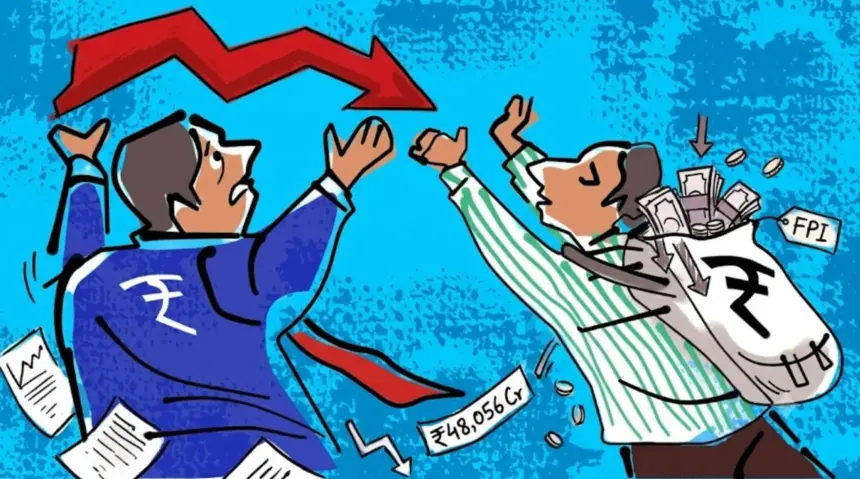
Illustration of investment flows leaving Indian equities beside a stock-market chart
SHARE

Foreign selling eased during the week ended October 23, but oil prices, earnings expectations and global interest rates remain important risks.

Contents
October selling follows a reversal after summer inflowsOil and earnings concerns weigh on sentimentWhy a positive daily flow can conceal stock-market sellingDomestic buying offers support, with limitsWhat would indicate a more durable improvement?

Foreign portfolio investors have withdrawn a net ₹48,056 crore from Indian equities in October so far, extending September’s selling as investors assess energy costs, geopolitical uncertainty and the outlook for corporate profits.

CDSL’s calendar-year investment data shows October equity outflows of approximately ₹48,056 crore, compared with September withdrawals of ₹35,861 crore. October is still underway, so the latest figure should not be treated as its closing total.

There were tentative signs of improvement during the week ended October 23. FPIs were net buyers on two trading days, according to PTI reporting. However, a brief change in daily flows does not establish a sustained return of foreign investment.

- Advertisement -

See more of our coverage in your search results.

Add INDYASTORY on Google

October selling follows a reversal after summer inflows

The latest withdrawals contrast with foreign buying earlier in the year.

PeriodReported net equity flow
July 2026₹20,200 crore inflow
August 2026₹29,631 crore inflow
September 2026₹35,861 crore outflow
October 2026 so far₹48,056 crore outflow

Source: PTI reporting citing CDSL investment data. October is a partial-month figure.

Using these rounded figures, September and October together account for approximately ₹83,917 crore in net withdrawals. That exceeds the combined ₹49,831 crore invested during July and August.

The comparison illustrates the scale of the recent reversal. It does not show whether the same investors bought and sold, or explain their individual portfolio decisions.

Oil and earnings concerns weigh on sentiment

Analysts quoted in published reporting linked the selling to expensive crude, West Asia tensions, inflation concerns and uncertainty around company earnings. Higher US interest rates also remain part of the competition for global capital.

- Advertisement -

See more of our coverage in your search results.

Add INDYASTORY on Google

For Indian businesses, persistently higher energy costs can affect transport, production and imported inputs. The eventual effect on profits depends on a company’s contracts, hedging, pricing power and ability to improve efficiency.

That distinction matters during earnings season. A business may report healthy results for the previous quarter while facing a more difficult cost environment ahead. Investors therefore need to examine management commentary and operating margins alongside headline profit growth.

Foreign portfolio flows also reflect decisions outside India. A global fund can reduce Indian exposure because of redemptions, currency management or changes in allocations across countries, even when its assessment of an individual Indian company remains favourable.

- Advertisement -

See more of our coverage in your search results.

Add INDYASTORY on Google

Why a positive daily flow can conceal stock-market selling

CDSL’s report dated October 23 provides a useful example of why the composition of foreign flows matters.

It records net equity selling of ₹2,262.17 crore through the stock-exchange route. However, ₹2,417.14 crore of net investment through “primary market and others” brought the overall equity subtotal to a positive ₹154.97 crore.

Equity investment routeNet flow in CDSL’s October 23 report
Stock exchange−₹2,262.17 crore
Primary market and others+₹2,417.14 crore
Combined equity subtotal+₹154.97 crore

The date is the reporting date; CDSL says custodian submissions can cover trades conducted up to previous trading days.

The positive total therefore did not mean foreign investors were net buyers of existing shares on the exchange.

Nor should the entire “primary market and others” amount be described as IPO investment. That category covers several transaction types, including preferential allotments and rights issues.

For readers following daily market headlines, this is an important distinction: an improvement in aggregate equity flows can coexist with continued secondary-market selling.

Domestic buying offers support, with limits

Domestic institutional investment and continuing systematic investment plan contributions have helped absorb foreign selling, according to analysts cited in PTI reporting.

However, SIP contributions and daily institutional share purchases measure different activities. Money entering a mutual fund is not necessarily invested immediately or entirely in equities.

Domestic participation can provide an additional source of demand, but it does not guarantee market stability. Prices still depend on earnings, valuations, liquidity and the willingness of investors to hold risk.

What would indicate a more durable improvement?

A stronger case for stabilisation would require more than isolated buying sessions. Useful indicators include:

  • Sustained flows: whether net buying continues across several reporting periods.
  • Exchange participation: whether improvement extends to secondary-market purchases.
  • Currency conditions: whether rupee volatility eases for investors measuring returns in foreign currencies.
  • Energy costs: whether crude prices relieve or intensify pressure on business margins.
  • Earnings delivery: whether companies support profit growth with operating performance and cash generation.

US monetary policy, bond yields and geopolitical developments will remain relevant to those assessments.

For now, the evidence points to substantial October outflows alongside a limited easing in recent selling. The composition and persistence of future buying will be more informative than any single positive daily total.

This article provides market news and explanatory analysis, not a recommendation to buy or sell securities. Figures are rounded unless otherwise stated and reflect information available on October 25, 2026.


TAGGED:CDSLCrude OilForeign InvestorsFPI FlowsIndian EquitiesStock Market
Share This Article
Email Copy Link Print
ByIndyaStory Staff
Follow:
IndyaStory Staff is the editorial team at IndyaStory, an independent digital news platform covering Indian business, stock markets, IPOs, personal finance, banking, technology, and economic developments. Our team focuses on delivering timely news, clear explanations, and informative analysis to help readers understand important developments affecting businesses, markets, and everyday financial decisions. IndyaStory Staff articles aim to present complex financial and business topics in accessible English, with an emphasis on factual accuracy, relevant context, and reader value.
Previous Article Illustration of a stock-market screen, oil pump and Federal Reserve building Indian Stock Market Outlook: Fed Decision, Earnings and Oil in Focus
Next Article Illustration of Indian government bonds, a rupee symbol and oil barrels Indian Bonds Extend 10-Week Slide as Oil and Global Yields Weigh
Leave a Comment Leave a Comment

Leave a Reply Cancel reply

Your email address will not be published. Required fields are marked *

Most Read
Audi A2 Electric Hatchback 2026 Preview

Audi Brings Back A2 as Electric Hatchback – Entry-Level EV Coming Soon

Renault Duster 2026 SUV Exterior and Interior India

Renault Duster 2026 Review: Can It Live Up to Its Legacy?

Lexus ES 500e 2026 Electric Sedan Exterior Interior India

2026 Lexus ES 500e EV: First Look at Lexus’ All-Electric Luxury Sedan

IndiQube Co-founder Meghna Agarwal discussing the company's expansion strategy

IndiQube Co-Founder Meghna Agarwal Explains How IPO Funds, Technology and Green Offices Are Driving Growth

BYD Seal U plug-in hybrid SUV featuring DM-i technology and premium SUV styling

BYD Seal U PHEV Confirmed for India: New Hybrid SUV to Bring Over 1,200km Driving Range

2026 Tata Tiago EV electric hatchback with updated styling and modern EV design

2026 Tata Tiago EV Review: The Urban Electric Hatchback Gets Better

Upcoming Nissan Tekton SUV expected to launch in India in 2026

Nissan Tekton SUV Launch Date Revealed: Creta and Tata Sierra Rival to Arrive in India Soon

Upcoming Mahindra Vision S-based compact SUV with rugged SUV styling

Mahindra Vision S-Based Compact SUV Expected to Launch in 2027 With Competitive Pricing

Maruti Suzuki Victoris hybrid SUV parked on road

Maruti Suzuki Victoris Hybrid EMI Details: Monthly Installment After ₹3 Lakh Down Payment

2026 Audi Q7 luxury SUV with redesigned front fascia, split LED headlights and large grille

2026 Audi Q7 Unveiled: New Platform, Premium Interior and New Seating Options

Related News
Illustration of Indian stock market indices declining as GIFT Nifty signals a weak opening for Sensex and Nifty
Stock Market

GIFT Nifty Falls 185 Points, Signals Weak Sensex and Nifty Opening as Nasdaq, Asian Markets Plunge

Illustration of the Nifty 50 rising above 24,500 with 25,000 marked as the next potential market target
Stock Market

Nifty Surges Past 24,500: Can the Index Reach 25,000? Analysts Identify Key Resistance Levels

NSE International Exchange Introduces 23.5-Hour Trading
Stock Market

NSE International Exchange Extends Trading to 23.5 Hours: New NSEIX Timings, Start Date and Key Details

Financial illustration explaining Choice International's proposed 1:1 bonus share issue
Stock Market

Choice International Announces 1:1 Bonus Share Issue; Record Date Awaited as Q2 Profit Rises 18%

Illustration of wind turbines and Suzlon Energy stock analysis highlighting Religare Broking's ₹57 price target
Stock Market

Suzlon Energy Share Price: Religare Broking Sees 65% Upside, Sets ₹57 Target Despite Margin Concerns

Brands

  • TechLayers
  • Hunterfly
  • IndyaStory
  • The CapTop
  • Wkend
  • SheZindagi
  • Hunterfly Style
  • Hunterfly Beauty

Topics

  • Nykaa
  • Zomato
  • Swiggy
  • Amazon
  • Cred
  • Meta
  • OpenAI
  • Microsoft

Financial Tools

  • SIP Calculator
  • EMI Calculator
  • Currency Converter
  • Home Rent vs Buy
  • Tax Calculator
  • Inflation Calculator
  • Loan Calculators
  • Wealth Calculators

Quick Links

  • About Us
  • Advertise
  • Privacy Policy
  • Terms of Use
  • Contact Us
  • Help Center
  • Prosenjit Barman
  • RSS Terms of Use

IS Buzz

Start your day with the latest business, tech, startup and entrepreneurship stories — delivered straight to your inbox in a quick five-minute read.
Copyright © 2026 IndyaStory. All rights reserved.
IndyaStory
Business Markets Economy Technology Innovation Startups Funding Fintech Opinion

Our Brands

TechLayers Tech & Innovation Hunterfly Women & Lifestyle IndyaStory Business & Economy The CapTop Markets & Investing Wkend Life, Work & Culture SheZindagi Women & Society Hunterfly Style Style & Lifestyle Hunterfly Beauty Beauty & Wellness IndyaStory AI AI Stories, News & Insights

Connect With Us

PitchUp ↗ Opens in a new tab List Your Company ↗ Opens in a new tab Media Kit →
Stay Ahead

Business, Markets &
Economic Insights

Explore the ideas, companies and market shifts shaping India’s economy.

Explore IndyaStory →
Welcome Back!

Sign in to your account

Username or Email Address
Password

Lost your password?

Not a member? Sign Up