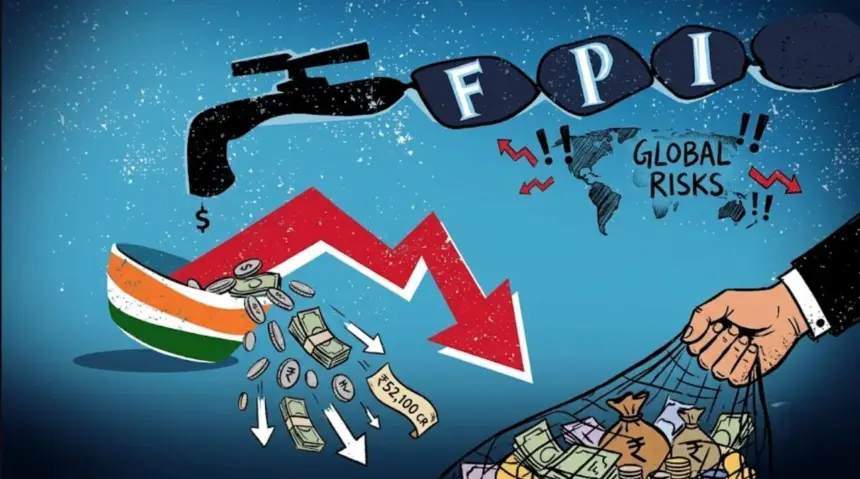
Foreign portfolio investors have reportedly withdrawn ₹52,100 crore from Indian equities in October so far, as elevated crude oil prices, higher US bond yields and a stronger dollar weigh on sentiment. The latest selling adds to substantial outflows recorded earlier in 2026.
Foreign portfolio investors (FPIs) have continued to reduce their exposure to Indian equities amid global economic uncertainty, according to figures cited in the supplied report. Net outflows reportedly reached ₹52,100 crore in October, following withdrawals of ₹35,861 crore in September.
The latest selling highlights the influence of international financial conditions on capital flows into emerging markets. Higher US bond yields and a stronger dollar can make dollar-denominated assets more attractive, while elevated oil prices can add to India’s inflationary and external-balance pressures.
Despite a brief return to marginal buying on October 16, the broader trend remains a concern for domestic market participants. Investors are watching global interest-rate expectations, crude oil prices, currency movements and India’s corporate earnings for signs of a sustained change in sentiment.
See more of our coverage in your search results.
Add INDYASTORY on GoogleKey Highlights: FPI Flows in October 2026
- October outflows: FPIs reportedly withdrew ₹52,100 crore from Indian equities so far this month.
- September outflows: Net selling stood at ₹35,861 crore, according to the supplied figures.
- 2026 cumulative outflows: The report puts year-to-date withdrawals at ₹3.12 lakh crore.
- Global pressures: Higher US Treasury yields, a stronger dollar, elevated crude oil prices and inflation concerns are weighing on sentiment.
- Brief buying reversal: FPIs reportedly became marginal net buyers on October 16.
- Sectoral trends: Financial services and oil-related shares faced selling, while selected consumer services and healthcare businesses attracted investment.
These figures are based on the supplied report and should be checked against the latest depository data before publication.
FPI Selling in India: Why Global Conditions Matter
Foreign investors assess the relative attractiveness of markets when allocating capital across countries. When US Treasury yields rise, investors may find dollar-denominated fixed-income assets more appealing compared with riskier assets in emerging markets.
A stronger US dollar can also affect returns for foreign investors holding Indian assets. Even if an Indian share price remains unchanged in rupee terms, currency movements can influence the investor’s return when converted back into dollars or another home currency.
Crude oil is another important factor for India, which relies heavily on imports to meet its oil requirements. Higher oil prices can increase import costs, put pressure on inflation, influence the rupee and complicate the outlook for economic growth and monetary policy.
Together, these factors can prompt foreign investors to reassess their exposure to Indian equities, particularly when valuations, earnings expectations or geopolitical risks also influence investment decisions.
See more of our coverage in your search results.
Add INDYASTORY on GoogleUS Bond Yields and Federal Reserve Expectations in Focus
The supplied report attributes part of the selling pressure to elevated US bond yields and expectations that persistent inflation could lead to tighter monetary policy from the US Federal Reserve.
When investors expect US interest rates to remain high or rise further, the relative appeal of emerging-market assets may weaken. Higher yields can increase the opportunity cost of investing in equities and influence global capital allocation.
Dheeraj Gaur, Chief Investment Strategy Officer at Choice Wealth, said foreign investors continued to sell Indian equities amid elevated US bond yields, a stronger dollar and rising crude oil prices.
See more of our coverage in your search results.
Add INDYASTORY on GoogleThe report also points to the artificial intelligence-led rally in North Asian markets as a factor attracting international capital. Strong performance in another market or sector can influence how global investors distribute funds across investment opportunities.
However, FPI flows are shaped by multiple variables. US yields, currency movements and oil prices should not be treated as the sole explanations for every daily or monthly change in foreign investment.
Cumulative FPI Outflows in 2026 Reportedly Exceed 2025
According to the figures supplied, cumulative foreign portfolio investor withdrawals from Indian equities reached ₹3.12 lakh crore in 2026, compared with ₹1.66 lakh crore during the whole of 2025.
The report also states that FPIs invested ₹20,200 crore in July and ₹29,631 crore in August before turning to net selling in September and October.
The contrast between buying and selling periods illustrates how quickly portfolio flows can change as global conditions and investor expectations evolve. Monthly figures should be interpreted alongside the reporting cut-off, the distinction between gross and net flows, and whether the data cover equities alone or other asset classes.
The year-to-date comparison is particularly important to verify because it combines flows across multiple months. Investors and readers should be able to trace the figures to a clearly identified source and reporting period.
Why FPIs Briefly Returned to Buying on October 16
The report says foreign investors became marginal net buyers on October 16, following a period of substantial selling.
V K Vijayakumar, Chief Investment Strategist at Geojit Investments Ltd, attributed the temporary shift partly to a decline in the US 10-year Treasury yield and a strengthening rupee. The supplied report places the Treasury yield at 5.08%, down from above 5.3%.
If confirmed, lower US yields and a firmer rupee could have temporarily improved the relative appeal of Indian assets. However, a single session of net buying does not necessarily signal a durable reversal in foreign investment flows.
A sustained change would be more convincing if buying continued over multiple sessions and was accompanied by improving global financial conditions, a more supportive currency trend and confidence in domestic earnings.
The reported Treasury yield figures should be checked against the relevant market data for the exact dates cited.
Financial Services and Oil-Related Stocks Face Selling
Sectoral investment patterns indicate where foreign investors may be reducing exposure and where they continue to identify opportunities.
According to the supplied report, FPIs remained net sellers in financial services and oil-related companies. Financial stocks can be sensitive to expectations around credit growth, funding costs, profitability and valuations, while oil-related businesses may respond differently depending on their position in the energy value chain.
At the same time, foreign investors reportedly continued to buy shares in selected consumer services businesses, including digital platforms, entertainment companies, restaurants and healthcare services.
This suggests that foreign selling has not necessarily extended uniformly across every segment of the Indian market. Sector-specific earnings prospects, business models and valuations can influence investment decisions even during a broader period of outflows.
The sectoral figures should be verified against the original data before drawing conclusions about the scale or persistence of these trends.
Crude Oil Prices and US-Iran Developments Remain Key Risks
The outlook for foreign investment flows will partly depend on how crude oil prices and geopolitical developments evolve.
For India, a sustained increase in oil prices can raise the import bill and contribute to inflationary pressure. It can also affect the rupee and influence expectations for interest rates, corporate costs and economic growth.
Pabitro Mukherjee, Deputy Vice President-Research at Bajaj Broking, said the moderation in selling and the reported reversal in flows pointed towards some stabilisation in investor sentiment, while elevated crude oil prices remained a risk to recovery.
The report identifies Brent crude prices and developments in US-Iran relations as factors investors will monitor. Domestic market participants will also be watching second-quarter FY27 corporate earnings for evidence of how companies are navigating cost pressures and changing demand conditions.
These developments could influence sentiment, but their market impact will depend on the nature of any new information and how it compares with investor expectations.
Foreign Investor Activity in the Debt Market
Foreign investors were also reported to have been net sellers in parts of India’s debt market in September, although flows varied by investment route.
The supplied figures show withdrawals of ₹1,620 crore through the Fully Accessible Route (FAR) and ₹772 crore through the Voluntary Retention Route (VRR), alongside investments of ₹3,387 crore through the general route.
These categories should be presented separately from equity flows because they represent different investment channels and asset classes. Combining them without clarification could give readers an inaccurate impression of total foreign investment activity.
Investors tracking capital movements should examine the relevant debt and equity disclosures, reporting periods and definitions before drawing conclusions about the overall direction of foreign capital.
What Could Happen to the Indian Stock Market Next?
The near-term outlook for FPI flows will depend on several interconnected factors:
- US Treasury yields: A sustained decline could improve the relative appeal of emerging-market assets, while renewed increases may reinforce pressure.
- Dollar and rupee movements: Currency trends can influence the returns foreign investors receive on Indian investments.
- Crude oil prices: Lower oil prices could ease some external and inflationary pressures, while sustained increases may create additional challenges.
- Corporate earnings: Results and forward guidance will help investors assess whether valuations are supported by business performance.
- Geopolitical developments: Changes in global risk sentiment can trigger shifts in portfolio allocations.
Domestic institutional investment may also affect the relationship between foreign selling and benchmark index performance. FPI outflows alone do not determine whether the Sensex or Nifty will rise or fall, as market prices reflect a broader mix of domestic and international factors.
Conclusion
Foreign portfolio investors have reportedly withdrawn ₹52,100 crore from Indian equities in October so far, adding to the selling recorded in September. Higher US bond yields, a stronger dollar, elevated crude oil prices and uncertainty over global monetary policy are among the factors cited for the pressure on flows.
The brief return to buying on October 16 may indicate a temporary improvement in sentiment, but it is not enough to establish a sustained reversal. The direction of future flows will depend on global financial conditions, oil prices, currency movements and the outlook for Indian corporate earnings.
For investors, the key is to distinguish short-term foreign fund movements from the underlying fundamentals of individual companies and the broader domestic economy.
Disclaimer: This article is for informational purposes only and does not constitute investment advice. Verify all flow figures, dates, quotations and market data against original disclosures before publication.