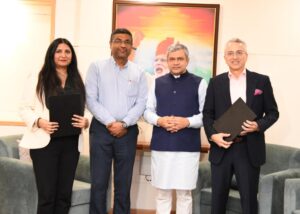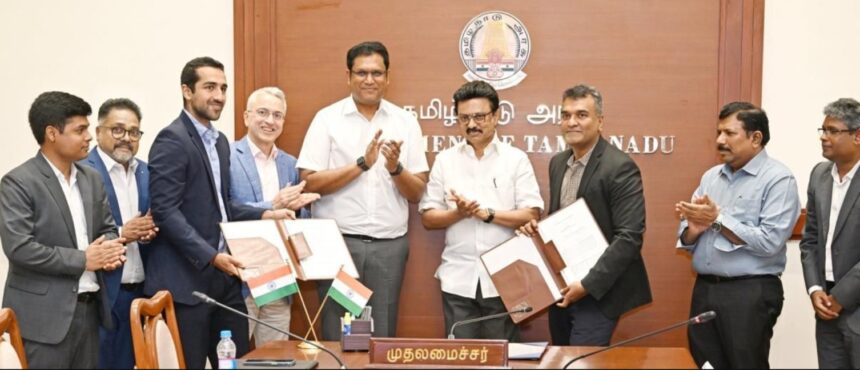
Dixon Technologies plans to establish a major laptop and personal computer manufacturing facility in Oragadam near Chennai, with a proposed investment of ₹1,000 crore and the potential to generate approximately 5,000 jobs.
Chennai, Tamil Nadu: India’s electronics manufacturing industry is set for another significant investment as Dixon Technologies has signed a Memorandum of Understanding (MoU) worth ₹1,000 crore with the Tamil Nadu government to establish a laptop and personal computer manufacturing facility in the state.
The agreement was signed in the presence of Tamil Nadu Chief Minister M.K. Stalin and Industries Minister T.R.B. Rajaa, highlighting the state’s continued push to attract large-scale electronics manufacturing investments.
The proposed facility will be located at IndoSpace Industrial Park in Oragadam, Kancheepuram district, approximately 45 kilometres from Chennai.
See more of our coverage in your search results.
Add INDYASTORY on GoogleAccording to the announced plans, the project is expected to create around 5,000 employment opportunities, supporting Tamil Nadu’s ambitions to expand its electronics manufacturing ecosystem.
The investment also marks an important step in Dixon Technologies’ efforts to strengthen its presence in India’s growing IT hardware manufacturing sector.
₹1,000 Crore Investment to Expand Laptop Manufacturing in Tamil Nadu
The proposed investment comes as India continues encouraging electronics companies to expand local production capabilities and reduce dependence on imported finished devices.
Under the agreement, Dixon Technologies intends to develop a modern manufacturing facility focused on laptops and personal computers.
The project will add to the company’s existing presence in electronics manufacturing, where it already serves multiple product categories.
See more of our coverage in your search results.
Add INDYASTORY on GoogleOragadam has emerged as an important industrial location due to its proximity to Chennai, transport infrastructure and an established network of manufacturing businesses.
The planned unit is expected to benefit from this industrial environment as Dixon expands into additional IT hardware production.
However, the MoU represents an investment commitment and does not, by itself, confirm that construction has been completed or commercial production has started.
See more of our coverage in your search results.
Add INDYASTORY on GoogleThe project timeline, initial production capacity and operational commencement date have not been specified in the supplied announcement.
Dixon’s New Oragadam Plant Could Generate 5,000 Jobs
Employment generation is one of the major highlights of the proposed project.
The facility is expected to create approximately 5,000 jobs, offering potential opportunities for workers across electronics manufacturing and related operations.
A large-scale computer manufacturing facility can require employees in production, equipment maintenance, quality assurance, inventory management, logistics and technical support.
Additional demand for transportation, packaging and industrial services could emerge as manufacturing activities expand.
Nevertheless, the announced employment figure remains a projection. Actual recruitment will depend on the plant’s implementation, production requirements and operating scale.
The announcement does not provide a breakdown of direct and indirect employment opportunities.
For Tamil Nadu, the project could contribute to the development of local technical skills and strengthen the state’s position in electronics manufacturing.
Key Details of Dixon Technologies’ Tamil Nadu Investment
| Project details | Announced information |
|---|---|
| Company | Dixon Technologies |
| Investment value | ₹1,000 crore |
| Agreement | Memorandum of Understanding |
| Government partner | Government of Tamil Nadu |
| Proposed location | Oragadam, Kancheepuram district |
| Industrial park | IndoSpace Industrial Park |
| Distance from Chennai | Approximately 45 km |
| Manufacturing focus | Laptops and personal computers |
| Expected employment | Around 5,000 jobs |
| Project status | Investment MoU announced |
Why Dixon Technologies Chose Tamil Nadu
Tamil Nadu has developed an extensive manufacturing ecosystem covering automotive production, electrical equipment, electronics and other industrial sectors.
The Chennai region in particular offers access to industrial parks, skilled workers, component suppliers and logistics infrastructure.
Oragadam’s location within this broader manufacturing corridor makes it a suitable destination for companies seeking to establish or expand large-scale industrial operations.
For Dixon Technologies, a manufacturing facility in this region could provide opportunities to strengthen production capabilities while improving access to suppliers and distribution networks.
The investment also aligns with Tamil Nadu’s broader strategy of attracting manufacturing projects and supporting industrial employment.
However, the long-term economic impact will depend on the actual scale of production, domestic component sourcing and the successful execution of the project.
Dixon Technologies’ Growing Role in India’s Electronics Industry
Founded in 1993, Dixon Technologies has become one of India’s prominent electronics manufacturing services (EMS) companies.
The company provides manufacturing services across multiple consumer electronics and technology categories.
Its business activities span televisions, home appliances, smartphones, lighting products, wearables, hearables, telecom equipment and IT hardware.
Dixon has also developed manufacturing relationships with major technology and consumer electronics brands.
Companies mentioned in connection with its manufacturing operations include Samsung, Xiaomi, Motorola, boAt, Panasonic, TCL and OnePlus.
Such relationships illustrate the increasing role of Indian contract manufacturers in global electronics supply chains, although individual customer arrangements and product portfolios can change over time.
The proposed laptop and PC facility represents another opportunity for Dixon to expand its capabilities beyond established consumer electronics categories.
How the Investment Supports Make in India
India’s Make in India initiative aims to promote domestic manufacturing, encourage investment and develop industrial capabilities across strategically important sectors.
Electronics manufacturing has become an important focus because of demand for smartphones, computers, telecommunications equipment and connected devices.
The government’s Production Linked Incentive (PLI) programmes also seek to encourage eligible investments and production in selected industries.
In IT hardware, the PLI 2.0 scheme was approved in 2023 with a budgetary allocation of ₹17,000 crore.
The programme is designed to encourage local manufacturing of eligible computing products and develop the supporting supply chain.
Although Dixon’s proposed investment aligns with India’s broader electronics manufacturing priorities, the supplied Tamil Nadu MoU announcement does not establish whether this particular investment will receive incentives under the IT Hardware PLI 2.0 scheme.
That distinction is important because scheme eligibility and incentive payments are subject to specified conditions.
Could More Laptop Manufacturing Reduce India’s Import Dependence?
India’s growing computer manufacturing sector offers opportunities to expand domestic production and improve manufacturing expertise.
Establishing additional laptop and PC production facilities could reduce reliance on imported finished systems over time.
However, manufacturing a computer in India does not necessarily mean all its components are produced domestically.
Processors, memory chips, displays, batteries and other electronic components may still be sourced internationally.
The degree of domestic value addition depends on the manufacturing processes performed in India and the development of local component suppliers.
Projects such as Dixon’s proposed Oragadam facility could support the expansion of domestic manufacturing capabilities, but their actual contribution will become clearer once production begins.
What Does the Investment Mean for Consumers?
For Indian consumers, increased domestic computer manufacturing capacity could eventually support greater product availability and more responsive supply chains.
However, there is no confirmed evidence from the supplied announcement that the proposed plant will directly reduce laptop or desktop prices.
Computer pricing is influenced by processor costs, memory and storage components, currency movements, taxes, logistics and brand-level commercial strategies.
Likewise, the announcement does not identify specific laptop brands or models that will be manufactured at the new facility.
Further company disclosures will be needed to establish its production portfolio and expected market impact.
What’s Next for Dixon’s ₹1,000 Crore Laptop Plant?
Following the signing of the MoU, attention will turn to the project’s implementation.
Important milestones include the finalisation of necessary arrangements, construction progress, manufacturing equipment installation, recruitment and the commencement of commercial production.
Details about production capacity, completion timelines and specific customer contracts will also help determine the project’s eventual scale.
If implemented successfully, the investment could strengthen Dixon Technologies’ role in India’s IT hardware supply chain while supporting manufacturing employment in Tamil Nadu.
For the state, it represents another opportunity to attract electronics investment and reinforce the Chennai region’s position as an industrial manufacturing hub.
The ₹1,000 crore project highlights the growing importance of domestic PC manufacturing, although its long-term impact will depend on execution, production scale and sustained demand.
Have a story tip or feedback? Write to [email protected].
© indyastory.com. Original editorial content.