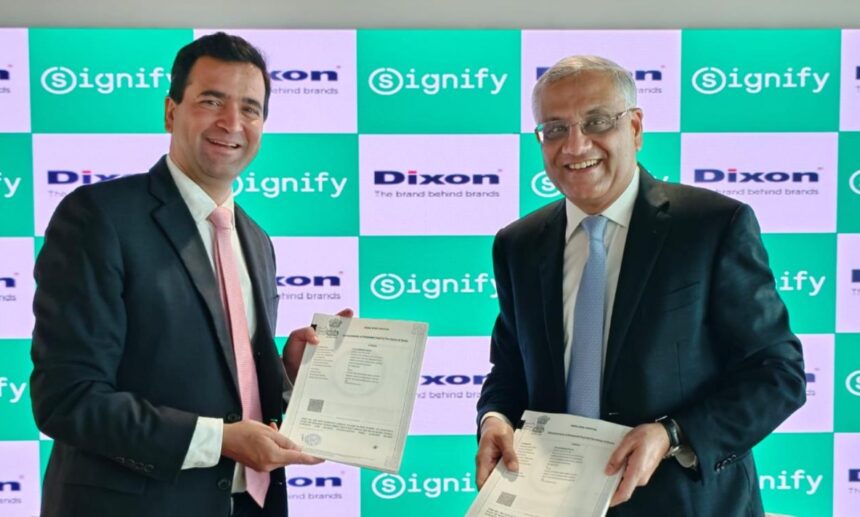
Dixon Technologies and Signify Innovations India have agreed on a proposed equal-ownership joint venture to manufacture lighting products and accessories in India, combining Dixon’s production expertise with Signify’s lighting technology capabilities.
India: Dixon Technologies (India) Limited is moving towards a new manufacturing partnership with Signify Innovations India Limited after the two companies signed a binding term sheet for a proposed joint venture focused on lighting products and accessories.
Under the proposed arrangement, Dixon and Signify will each hold a 50% equity stake in the new joint venture entity.
The business will focus on original equipment manufacturing (OEM), initially handling a portion of Signify’s lighting manufacturing orders in India while also supplying products to other lighting brands.
See more of our coverage in your search results.
Add INDYASTORY on GoogleThe announcement marks a potential expansion of Dixon’s role in India’s lighting industry and reflects the increasing importance of domestic manufacturing partnerships.
However, the proposed joint venture has not yet completed all the necessary formalities. Its final structure, governance arrangements and commercial terms will be established through definitive agreements, subject to applicable conditions and regulatory approvals.
Dixon–Signify Joint Venture: What Has Been Agreed?
The binding term sheet establishes the broad framework for the proposed partnership between the two companies.
One of its most important elements is the planned ownership structure.
Dixon Technologies and Signify Innovations India will hold equal equity interests in the proposed joint venture, giving each company a 50% stake.
See more of our coverage in your search results.
Add INDYASTORY on GoogleImportantly, neither Dixon nor Signify will acquire an ownership stake in the other company as part of this arrangement.
Instead, both businesses intend to participate through a separate joint venture entity focused on manufacturing lighting products and related accessories.
The proposed business is expected to begin by undertaking selected OEM orders from Signify’s Indian operations.
See more of our coverage in your search results.
Add INDYASTORY on GoogleIt will also be able to serve other lighting brands, potentially expanding the manufacturing operation beyond a single customer.
The companies have not disclosed a final investment amount, manufacturing capacity, facility location or operational launch date in the supplied announcement.
Key Details of the Dixon–Signify Partnership
| Particulars | Announced details |
|---|---|
| First company | Dixon Technologies (India) Limited |
| Second company | Signify Innovations India Limited |
| Agreement type | Binding term sheet |
| Business structure | Proposed joint venture |
| Dixon ownership | 50% |
| Signify ownership | 50% |
| Primary business | Lighting products and accessories OEM manufacturing |
| Initial customer orders | A portion of Signify’s Indian OEM requirements |
| Other customers | Additional lighting brands |
| Final agreements | Yet to be executed |
| Regulatory requirements | Approvals where applicable |
| Investment and plant location | Not disclosed |
Why Dixon Technologies Is Partnering with Signify
For Dixon Technologies, the proposed partnership could strengthen its existing lighting manufacturing business by combining its production capabilities with Signify’s industry expertise.
Dixon already manufactures products across several electronics categories, including LED lighting, consumer electronics, home appliances, smartphones, wearables and IT hardware.
The company’s manufacturing-led business model allows technology brands to outsource production while concentrating on product development, marketing, distribution and customer relationships.
The proposed Signify partnership could expand this model within the lighting segment.
Access to Signify’s technical knowledge and manufacturing processes may support improved production consistency, operational efficiency and product development.
However, the actual benefits will depend on the final agreement, manufacturing investments, customer orders and execution.
Signify Sees Opportunity in Indian Lighting Manufacturing
Signify is an established international lighting technology company with operations serving consumer, professional and connected lighting markets.
The proposed venture creates an opportunity for Signify’s Indian operations to work alongside an experienced domestic electronics manufacturer.
Through the new entity, Signify intends to combine its knowledge of lighting technologies with Dixon’s manufacturing capabilities.
This approach could help address production requirements across different lighting categories while supporting competitive manufacturing operations in India.
The venture’s ability to supply other lighting brands is particularly notable.
Instead of functioning solely as a dedicated production operation for Signify, the proposed company would have the potential to operate as a broader OEM supplier in the Indian lighting market.
That business model could support a more diversified customer base over time, provided the venture secures additional orders.
Dixon Managing Director Highlights Manufacturing Synergies
Atul B. Lall, Vice Chairman and Managing Director of Dixon Technologies, welcomed the proposed partnership and described Signify as a strategic fit for the company’s manufacturing ambitions.
He highlighted the companies’ shared focus on quality, innovation, manufacturing capability and customer satisfaction.
Lall also expressed confidence that Signify’s process-driven approach and knowledge of lighting technology could help improve operational efficiency.
His comments underline Dixon’s strategy of working with established technology companies to strengthen its manufacturing capabilities across different product categories.
The proposed arrangement is not Dixon’s entry into lighting manufacturing, as the company already has operations in the segment. Rather, it represents a potential expansion through a dedicated partnership.
Signify India CEO Backs the Make in India Vision
Sumit Joshi, Managing Director and CEO of Signify Innovations India Limited, also welcomed the proposed association.
Joshi said the partnership aligns with the Indian government’s Make in India vision and aims to establish a manufacturing business combining lighting technology expertise with production efficiency.
He indicated that the proposed joint venture would focus on delivering high-quality, competitively positioned lighting products for customers in India.
The collaboration reflects the role of manufacturing partnerships in supporting domestic production while allowing participating companies to contribute different capabilities.
For the venture, these capabilities would include Signify’s lighting industry knowledge and Dixon’s experience in large-scale electronics manufacturing.
What Is OEM Manufacturing in the Lighting Industry?
Original equipment manufacturing, commonly known as OEM, involves producing goods or components for other companies, which may then sell the products under their own brands.
In the lighting industry, OEM manufacturing can cover various categories of lighting equipment and accessories.
Depending on the manufacturing agreement and technical requirements, these may include LED lamps, lighting fixtures, electronic assemblies and other supporting products.
For example, a lighting brand may develop product specifications, performance requirements and quality standards while an OEM partner handles some or all of the manufacturing process.
This allows the brand to use external manufacturing capacity without necessarily operating every production facility itself.
For manufacturers, OEM agreements can provide access to customer orders and opportunities to expand production volumes.
However, the precise product categories that Dixon and Signify’s proposed joint venture will manufacture have not yet been disclosed.
Why the 50:50 Ownership Structure Matters
The proposed equal shareholding arrangement is a central feature of the Dixon–Signify agreement.
With each company expected to own 50% of the venture, both would have an equal economic ownership interest in the new entity.
This differs from an acquisition, where one company purchases a controlling stake in another business.
The proposed structure allows Dixon and Signify to retain their separate corporate identities while collaborating through a jointly owned manufacturing company.
However, equal equity ownership does not automatically determine how management decisions, board appointments or operational responsibilities will be divided.
Those details will depend on the definitive agreements and the venture’s agreed governance framework.
The companies have stated that the final structure, valuation and other terms remain subject to further documentation.
How the Partnership Supports Make in India
India’s Make in India initiative aims to strengthen domestic manufacturing capabilities and encourage investment across industrial sectors.
Electronics and electrical equipment manufacturing form an important part of this ambition.
Partnerships between domestic manufacturing companies and technology-focused businesses can support the transfer of operational expertise, increase production capabilities and create opportunities for local suppliers.
In the lighting sector, manufacturing competitiveness depends on factors such as production efficiency, component sourcing, energy-efficiency standards, product reliability and quality control.
The proposed Dixon–Signify venture could support these capabilities by combining manufacturing infrastructure with lighting technology expertise.
Nevertheless, the agreement does not currently establish the amount of fresh investment, the number of jobs to be created or the level of domestic component sourcing.
Such outcomes should be assessed once the companies provide more detailed information.
What Could the Joint Venture Mean for India’s Lighting Market?
The Indian lighting industry serves residential, commercial, industrial and infrastructure requirements.
Consumer demand includes products for homes and offices, while institutional and industrial customers require lighting systems designed for specific operating conditions.
Manufacturers compete on product quality, energy efficiency, reliability, distribution and cost.
A manufacturing company with access to established technological expertise and large-scale production capabilities could potentially compete across multiple segments of this market.
For Dixon and Signify, the planned venture may provide an opportunity to supply different lighting businesses through a shared production platform.
However, the companies have not confirmed specific product launches, customer contracts beyond the initial proposed Signify orders or any retail pricing changes resulting from the partnership.
What Happens Next for the Dixon–Signify JV?
The next major step will be the negotiation and execution of definitive agreements.
These documents are expected to clarify the venture’s final governance structure, valuation, operational responsibilities and other commercial arrangements.
The transaction must also satisfy applicable conditions precedent and obtain regulatory approvals wherever required.
Only after these formalities are completed will there be greater clarity about the proposed venture’s operational roadmap.
Further announcements may provide information about the manufacturing location, investment requirements, employment plans, production capacity and expected commencement of operations.
The proposed 50:50 joint venture represents a strategic opportunity for Dixon Technologies and Signify India to expand lighting manufacturing capabilities, but its eventual impact will depend on final agreements, customer demand and successful execution.
For India’s electronics manufacturing industry, the announcement is another example of established technology businesses exploring partnerships to strengthen local production.
Have a story tip or feedback? Write to [email protected].
© indyastory.com. Original editorial content.