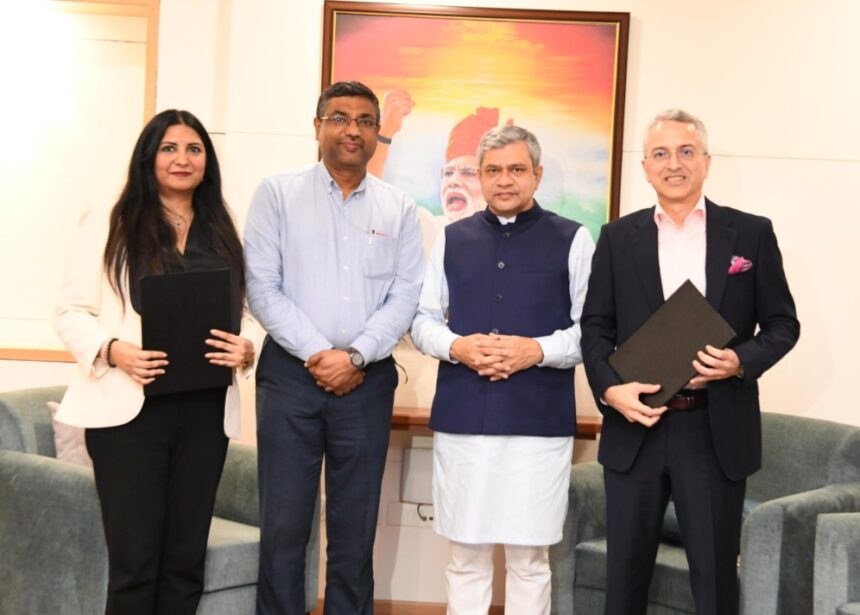
Dixon Technologies’ subsidiary Padget Electronics intends to work with HP India to manufacture laptops, desktops and all-in-one PCs at a new Chennai-area facility with a planned annual capacity of two million units.
India’s ambition to become a major electronics manufacturing hub could receive another boost as Dixon Technologies and HP India move towards a partnership to manufacture personal computers domestically.
Padget Electronics Private Limited, a wholly owned subsidiary of Dixon Technologies (India) Limited, intends to enter into a memorandum of understanding (MoU) with HP India Sales Private Limited for the production of notebooks, desktop computers and all-in-one PCs.
The proposed arrangement falls under the Government of India’s Production Linked Incentive (PLI) Scheme 2.0 for IT Hardware, which aims to encourage domestic manufacturing and strengthen India’s electronics supply chain.
See more of our coverage in your search results.
Add INDYASTORY on GoogleThe companies’ proposed collaboration remains subject to the execution of definitive agreements.
New PC Manufacturing Facility Planned in Oragadam, Chennai
A major part of the manufacturing initiative is a new facility being established in Oragadam, near Chennai, Tamil Nadu.
The plant is being developed as a modern manufacturing centre for multiple categories of personal computers, including laptops, conventional desktops and all-in-one systems.
According to the information shared about the project, the facility will cover approximately 300,000 square feet.
Once it reaches peak operating capacity, the plant is expected to be capable of producing up to two million PCs annually.
See more of our coverage in your search results.
Add INDYASTORY on GoogleThe proposed facility is also projected to generate approximately 1,500 direct employment opportunities, potentially supporting manufacturing operations, production management, quality assurance and related functions.
These figures represent projected capacity and employment rather than confirmed operational output or completed recruitment.
The announcement does not specify a production commencement date or provide a detailed schedule for reaching maximum capacity.
See more of our coverage in your search results.
Add INDYASTORY on GoogleDixon–HP Manufacturing Project: Key Details
| Particulars | Announced details |
|---|---|
| Manufacturing company | Padget Electronics Private Limited |
| Parent company | Dixon Technologies (India) Limited |
| Proposed partner | HP India Sales Private Limited |
| Manufacturing location | Oragadam, Chennai, Tamil Nadu |
| Government programme | IT Hardware PLI 2.0 |
| Proposed products | Laptops, desktops and all-in-one PCs |
| Facility size | 300,000 sq. ft. |
| Projected direct employment | 1,500 jobs |
| Planned annual capacity | Up to 2 million units |
| Agreement status | Proposed MoU, subject to definitive agreements |
HP Highlights Its Commitment to Make in India
The proposed partnership reflects HP’s interest in expanding its locally manufactured personal computer portfolio.
Commenting on the initiative, Ipsita Dasgupta, Managing Director, India Market, HP, welcomed the opportunity to combine the company’s technology capabilities with Dixon’s manufacturing expertise.
Dasgupta said the collaboration demonstrates HP’s commitment to participating in the Government of India’s Make in India initiative.
She also indicated that the partnership could support a broader range of domestically manufactured HP products for Indian customers.
Local production may help manufacturers develop closer relationships with suppliers and respond to market requirements, although its effect on retail prices, delivery times and product availability will depend on costs, sourcing arrangements and production scale.
The companies have not announced whether the proposed manufacturing arrangement will lead to lower consumer prices.
Dixon Technologies Sees Opportunity in India’s PC Manufacturing Market
For Dixon Technologies, the proposed agreement represents another step towards expanding its role in India’s electronics manufacturing industry.
Atul B. Lall, Vice Chairman and Managing Director of Dixon Technologies, welcomed the proposed collaboration with HP.
Lall highlighted HP’s global presence and technological capabilities, expressing confidence that combining HP’s established processes with Dixon’s manufacturing experience could help bring a wider range of personal computing products to Indian customers.
Dixon already operates across multiple electronics categories, including smartphones, consumer appliances, televisions, lighting, wearables, telecommunications equipment and IT hardware.
The company also provides repair and refurbishment services through its reverse logistics operations.
Its proposed work with HP would further strengthen its involvement in personal computer manufacturing, subject to the completion of the necessary commercial agreements.
What Is India’s IT Hardware PLI 2.0 Scheme?
The Production Linked Incentive Scheme 2.0 for IT Hardware is a Government of India initiative intended to encourage domestic manufacturing of eligible IT products.
The programme supports the development of India’s electronics manufacturing ecosystem by linking qualifying incentives to specified production and investment conditions.
It covers eligible IT hardware categories, including laptops, tablets, all-in-one PCs, servers and certain other computing products defined under the scheme.
The programme was approved in 2023 with an overall budgetary outlay of ₹17,000 crore.
Its broader objectives include attracting investment, increasing local manufacturing output, supporting employment and strengthening domestic supply chains.
For international computer brands, Indian manufacturing partnerships can offer access to established local production capabilities without requiring every company to build an entirely independent manufacturing operation.
For Indian electronics manufacturers, such partnerships can create opportunities to develop expertise in more sophisticated hardware categories.
However, the extent of domestic value addition depends on where components are sourced and which manufacturing processes are carried out locally.
Final assembly in India does not necessarily mean that every critical component is manufactured domestically.
Why the Dixon–HP Partnership Matters for India
The proposed agreement is significant for several reasons.
First, it could increase domestic production capacity for personal computers, a segment that serves consumers, educational institutions, enterprises and government organisations.
Second, the planned Oragadam facility could contribute to Tamil Nadu’s established electronics manufacturing ecosystem.
The state already hosts a network of electronics manufacturers and suppliers, supported by industrial infrastructure and proximity to major logistics networks.
Third, the project could create direct manufacturing jobs while generating additional demand for supporting services, including logistics, maintenance and industrial supplies.
Such indirect benefits remain potential outcomes rather than confirmed employment commitments.
Finally, a larger domestic PC manufacturing base could help India expand its position in international electronics supply chains over time.
Achieving that goal will depend on competitive production costs, manufacturing quality, component availability and the ability to scale operations sustainably.
Will HP Laptops and Desktops Become Cheaper in India?
The proposed partnership may raise expectations about more affordable locally manufactured computers.
However, neither HP nor Dixon has confirmed any consumer price reductions linked to the arrangement.
Retail PC prices depend on numerous factors, including processors, memory, storage, display components, imported parts, currency movements, taxes and distribution expenses.
Domestic assembly can provide certain logistical and manufacturing advantages, but these do not automatically translate into lower retail prices.
Customers will need to wait for actual product announcements and pricing details to understand the commercial impact of the proposed partnership.
What Happens Next?
The immediate next step is the formalisation of the proposed manufacturing arrangement between Padget Electronics and HP India.
Once definitive agreements are signed, further disclosures may clarify the production timeline, initial product models, investment arrangements and scale-up plans.
The announced project provides a potential roadmap for a large PC manufacturing operation, but important milestones remain ahead.
If implemented as planned, the Oragadam facility could become a significant addition to India’s domestic computer manufacturing capacity, supporting the country’s longer-term ambition to build a stronger electronics production ecosystem.
For Dixon Technologies and HP, the outcome will depend on converting the proposed agreement into sustained manufacturing operations.
Have a story tip or feedback? Write to [email protected].
© indyastory.com. Original editorial content.