A Public Interest Litigation (PIL) has been filed in the Supreme Court challenging the Centre’s decision to introduce a Merchant Discount Rate (MDR) on certain merchant UPI transactions above Rs 2,000.
The petition, titled Anjan Datta v. Union of India, challenges the new multi-tiered fee structure and argues that it places an arbitrary burden on small merchants. The petitioner has also raised constitutional challenges under Articles 14 and 19(1)(g).
The legal challenge comes amid a wider political dispute over the government’s decision to move away from the statutory zero-MDR framework for specified merchant transactions.
What Is the New UPI MDR Framework?
Under the new framework described in the supplied report, a 0.4 per cent MDR will apply to eligible merchant transactions above Rs 2,000 through UPI from October 15, 2026.
See more of our coverage in your search results.
Add INDYASTORY on GoogleThe charge is to be paid by merchants rather than consumers.
The framework keeps person-to-person UPI transfers outside the charge and also retains zero MDR for merchant transactions of up to Rs 2,000.
For transactions worth Rs 75,000 or more, the MDR is reportedly subject to a Rs 300 cap.
The PIL challenges this differentiated structure and questions the legal basis for imposing the charge on the specified category of transactions.
What Does the Supreme Court Plea Argue?
The petition challenges the withdrawal of statutory protection for zero MDR on UPI transactions above the specified threshold.
See more of our coverage in your search results.
Add INDYASTORY on GoogleAccording to the supplied description of the petition, the petitioner argues that the multi-tiered fee system creates an unreasonable burden, particularly for smaller merchants.
The petition invokes Article 14, which guarantees equality before the law, and Article 19(1)(g), which protects the right to practise a profession or carry on an occupation, trade or business.
These are legal arguments advanced in the PIL. The filing itself does not mean that the Supreme Court has accepted those arguments or ruled that the government’s framework is unconstitutional.
See more of our coverage in your search results.
Add INDYASTORY on GoogleWhy Has MDR Been Introduced?
The decision has been presented by the payments ecosystem and government authorities in the context of the rising cost of operating and securing UPI infrastructure.
The National Payments Corporation of India (NPCI) operates the UPI network, which was introduced in 2016.
According to the figures cited in the supplied report, industry estimates place the annual cost of running UPI infrastructure at around Rs 20,000 crore, covering areas such as servers, bandwidth, fraud prevention and technical support.
The Department of Financial Services has separately told the Parliamentary Standing Committee on Finance that the payments industry spends approximately Rs 20,700 crore annually on person-to-merchant (P2M) transactions.
NPCI has said revenue generated through the new framework will support investments in areas including infrastructure resilience, cybersecurity, fraud prevention, innovation and customer service.
Parliamentary Panel Had Raised Sustainability Concerns
The issue of UPI’s financial sustainability had already been examined by a Parliamentary Standing Committee on Finance.
A report from the committee flagged concerns about the absence of MDR and its implications for the long-term financial sustainability of the UPI ecosystem.
The committee also highlighted a gap between the government’s allocation of approximately Rs 2,000 crore and the industry’s estimated annual operational cost of around Rs 20,700 crore, according to the supplied report.
The panel had recommended legislative provisions enabling a tiered MDR structure, citing the need for a viable revenue model.
Congress MPs Dispute Claims About Their Position
The introduction of UPI charges has also triggered a political dispute over what happened during the Finance Committee’s deliberations.
Five Congress MPs — Gaurav Gogoi, P Chidambaram, Manish Tewari, Kishori Lal and K Gopinath — attended the committee meeting in August, according to the supplied report.
Reports subsequently claimed that Congress members present at an August 12 meeting had not recorded dissent against the panel’s recommendation concerning a tiered MDR framework.
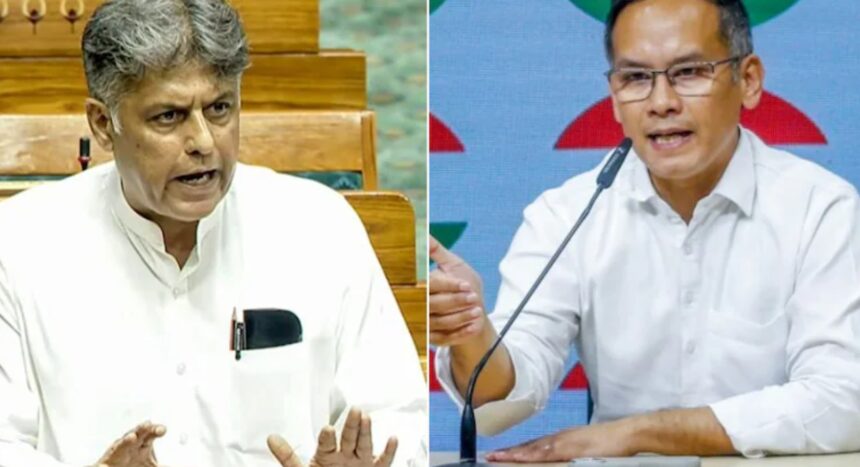
Congress MPs Gaurav Gogoi and Manish Tewari have disputed that characterization.
Gogoi said there had been no specific proposal before the committee concerning the UPI charge that the government subsequently announced.
He said questions about the need for MDR had been raised during the committee’s proceedings but argued that government representatives had not provided specific or satisfactory answers at that stage.
Manish Tewari Rejects the Claim
Manish Tewari also backed Gogoi’s account.
He said the specific MDR proposal that was subsequently announced — including its rate, transaction threshold, ceiling and exemption slabs — had not been presented to the Parliamentary Standing Committee on Finance.
Tewari further argued that describing the confidential proceedings of the committee as evidence that particular members supported the eventual measure was inaccurate.
His comments concerned both the specific MDR framework and the broader principle of introducing MDR on UPI transactions.
Congress Raises Foreign Influence Allegation
The UPI decision has also become part of a broader political argument over India’s digital payments policy.
Congress leaders have alleged that the move away from zero MDR was influenced by pressure from foreign card networks, including major US-based companies.
The argument follows criticism from the US Trade Representative earlier in 2026 regarding India’s zero-cost UPI model and its impact on international card networks, according to the supplied report.
Congress has connected that criticism with the government’s subsequent decision to introduce MDR.
These claims about foreign influence have been rejected by the Union government.
Centre Denies Foreign Influence
The Finance Ministry has said that the decision to introduce MDR was not the result of foreign pressure.
In a statement cited in the supplied report, the ministry said:
“Some claims suggest the change is due to foreign influence. This is false. India’s UPI policy decisions are made independently, with the clear goal of building a self-sustaining, inclusive, and affordable digital payments ecosystem.”
The government has therefore framed the measure primarily around the long-term sustainability of India’s digital payments infrastructure.
UPI’s International Expansion
The debate over MDR comes as India’s UPI system has expanded beyond the domestic market.
According to the supplied report, UPI is operational in at least eight countries, including Bhutan, Nepal, Sri Lanka, the UAE, Singapore, France and Qatar.
India has also entered into agreements with more than 20 other countries concerning cooperation involving the UPI system.
The international expansion has increased attention on the sustainability and operating model of India’s digital payments infrastructure.
Supreme Court Challenge Comes Amid Wider Debate
The Supreme Court petition adds a legal dimension to an already active debate involving the government, the payments industry and political parties.
The PIL questions whether the new MDR framework is legally and constitutionally sustainable, particularly in relation to its impact on merchants.
At the same time, the Centre and NPCI have pointed to the substantial cost of maintaining UPI infrastructure and the need for a revenue model capable of supporting security, resilience and continued development.
The Supreme Court will determine the legal questions raised by the petition through the judicial process. Until then, the allegations and constitutional objections contained in the PIL remain arguments advanced by the petitioner rather than findings of the court.