Quad ministers also outlined more than $85 million in planned technology assistance for the Indo-Pacific during their October 31 meeting in Atlanta.
The United States has committed $10 million to support critical minerals recycling infrastructure in India and ASEAN countries, as Quad members seek more diversified supplies of materials used by advanced industries.
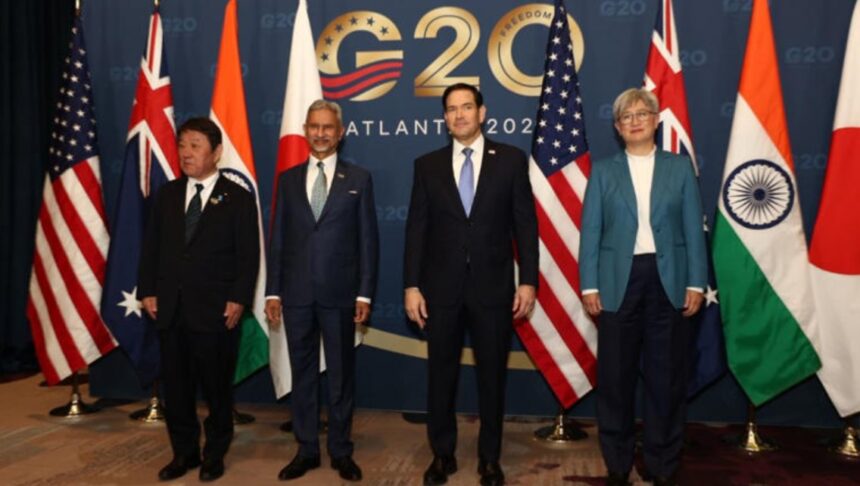
The announcement followed a meeting of the foreign ministers of India, the US, Japan and Australia in Atlanta on October 31, held alongside the G20 Foreign Ministers’ Meeting.
India was represented by External Affairs Minister S. Jaishankar, alongside US Secretary of State Marco Rubio, Japanese Foreign Minister Toshimitsu Motegi and Australian Foreign Minister Penny Wong.
See more of our coverage in your search results.
Add INDYASTORY on GoogleWhat the recycling commitment covers
The funding is intended to promote facilities that recover critical minerals from waste. The Quad’s joint statement identifies discarded electronics and scrap as sources for recovery and supports private investment across collection networks, processing plants and refineries.
The partners also plan to explore simpler export and import procedures for recyclable materials while strengthening implementation of existing regulations.
The announcement does not establish an India-only funding amount, identify individual recipients or confirm that the money has already been disbursed.
| Announcement | Intended coverage | Status |
|---|---|---|
| US commitment of $10 million | Critical minerals recovery infrastructure in India and ASEAN countries | Commitment announced |
| More than $85 million in technical and financial assistance | Access to trusted technology across the Indo-Pacific | Intention announced |
Why mineral recovery matters
Recycling provides a way to recover useful materials from products and industrial waste that have already entered the economy.
The Quad’s stated objective is to reduce dependence on any single supplier by developing trusted recycling value chains. The initiative builds on its Critical Minerals Initiative Framework announced in May 2026.
See more of our coverage in your search results.
Add INDYASTORY on GoogleIts practical impact will depend on implementation: which facilities receive support, the materials they can process and whether recovered minerals meet buyers’ requirements. A funding commitment alone does not establish future production capacity.
How it relates to India’s existing recycling scheme
India already has a separate ₹1,500 crore incentive scheme for critical mineral recycling, approved by the Union Cabinet on September 3, 2025.
The domestic programme supports recovery from secondary sources, including battery waste and electronic waste. It forms part of the National Critical Mineral Mission’s effort to develop recycling capacity and strengthen supply security.
See more of our coverage in your search results.
Add INDYASTORY on GoogleThe US commitment and India’s domestic incentive scheme are distinct announcements. They should not be presented as a single funding pool or treated as automatically financing the same projects.
What does the statement mean by “Super Intelligence”?
The joint release uses the term “Super Intelligence,” or SI, and refers to a Quad SI Accelerator. A footnote explains that Australia, India and Japan refer to this technology as artificial intelligence.
According to reporting on the statement, the ministers intend to provide more than $85 million in technical and financial assistance to expand access to trusted technology across the Indo-Pacific. The announcement does not specify how that assistance will be distributed among countries.
The terminology should therefore not be interpreted as proof that the Quad has deployed a particular level of AI capability.
What comes next
For businesses in India and Southeast Asia, the next useful details will be project eligibility, implementing agencies, application procedures and disbursement schedules.
Those details will determine how the recycling commitment translates into operating facilities and commercial opportunities. Until they are published, the announcement establishes a direction for cooperation rather than a ready-to-access grant programme.