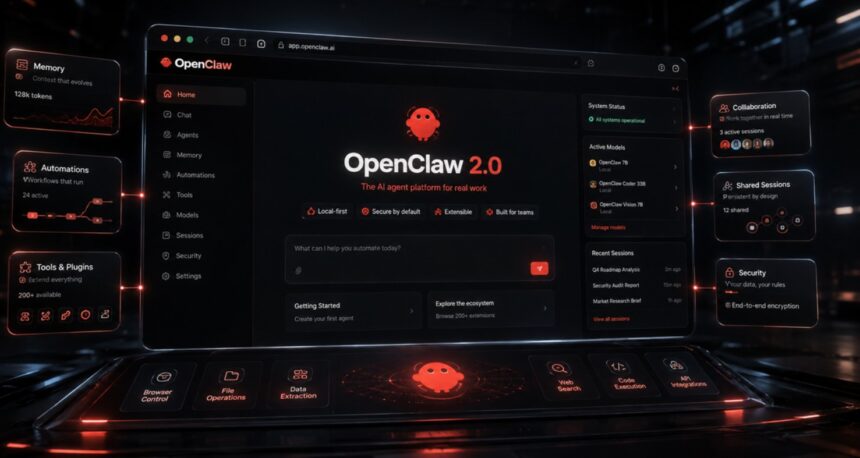
OpenClaw 2.0 is positioning itself as more than an incremental update to an open-source AI agent. Released on August 30, the new version focuses on making the platform easier to install, configure, customise and use, while expanding its ability to perform tasks across different digital services.
The project describes the release as the biggest update in its history. According to OpenClaw’s release blog, the development involved 933 contributors, including 569 people making their first contribution to the project. The release also contains more than 16,000 pull requests.
The changes span much of the platform, covering installation, messaging, memory, skills, AI models, automations, browser functionality, native applications, plugins and security.
Why Did OpenClaw Move to Version 2.0?
OpenClaw had released 106 versions during its first 230 days, with some updates arriving only a day or two apart. The project then went almost seven weeks without a new release.
See more of our coverage in your search results.
Add INDYASTORY on GoogleAccording to the development team, that pause was not caused by a slowdown in development. Instead, the project had accumulated a large volume of changes as its contributor community expanded.
The growing number of contributions put pressure on OpenClaw’s underlying architecture as well as its release process. OpenClaw says the 2.0 release contains approximately half of all the pull requests that had been merged into the project up to that point.
Rather than publishing the accumulated work as another minor version, developers used the extended release cycle to improve the platform’s foundation. They also focused on making the transition suitable for both newcomers and existing users upgrading their Claws.
That combination of a major technical overhaul and a new user experience is behind the 2.0 designation.
OpenClaw 2.0 Makes Installation and Setup Simpler
One of the most visible changes is the revised installation and onboarding process.
See more of our coverage in your search results.
Add INDYASTORY on GoogleOpenClaw 2.0 can work with resources users may already have, including ChatGPT and Claude subscriptions, API keys and models installed locally.
The project has also reduced the amount of configuration required during the initial setup. Instead of forcing users to configure every feature before getting started, the updated system allows them to begin interacting with their Claw sooner.
Additional configuration can then be handled through conversations with the agent itself.
See more of our coverage in your search results.
Add INDYASTORY on GoogleThe objective is straightforward: shorten the path between installing OpenClaw and getting an AI agent to perform a useful task.
Browser Becomes a More Important Part of the Agent Experience
OpenClaw 2.0 also puts greater emphasis on its browser-based interface.
Users can continue configuring their agent through the browser, return to tasks that are already underway and monitor the agent’s activity as it works.
This is significant because an agent-oriented interface needs to show more than a sequence of text responses. Users also need visibility into ongoing tasks and the state of work being performed across connected services.
The redesigned browser experience is intended to make that process easier to follow.
OpenClaw Wants to Move Beyond the Traditional Chatbot
The central idea behind OpenClaw 2.0 is the distinction between an AI chatbot and an AI agent.
A conventional chatbot generally waits for a user’s question or prompt before producing a response. An agent, by contrast, is designed to act on an instruction and interact with other tools or services to complete a task.
OpenClaw allows users to begin with a relatively simple workflow and expand the agent’s capabilities as additional services are connected.
One example highlighted by the project involves monitoring an email inbox for messages from a child’s school and forwarding important information through Telegram.
That workflow could potentially become more sophisticated. An agent could identify relevant information in an incoming email, respond to a message or transfer information between different applications, depending on the services and capabilities connected to it.
This task-oriented approach is central to OpenClaw’s attempt to make AI agents useful beyond question-and-answer interactions.
What Is the Multiplayer Feature in OpenClaw 2.0?
Another major addition is shared cloud sessions, which OpenClaw refers to as a “multiplayer” experience.
The feature allows multiple people to work with the same Claw while retaining the context accumulated during a task.
The concept reportedly emerged from the OpenClaw team’s own experience while developing the product. Team members wanted to collaborate with agents, share tasks and hand ongoing work to one another without requiring the agent to start from the beginning.
Shared sessions extend that approach to users.
For example, a family or team could interact with the same Claw and continue building on the context it has already gathered instead of maintaining completely separate agent sessions.
OpenClaw therefore sees the multiplayer model as a way to expand AI-agent workflows from individual users to collaborative environments.
OpenClaw 2.0 Expands the Role of AI Agents
The broader direction of OpenClaw 2.0 is clear: the project is attempting to make AI agents less intimidating to set up while giving them a larger role in everyday digital workflows.
Simpler onboarding addresses the barrier faced by first-time users. Browser-based controls provide greater visibility into what an agent is doing, while integrations allow it to work across multiple services.
The addition of shared sessions takes the concept further by allowing an agent and its accumulated context to become useful to more than one person.
Rather than treating AI as a system that simply produces answers, OpenClaw 2.0 is built around the idea of software that can receive instructions, monitor information, interact with connected tools and carry out multi-step digital tasks.
Whether that approach becomes practical for mainstream users will depend on factors including reliability, security, integrations and how much control users retain over autonomous actions. But with its 2.0 release, OpenClaw is clearly attempting to move the AI-agent concept closer to an everyday software experience.