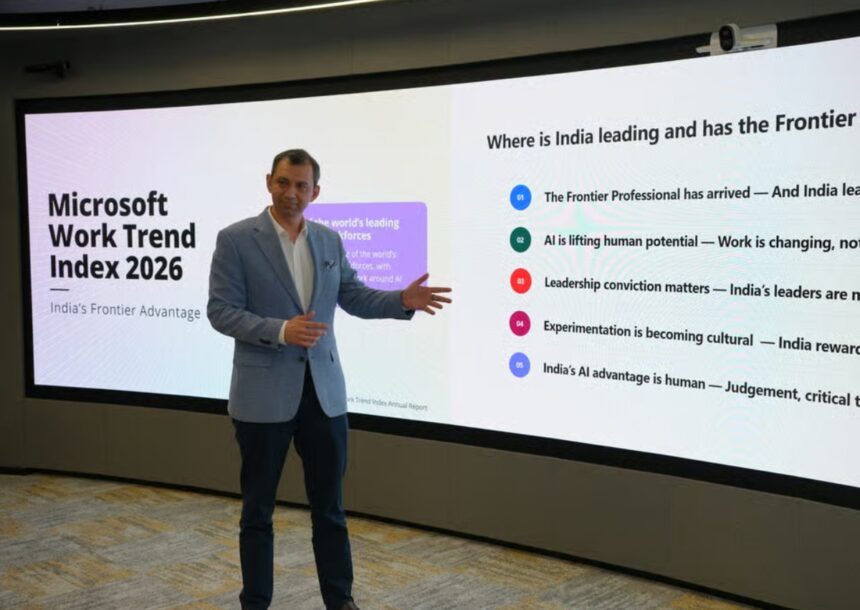
India is emerging as a global leader in workplace artificial intelligence adoption, with nearly one in three professionals classified as “Frontier Professionals”, according to Microsoft’s Work Trend Index 2026.
The report, which released its India findings on Thursday, found that 32% of professionals in India fall into the Frontier Professional category. That is twice the global average of 16%, highlighting the country’s rapid shift from simply using AI tools to redesigning how work is performed.
Microsoft defines Frontier Professionals as advanced AI users who work with AI agents to manage complex, multi-step tasks and use the technology to rethink processes, workflows and team structures.
According to Microsoft India and South Asia President Puneet Chandok, India’s advantage is not simply the volume of AI usage. It is the way professionals are combining AI capabilities with human judgment, quality control and critical thinking.
See more of our coverage in your search results.
Add INDYASTORY on Google“It’s not a gap, it’s a leap. One in three professionals in India are Frontier, versus one in six in the world,” Chandok told The Economic Times Digital.
He said Frontier Professionals are increasingly working with multiple AI agents while retaining responsibility for decision-making and oversight.
India’s AI Advantage Goes Beyond Adoption Numbers
The Microsoft report suggests that India’s position in the AI race is closely linked to the way workers are adapting their jobs around AI agents.
Among Indian AI users surveyed, 63% identified quality control as a top skill, while 59% cited critical thinking. Meanwhile, 87% said they remain responsible for the thinking involved in their work.
Microsoft said these figures were the highest among the 10 countries included in the survey.
The findings point to an important distinction in the current AI transition. The technology is not necessarily replacing human involvement in knowledge work; instead, many advanced users are changing the division of labour between people and AI systems.
See more of our coverage in your search results.
Add INDYASTORY on GoogleChandok described this as a fundamental redesign of organisational processes.
According to him, traditional workflows were largely structured around the sequential way humans complete tasks. AI agents, by contrast, can operate simultaneously and continuously, allowing organisations to rethink how different parts of a process are handled.
AI Is Helping Indian Workers Create New Types of Work
The Work Trend Index also found that 78% of respondents in India said they are producing work that was not conceivable a year earlier.
See more of our coverage in your search results.
Add INDYASTORY on GoogleThat compares with a global average of 58%.
The finding suggests that AI adoption is extending beyond productivity gains. Workers are using AI capabilities to attempt tasks, services and forms of output that previously may not have been practical within the same time or resource constraints.
This comes amid a wider debate over whether artificial intelligence will ultimately destroy more jobs than it creates.
A recent analysis from Nomura offered another perspective on the employment impact of AI in Asia. According to the research, during the roughly three-and-a-half years following the launch of ChatGPT, AI-related hiring in Asia amounted to approximately 131,000 jobs, compared with around 61,000 AI-related firings.
However, the report also highlighted an uneven impact across the labour market, with entry-level positions facing greater pressure while experienced workers with specialised skills remain in demand.
What Happens to Young Professionals as AI Automates Entry-Level Work?
The changing employment landscape raises a difficult question for younger workers entering the workforce.
Many entry-level jobs traditionally allow graduates to gain experience by performing repetitive or routine tasks before gradually taking on more complex responsibilities. If AI agents increasingly perform some of that foundational work, companies and employees may have to rethink how early-career experience is developed.
Chandok takes a relatively optimistic view of this shift.
He suggested that younger professionals may increasingly build careers through a portfolio of skills and projects rather than following a conventional, linear career ladder.
His message to young workers is to focus less on qualifications and titles and more on demonstrable work.
“Don’t go after degrees and titles. What travels in this world is proof,” Chandok said.
He encouraged young professionals to ask themselves what they have actually created or delivered in recent months and what level of judgment they brought to that work.
Microsoft Says Leadership Must Drive AI Transformation
The Work Trend Index also points to a leadership challenge.
While 44% of Indian leaders surveyed said they are clearly aligned on AI, only 25% of workers said they feel their efforts to reinvent how they work are rewarded when those efforts do not immediately generate results.
That gap could become a major obstacle to large-scale AI adoption.
Employees may be willing to experiment with AI, but meaningful organisational change requires companies to create room for experimentation, tolerate early failures and recognise improvements that may not deliver immediate financial returns.
Chandok argued that business leaders need to demonstrate the behaviour they expect from employees.
“Alignment is ahead of real action. Leaders are convicted, they’re using it, they’re creating the platforms. Now that message has to get to the floor where the leaders walk the talk, use it themselves,” he said.
Once senior management actively uses AI and supports experimentation, he suggested, employees may feel more comfortable changing established workflows.
India’s Large Developer Base Could Accelerate AI Adoption
Chandok also attributed part of India’s strong AI position to the country’s large technology workforce and developer ecosystem.
He pointed to approximately 27 million developers on GitHub, along with India’s major IT services companies and its established role as a global technology-services hub.
But he argued that the size of the workforce alone does not explain the country’s momentum.
“The real fuel is hunger,” Chandok said, describing Indian developers as having a strong appetite for learning and acquiring new skills.
That willingness to continuously adapt could become increasingly important as AI capabilities develop rapidly and the skills required to work effectively with them change.
Human Judgment Remains Central to AI-Driven Work
One of the clearest themes emerging from Microsoft’s findings is that advanced AI adoption does not necessarily mean removing people from the workflow.
Instead, the company’s data indicates that experienced AI users are placing greater emphasis on quality assurance, critical thinking, judgment and accountability.
That human-in-the-loop model could become particularly important as organisations deploy AI agents capable of performing increasingly complex tasks with limited direct intervention.
The challenge for businesses will be to determine which decisions can safely be delegated to AI, where human review remains essential and how employees can be trained to supervise increasingly capable systems.
AI Adoption Could Reshape the Definition of Career Growth
The Microsoft findings suggest that the impact of AI on employment may be more complicated than a straightforward story of automation and job losses.
Some routine tasks may disappear, while entirely new responsibilities and forms of work emerge around AI systems. At the same time, the traditional progression from entry-level work to more senior roles could change if AI takes over some of the tasks through which employees historically gained experience.
For Indian professionals, the report points to an environment where continuous learning and practical experimentation could become increasingly important.
As Chandok put it, the next generation may not necessarily “climb a ladder” in the traditional sense. Instead, careers could increasingly be built around a portfolio of projects, capabilities and demonstrated results.
India’s unusually high share of Frontier Professionals suggests that this transition is already underway in parts of the country’s workforce. The bigger test will be whether businesses can translate individual AI experimentation into responsible, scalable and sustainable changes across entire organisations.