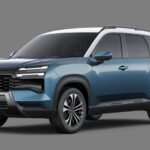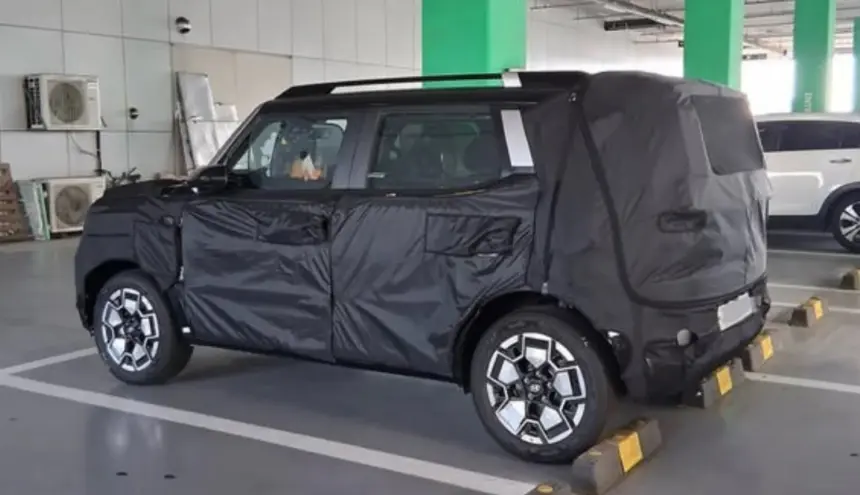
Hyundai appears to be accelerating its electric vehicle strategy with a new compact SUV that has been spotted undergoing road tests. The heavily camouflaged prototype was recently seen in South Korea, adding to earlier sightings from India and fueling speculation that the automaker is preparing a new mass-market electric SUV for one of the world’s fastest-growing EV markets.
The upcoming model is expected to strengthen Hyundai’s position in the affordable electric vehicle segment and could play a key role in the company’s long-term product expansion roadmap. Industry observers believe the vehicle may arrive in India within the next few years as Hyundai broadens its EV lineup beyond premium offerings.
Boxy SUV Design Hints at Practical Urban Electric Vehicle
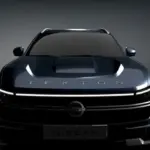
Although camouflage hides most design details, the test vehicle reveals several important styling cues. The SUV features a tall stance, upright proportions, and a high roofline, suggesting a focus on cabin space and practicality.
Spy images indicate a split-headlamp arrangement, with slim LED daytime running lights positioned higher and the main headlamp units placed below. A closed front grille, a common feature among modern electric vehicles, further signals its EV identity.
See more of our coverage in your search results.
Add INDYASTORY on GoogleAdditional exterior highlights visible on the test vehicle include:
- Roof rails
- Black body cladding
- Squared wheel arches
- Five-spoke alloy wheels
- Black-finished outside mirrors
- Potential dual-tone paint options
The overall appearance suggests Hyundai is targeting buyers seeking an SUV-inspired design without compromising urban usability.
Premium Cabin Expected with Advanced Technology
While interior details remain concealed, early observations indicate Hyundai is likely to equip the electric SUV with several premium features typically found in higher segments.
Expected equipment includes:
- Large floating touchscreen infotainment system
- Wireless Android Auto and Apple CarPlay
- Fully digital instrument cluster
- Connected car technology
- Automatic climate control
- Ambient interior lighting
- Multifunction steering wheel
- Over-the-air software updates
- Wireless smartphone charging
Given Hyundai’s recent focus on digital experiences, the new EV could offer one of the most technology-rich cabins in its category.
See more of our coverage in your search results.
Add INDYASTORY on GoogleADAS and 360-Degree Camera Could Boost Safety Credentials
Safety is expected to be a major focus area for Hyundai’s upcoming electric SUV.
Visible components on the prototype suggest the presence of front parking sensors and systems that may support a 360-degree camera setup. Industry expectations also point toward advanced driver assistance systems (ADAS), which are increasingly becoming a differentiating factor in the compact SUV segment.
Potential safety equipment may include:
See more of our coverage in your search results.
Add INDYASTORY on Google- Multiple airbags
- Electronic Stability Control (ESC)
- Hill-start assist
- Blind-spot monitoring
- Lane-keeping assist
- Forward collision warning
- Adaptive cruise control
- 360-degree camera
- Rear parking sensors
If launched with a comprehensive ADAS package, the SUV could become one of the safest offerings in its class.
Battery Options and Range Expectations
While Hyundai has not officially confirmed technical specifications, reports suggest the compact electric SUV may share engineering elements with the globally marketed Inster EV.
The vehicle is expected to use battery packs around:
- 42 kWh
- 49 kWh
Depending on final tuning and market-specific configurations, the driving range could fall between 300 km and 400 km on a single charge.
For India, Hyundai may introduce localized battery solutions and software calibration tailored to local driving conditions and pricing requirements.
Fast Charging Likely to Be a Key Selling Point
Charging convenience is expected to be one of the vehicle’s major strengths.
Industry estimates suggest the electric SUV could support DC fast charging capable of replenishing the battery from 10% to 80% in approximately 30 minutes under suitable charging conditions.
This capability would place it among the more practical EV options for both city commuting and occasional highway travel.
Local Manufacturing Could Help Hyundai Price It Competitively
Hyundai is widely expected to manufacture the new electric SUV in India. Local production would allow the company to optimize costs, increase localization levels, and remain competitive against domestic and international rivals.
India’s EV market continues to witness rising consumer interest, supported by expanding charging infrastructure, government incentives, and growing awareness around sustainable mobility.
By producing the SUV locally, Hyundai could position the model as an attractive alternative to existing electric compact SUVs.
Expected Rivals in India
Once launched, Hyundai’s new compact electric SUV is expected to compete in one of the fastest-growing segments of the Indian automotive industry.
Likely competitors include:
- Tata Nexon EV
- Tata Punch EV
- Citroen eC3X
- Kia’s upcoming compact EV offerings
- Future electric SUVs from Mahindra and MG
The combination of Hyundai’s brand strength, advanced features, and local manufacturing could make the vehicle a strong contender in the segment.
Outlook
The latest test sightings indicate Hyundai is moving steadily toward expanding its electric vehicle portfolio with a new compact SUV designed for global and emerging markets. While official specifications and launch timelines remain under wraps, the model is shaping up to be a significant addition to Hyundai’s future EV lineup.
With competitive range figures, modern technology, advanced safety systems, and expected local production, Hyundai’s upcoming sub-4-meter electric SUV has the potential to become a major player in India’s rapidly evolving electric mobility landscape.