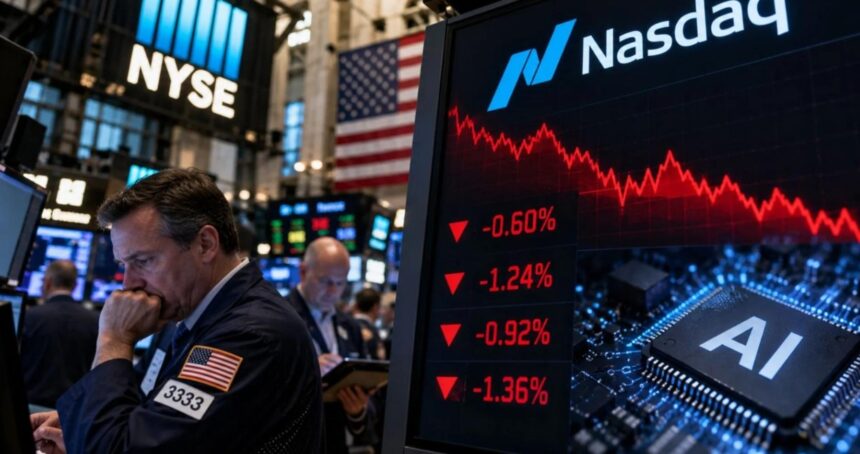
A reported wave of selling across US technology stocks has revived concerns about stretched artificial intelligence valuations, expensive data centre expansion and the time it could take for companies to earn meaningful returns on their AI investments. While the latest market turmoil has raised questions about a possible AI bubble, analysts distinguish between a sharp correction in technology shares and a lasting collapse in demand for artificial intelligence.
Wall Street’s artificial intelligence trade is facing renewed scrutiny following reports of a steep decline in major US technology stocks on November 5, 2026.
According to a market account published by IndyaStory and subsequently carried by 36Kr, technology shares experienced heavy selling, with the Nasdaq 100 reportedly dropping 6.4% and the S&P 500 declining 4.4%.
The report estimated that the Nasdaq 100 lost approximately $2.3 trillion in market capitalisation during the session, while the combined market value of the seven largest US technology companies fell by more than $1 trillion.
See more of our coverage in your search results.
Add INDYASTORY on GoogleThese figures require verification against official index and exchange data before being treated as confirmed market results.
Nevertheless, the questions raised by the report extend beyond a single trading session.
For several years, investors have rewarded companies positioned to benefit from the expansion of artificial intelligence. Semiconductor manufacturers, cloud computing providers, data centre operators and electrical infrastructure suppliers have attracted considerable attention.
A major part of the investment case has rested on the expectation that AI adoption will generate substantial future revenue and productivity improvements.
But as companies commit increasingly large amounts of capital to chips, servers, facilities and electricity infrastructure, investors are examining the relationship between spending and eventual profitability more closely.
See more of our coverage in your search results.
Add INDYASTORY on GoogleThe central question is no longer simply whether AI technology will continue expanding.
It is whether the financial returns from that expansion can justify the valuations investors have assigned to companies throughout the AI supply chain.
What Happened to US Technology Stocks?
The supplied market report describes a broad sell-off affecting several interconnected parts of the technology industry.
See more of our coverage in your search results.
Add INDYASTORY on GoogleSemiconductor companies were among the hardest-hit groups, followed by businesses involved in memory, data storage, cloud computing and data centre infrastructure.
The reported weakness also extended to some industrial and energy businesses associated with expanding computing capacity.
Reported November 5 market movements
| Index or company | Movement cited in source |
|---|---|
| Nasdaq 100 | -6.4% |
| S&P 500 | -4.4% |
| Philadelphia Semiconductor Index | -5.23% at close |
| AMD | -17.3% |
| Micron Technology | More than -17% |
| NVIDIA | -9.3% |
| Tesla | -10.8% |
| GE Vernova | -7.5% |
| Microsoft | -3.6% |
| Meta Platforms | -4.0% |
| Apple | -1.5% |
If confirmed, declines of this magnitude would represent a significant reassessment of technology-sector risk.
However, a fall in share prices does not directly measure a decline in the commercial use of artificial intelligence.
Stock markets reflect expectations about future earnings, financing conditions and valuations.
Those expectations can change much faster than the underlying demand for products or services.
Why Are Investors Concerned About an AI Bubble?
The term AI bubble refers to the possibility that investor enthusiasm has pushed the prices of AI-related companies beyond levels justified by their realistic future financial performance.
A technology can be commercially valuable while some businesses associated with it remain overvalued.
That distinction is essential.
Artificial intelligence is already being used in software development, business services, scientific research, customer support and numerous other applications.
But the success of the technology does not guarantee that every company building or supplying AI infrastructure will earn attractive returns.
During periods of rapid technological change, investors often place substantial value on expected future growth.
If companies subsequently report lower-than-expected revenue, rising expenses or delayed profits, valuations may decline sharply.
The most important test for AI-related businesses is therefore whether they can turn demand into sustainable earnings and cash flow.
The Big Question: When Will AI Spending Generate Profits?
Large technology companies have been investing heavily in infrastructure required to develop and operate advanced AI systems.
That spending includes specialised processors, networking equipment, storage systems, servers, data centres and electricity-related infrastructure.
The investment is known as capital expenditure, or capex.
Unlike a routine operating expense, capital expenditure often produces assets expected to be used over multiple years.
However, the cash required to purchase or build those assets may leave the business well before the associated revenue is fully realised.
This timing difference creates one of the biggest financial challenges in AI infrastructure expansion.
Why high capital expenditure can pressure cash flow
Imagine a technology company spending $20 billion on additional computing infrastructure.
If that investment generates only limited incremental revenue during its initial operating period, the company’s cash flow could weaken even if demand for its services continues growing.
Over subsequent years, the infrastructure may produce additional revenue.
But the company must still account for ongoing electricity consumption, maintenance, staffing, financing and the eventual replacement of equipment.
Depreciation also affects reported accounting profits over time.
The investment makes financial sense only if the future economic benefits justify its total costs and risks.
This is why investors increasingly want evidence that AI spending supports profitable commercial activity, not merely expanding computing capacity.
NVIDIA, AMD and the Semiconductor Sector Face Greater Scrutiny
Semiconductor companies have been central to the expansion of artificial intelligence.
Advanced processors provide the computing power required to train and operate complex machine learning models.
NVIDIA has become closely associated with demand for AI accelerators, while AMD and other semiconductor businesses are competing across parts of the computing market.
The supplied market report describes substantial declines in both companies’ shares during the alleged November 5 sell-off.
But the financial risks facing chip manufacturers are not identical to those facing the companies purchasing their equipment.
Chip suppliers can benefit from strong infrastructure orders even before the final AI applications produce substantial profits.
The longer-term concern is whether customers will maintain similar spending levels once initial infrastructure requirements have been met.
What could slow AI chip demand?
Several developments could influence future semiconductor demand.
A slowdown in data centre construction could reduce orders for new processors.
Improved computing efficiency may change how much hardware is required for particular workloads.
Competition could affect pricing and profit margins.
Customers might also delay purchases while assessing newer technology generations or existing equipment utilisation.
None of these scenarios necessarily implies that AI adoption has stopped.
Instead, they reflect the difference between continued technological progress and uninterrupted growth in hardware spending.
Why Data Centre Financing Has Become a Key Risk
The AI infrastructure industry includes companies with significantly different financial resources.
Established technology groups may finance a large portion of their investments through operating cash flow and existing capital.
Other businesses may depend more heavily on borrowing, external investors or long-term financing arrangements.
The supplied report identifies companies such as CoreWeave, Nebius, IREN and Applied Digital among the businesses exposed to investor concerns about AI infrastructure.
For capital-intensive operators, financing conditions can be especially important.
Data centres require substantial upfront investment before they begin generating their full commercial potential.
Construction delays, higher borrowing costs or weaker customer demand can therefore affect expected returns.
How higher financing costs can affect a project
Consider a hypothetical infrastructure project requiring $5 billion in borrowed capital.
At a 5% annual interest rate, the simple annual interest expense would be approximately $250 million.
At 8%, that amount would rise to $400 million.
The difference is $150 million annually, before considering principal repayments and other financing conditions.
This example illustrates why infrastructure projects can be sensitive to interest rates and financing structures.
Actual project financing arrangements are more complex and may involve fixed-rate borrowing, equity contributions, staged construction and contractual commitments.
Investors must therefore evaluate each company’s debt obligations, customer contracts, cash reserves and expected project returns.
The Risk of Building Too Much AI Infrastructure
Another concern is whether the pace of infrastructure construction could temporarily exceed economically profitable demand.
This possibility is sometimes described as overcapacity.
During periods of technological optimism, multiple companies may expand simultaneously in anticipation of future customers.
If demand grows more slowly than expected, some facilities could experience lower utilisation or reduced pricing power.
The risk is not limited to AI.
Similar patterns have occurred in other capital-intensive industries when businesses invested heavily in anticipation of sustained demand.
For AI infrastructure, the key indicators include computing utilisation, customer contract commitments, pricing, operating costs and the useful lives of specialised equipment.
The fact that infrastructure is being built does not itself establish that it will generate adequate returns.
How the Sell-Off Could Affect the Wider AI Supply Chain
AI infrastructure investment supports a much broader network than semiconductor manufacturers.
Data centres require storage systems, high-speed networking, cooling equipment, electricity infrastructure and construction services.
The supplied report identifies storage companies such as SanDisk, Seagate and Western Digital among those experiencing pressure.
It also describes declines in companies associated with cloud infrastructure, servers and power equipment.
The commercial connection is straightforward.
If technology companies reduce or postpone infrastructure spending, suppliers may experience slower orders or changing revenue expectations.
However, the effect would vary across sectors.
A business serving AI data centres may also serve enterprise computing, conventional cloud services or other markets.
For investors, it is important to examine actual customer concentration and revenue exposure rather than assuming that every infrastructure supplier depends entirely on AI.
Why the Magnificent Seven Matter to Wall Street
The group commonly known as the Magnificent Seven includes Apple, Microsoft, NVIDIA, Amazon, Alphabet, Meta and Tesla.
These companies have substantial influence on major US equity indexes because of their large market capitalisations.
When several of them decline simultaneously, the effect on index performance can be significant.
The supplied report estimates that the group’s combined market value contracted by approximately $1.04 trillion during the alleged November 5 session.
That estimate remains unverified.
The wider significance, however, is the influence of concentrated large-cap stock performance on market indexes.
An index can decline sharply when its largest constituents fall, even if smaller companies experience less severe losses.
Investors holding broad market funds may therefore have more exposure to major technology companies than they initially realise.
Market Concentration Can Make Declines More Severe
Concentrated investment positions can amplify volatility.
When a small number of companies drive a large share of market gains, many funds may develop similar exposures.
Those exposures may arise through direct share purchases, index-tracking funds, sector funds or leveraged positions.
When expectations change, multiple investors may attempt to reduce risk at the same time.
This can create further selling pressure.
Leveraged investors may also face margin requirements if the value of their holdings declines.
Such mechanisms can intensify short-term market movements without necessarily indicating a corresponding deterioration in every company’s underlying business.
Why hedging activity matters
Investors sometimes use options and other financial instruments to protect portfolios against losses.
When volatility rises suddenly, the demand and cost of downside protection can change.
The supplied report attributes comments about increasing hedging demand to Steve Sosnick of Interactive Brokers.
That specific attribution should be checked against the original statement.
More broadly, rapid changes in hedging activity can contribute to market volatility, particularly when traders and financial intermediaries adjust their positions.
However, these mechanisms do not prove that leveraged selling or options hedging caused any particular market decline without supporting trading data.
Did the US Midterm Elections Trigger the AI Sell-Off?
The supplied IndyaStory account links the reported technology decline to the November 2026 US midterm elections.
It suggests that investors became concerned about potential restrictions on data centre development and changing regulatory conditions.
This explanation requires particular caution.
Election results, legislative control, candidates’ positions and the market’s response must all be confirmed through reliable sources.
The fact that an election occurred near a stock market decline does not establish that the election caused the decline.
Market movements can reflect several overlapping developments, including corporate earnings, interest-rate expectations, economic data and portfolio positioning.
Why data centre regulation matters
Large data centres can require substantial electricity, water, land and supporting infrastructure.
Proposed projects may face scrutiny over environmental impacts, local utility capacity, infrastructure costs and community concerns.
Stricter permitting requirements or longer approval processes could affect construction schedules and project economics.
However, regulations differ considerably across jurisdictions.
Any claim that a specific election outcome will force widespread AI infrastructure delays requires evidence of the relevant proposed policies, legal authority and implementation plans.
Attributing the entire reported sell-off to political developments would therefore be premature.
Cathie Wood and ARK Invest: A Different Approach to High-Growth Stocks?
The supplied report also describes trading activity involving Cathie Wood’s ARK Investment Management.
ARK’s investment strategies are associated with companies pursuing technologies that may produce substantial long-term business changes.
Such portfolios can experience significant volatility because the valuations of growth companies are sensitive to future expectations.
The source claims that certain ARK funds purchased SpaceX-related assets while reducing exposure to Alphabet.
However, the specific share count, transaction value and security description cannot be independently confirmed from the supplied information.
Private-company interests, listed securities and investment vehicles that provide indirect exposure to a company are not interchangeable.
Before reporting the alleged $47.4 million purchase or 348,400-share figure as fact, the original ARK transaction disclosures and instrument details should be checked.
The general investment principle remains relevant.
Some investors respond to market declines by reducing exposure, while others view lower prices as an opportunity to purchase assets they believe have long-term value.
Neither approach guarantees a favourable result.
Does a Market Crash Mean the AI Bubble Has Burst?
A sharp decline in technology stock prices can indicate that investors are reassessing expectations.
But a single trading session is not enough to establish whether an entire investment theme has entered a prolonged collapse.
A speculative bubble is generally associated with prices becoming disconnected from realistic economic value, often followed by a substantial correction.
Determining whether that description applies requires examining valuations, earnings, investment returns, market behaviour and the durability of underlying demand.
Three distinctions are particularly important.
AI technology and AI stocks are not the same thing. The technology may continue developing even when shares of some companies decline.
Revenue growth and shareholder returns are different. A company can expand rapidly while delivering disappointing investment returns if its stock was initially too expensive.
A correction and a lasting collapse are different outcomes. Share prices can recover after volatility, but they can also remain depressed if financial expectations deteriorate.
The correct conclusion depends on evidence over time rather than the size of one reported decline.
What Could Happen Next? Three Scenarios for AI Stocks
Scenario 1: Market stabilisation
If investors conclude that the sell-off has been excessive and corporate earnings remain supportive, technology shares could stabilise.
In this scenario, market attention may return to revenue growth, customer demand and long-term business opportunities.
Scenario 2: Continued valuation adjustment
Even if AI demand remains strong, investors could assign lower valuation multiples to companies facing higher costs or slower expected growth.
This would allow the industry to continue expanding while share prices remain under pressure.
Scenario 3: A broader infrastructure investment slowdown
If financing conditions deteriorate or customers significantly reduce spending, some AI infrastructure projects could be postponed.
Such an outcome could affect suppliers of chips, servers, storage systems and related equipment.
These scenarios are illustrative possibilities, not predictions or assigned probabilities.
What Investors Should Watch Before Calling the AI Boom Over
The most useful signals will come from company fundamentals and actual spending trends.
Investors should examine whether AI-related revenue is growing quickly enough to justify infrastructure investment.
Free cash flow is also important because large capital expenditures can create substantial funding requirements.
For semiconductor companies, customer order trends, pricing and margins may provide evidence of whether demand remains healthy.
For data centre operators, utilisation, contracts, debt obligations and financing costs can influence financial sustainability.
Valuation remains another critical factor.
A commercially successful company can still be an unattractive investment if its share price assumes unrealistic future growth.
Finally, investors should consider portfolio concentration and the extent to which their investments depend on a small group of technology companies.
What Could a US AI Stock Correction Mean for India?
India’s stock market and technology industry are connected to global investment trends.
Major changes in US technology valuations can influence international investor sentiment, particularly towards growth-oriented companies.
Indian IT services businesses may also be affected by changes in technology spending among overseas customers.
However, the effect is not necessarily uniform.
Some businesses could benefit from demand for AI implementation, software integration and enterprise technology services even if infrastructure spending becomes more selective.
Indian investors should distinguish between global sentiment, company-specific financial exposure and the actual performance of domestic businesses.
A decline in US technology shares does not automatically imply an equivalent decline in Indian technology companies.
The Bigger Question: Can AI Deliver Enough Economic Value?
Artificial intelligence has the potential to improve productivity and create new products and services.
But economic value depends on how effectively businesses implement the technology.
For a company deploying AI, the important questions include whether the system reduces costs, improves service quality, increases revenue or enables capabilities that would otherwise be difficult to provide.
For an AI infrastructure supplier, the corresponding questions involve sales demand, pricing, profitability and capital efficiency.
These are ordinary business fundamentals applied to an unusually fast-developing technology.
The market’s growing attention to financial returns should not be confused with a rejection of AI itself.
It may instead represent a shift from broad enthusiasm towards more demanding evaluation of business performance.
Conclusion: The AI Boom Faces a Financial Reality Check
The reported November 5 technology sell-off has renewed the debate about whether valuations across the AI sector have become excessive.
Large investments in chips, computing facilities and supporting infrastructure have created substantial opportunities for technology suppliers.
They have also increased the pressure on companies to demonstrate that spending will produce sustainable financial returns.
Concerns about financing costs, infrastructure utilisation, market concentration and future profitability are legitimate issues for investors to examine.
Yet a major market correction, even if the supplied figures are confirmed, would not by itself prove that AI technology has failed or that long-term commercial demand has disappeared.
The more important question is which businesses can convert AI adoption into durable revenue, healthy margins and positive cash flow.
That distinction will matter long after the volatility of any single trading session has passed.