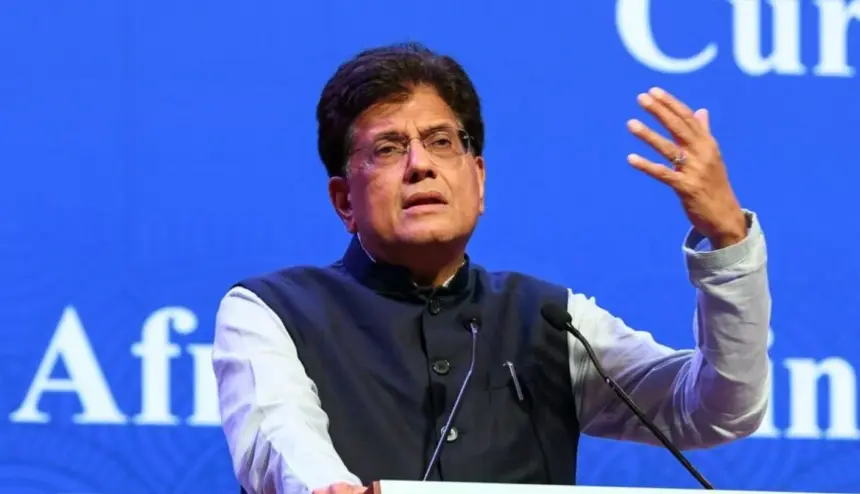
India is confident of achieving $1 trillion in exports during the current financial year, Commerce and Industry Minister Piyush Goyal said, as the country seeks to expand its share of global trade despite a challenging international environment.
According to an official statement issued on Thursday, India recorded $863 billion in exports last year and has set a target of $1 trillion for the current fiscal year.
Reaching the target would require growth of nearly 16% over the previous year’s level, significantly faster than the expected expansion in global trade.
Goyal said the target reflects the collective ambition of India’s businesses and workers at a time when international trade is expected to grow by only around 2.5% to 3%, while global economic growth is projected to remain below 3%.
See more of our coverage in your search results.
Add INDYASTORY on GoogleIndia targets rapid export growth despite global uncertainty
Speaking at the curtain-raiser event for the 31st CII Partnership Summit, Goyal said India was seeking to expand trade links while other parts of the world were increasingly turning towards protectionist measures.
More Read

“India began building bridges when the world was building walls,” Goyal said.
The minister argued that the $1 trillion target should not be viewed as a government-only objective.
He said the effort was being driven by India’s broader business ecosystem, including 63 million micro, small and medium enterprises (MSMEs), large and small industries, global capability centres and approximately 250,000 startups.
Together, these businesses form a wide base from which India can seek to increase merchandise and services exports.
More Read

$1 trillion target requires nearly 16% growth
India’s reported export base of $863 billion means the country needs a substantial increase to reach $1 trillion in the current fiscal year.
See more of our coverage in your search results.
Add INDYASTORY on GoogleThe implied growth requirement is close to 16%.
That is significantly above the projected growth of international trade, making the target dependent not only on overall global demand but also on India gaining market share and expanding exports in competitive sectors.
The target also comes at a time when supply chains, tariffs and geopolitical developments are reshaping international commerce.
See more of our coverage in your search results.
Add INDYASTORY on GoogleGlobal trade environment remains difficult
Goyal highlighted the contrast between India’s export ambitions and the broader global outlook.
International trade is expected to expand at only about 2.5% to 3%, while global economic growth is expected to remain below 3%, according to the figures cited in the official statement.
More Read

That means Indian exporters could face weaker external demand even as they seek double-digit growth.
Geopolitical uncertainty, changes in trade policy and disruptions to global supply chains could further affect individual industries.
For India, expanding exports would therefore require greater competitiveness as well as access to new markets.
MSMEs and startups central to export ambitions
Goyal’s emphasis on MSMEs and startups reflects the increasingly broad base of India’s export economy.
The country has millions of smaller businesses operating across manufacturing, services, engineering, textiles, pharmaceuticals, technology and other sectors.
Improving their ability to participate in global supply chains could help increase India’s overall exports.
Large companies and global capability centres can also contribute by integrating India more deeply into multinational production and services networks.
Startups, meanwhile, can expand India’s export footprint through software, technology and digitally delivered services.
Growth outlook remains supportive
The minister also referred to the Reserve Bank of India’s latest growth outlook, saying the central bank had raised its growth projections for the current year and continued to expect India to grow at more than 7%.
The statement cited the RBI’s assessment that India would remain the fastest-growing large economy.
A relatively strong domestic economy could provide support for investment and production even if external demand remains uneven.
For exporters, however, stronger domestic growth alone is not enough. Maintaining international competitiveness, reducing logistics costs and securing access to major markets will remain important to achieving the government’s target.
Digital transformation has reduced economic costs
Goyal also highlighted the impact of India’s digitalisation programme.
Referring to the 10th edition of India Mobile Congress, he said Prime Minister Narendra Modi had cited savings of more than ₹5 lakh crore, or over $55 billion, generated through the Digital India movement over the past 12 years.
The government has positioned digital infrastructure as a tool for improving financial inclusion, public-service delivery and administrative efficiency.
Goyal argued that the country’s reform programme has similarly focused on replacing fragmented systems with more integrated national frameworks.
GST and power-grid integration among reform examples
The minister cited the introduction of the Goods and Services Tax (GST) as an example of structural reform.
GST brought multiple indirect tax systems under a common framework, creating a more integrated domestic market and simplifying the tax structure across states, although businesses have continued to adapt to the system’s compliance requirements.
Goyal also pointed to the integration of regional electricity networks into a national power grid as another example of reforms designed to build nationwide infrastructure.
The broader argument is that national-scale economic infrastructure can reduce fragmentation and improve the ability of businesses to operate across India’s large domestic market.
Modi’s 25 years in public service highlighted
Goyal also referred to Prime Minister Narendra Modi’s 25 years as a head of government, describing the period as one of sustained public service and linking it to the government’s longer-term ambition of making India a developed economy by 2047.
He said the broader development objective depends on the collective efforts of India’s population and business community.
Those political assessments were part of Goyal’s address rather than independent economic projections.
Can India turn the target into actual export growth?
The $1 trillion export target represents a substantial step up from India’s previous performance.
The challenge will be to generate nearly 16% growth in exports while global trade expands at a much slower pace.
That makes competitiveness, market diversification, supply-chain integration and the expansion of high-value goods and services particularly important.
India’s large MSME base, technology sector, startups and manufacturing ambitions provide a broad platform for export growth, but international conditions will remain an important variable.
For now, the government remains confident that India can reach $1 trillion in exports in FY27. The actual outcome will depend on global demand, trade policy, commodity prices, currency movements and the ability of Indian businesses to capture a larger share of international markets.