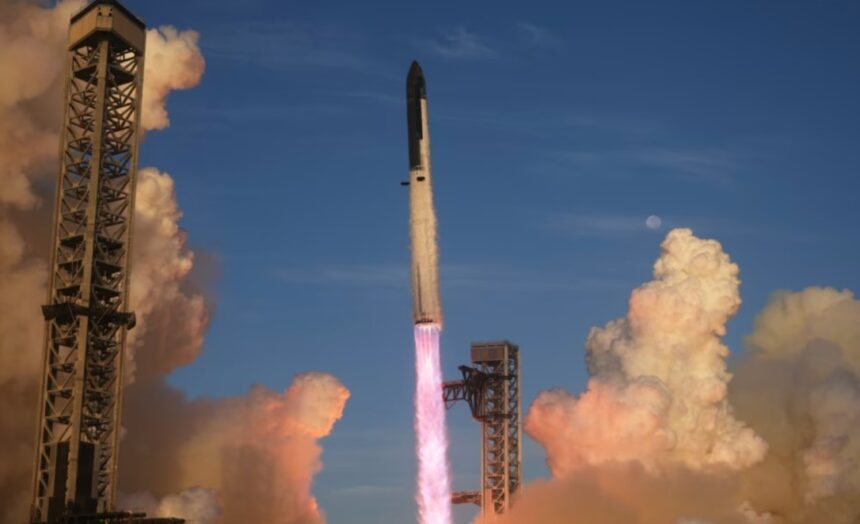
SpaceX’s latest quarterly earnings report has brought renewed attention to Elon Musk’s expanding business ambitions, including discussions about a possible merger with Tesla, a major artificial intelligence infrastructure project in Memphis and plans for another rocket launch facility in Louisiana.
The company reportedly generated $14.6 billion in revenue during the third quarter of 2026 and recorded a profit of $4.4 billion. During discussions surrounding the results, Musk also outlined an ambitious long-term revenue target and provided updates on several projects that could influence SpaceX’s future growth.
The announcements highlight how SpaceX is developing beyond its traditional rocket-launch business. Satellite internet, artificial intelligence computing and new launch infrastructure are becoming increasingly important to its broader commercial strategy.
Here are five major takeaways from the reported earnings discussion.
See more of our coverage in your search results.
Add INDYASTORY on Google1. SpaceX and Tesla merger discussions raise new questions
One of the most significant developments was Musk’s statement that special committees at SpaceX and Tesla had been established to discuss a possible merger at the request of shareholders.
According to the supplied report, Musk emphasised that a combination was not certain. The discussions should therefore not be interpreted as confirmation that the companies will merge.
A potential combination would bring together businesses with different core operations. SpaceX focuses on rockets, spacecraft, satellite communications and related infrastructure, while Tesla operates in electric vehicles, energy storage and associated technologies.
Artificial intelligence and autonomous systems are relevant to both companies, making the prospect of closer cooperation a subject of interest for investors. However, overlapping technological ambitions do not necessarily mean that a merger would create sufficient financial or operational benefits.
Any transaction would raise substantial questions about valuation, ownership, governance, financing and the treatment of existing shareholders. Depending on its structure, it could also require regulatory review and other formal approvals.
See more of our coverage in your search results.
Add INDYASTORY on GoogleThe establishment of special committees would be an important procedural step if confirmed, but it would not establish that an agreement has been reached.
For now, the key development is the reported discussion itself. Investors should distinguish between preliminary consideration, a formal agreement and a completed transaction.
2. SpaceX reports $4.4 billion in quarterly profit
SpaceX reportedly earned $4.4 billion in the third quarter of 2026, marking a significant financial milestone for the aerospace and satellite communications company.
See more of our coverage in your search results.
Add INDYASTORY on GoogleThe supplied figures also put quarterly revenue at $14.6 billion.
The results suggest that the company’s expanding operations are contributing to a broader revenue base. SpaceX has historically been associated with rocket launches and spacecraft, but its commercial activities now also include Starlink satellite internet and artificial intelligence-related operations.
Starlink provides connectivity through a satellite network designed to serve customers in locations where conventional broadband can be limited or difficult to deploy. Its recurring service revenue offers a different income stream from individual launch contracts.
Meanwhile, AI-related investments could provide opportunities to participate in the growing market for computing capacity and advanced digital infrastructure.
Nevertheless, quarterly profit alone does not explain how much each business contributes to the company’s overall performance. Investors would need segment-level financial information, operating costs, capital expenditure and cash-flow disclosures to understand the quality and sustainability of those earnings.
The reported profit is significant, but subsequent results will help determine whether SpaceX can maintain profitability while funding its ambitious expansion plans.
3. Elon Musk forecasts annual recurring revenue above $500 billion
Musk reportedly predicted that SpaceX’s annual recurring revenue could exceed $500 billion by the end of 2027, with the possibility of reaching $1 trillion.
The forecast represents an exceptionally ambitious growth target and should be treated as management’s projection rather than an established outcome.
The distinction between annual revenue and annual recurring revenue is important. Annual recurring revenue, commonly abbreviated as ARR, is an annualised measure of recurring income from ongoing services or contracts. It is not necessarily the same as revenue recognised under accounting rules over a particular financial year.
That distinction matters when comparing the reported $14.6 billion in quarterly revenue with Musk’s longer-term target.
SpaceX’s ability to increase recurring income could depend heavily on Starlink’s customer growth, service pricing, network expansion and the development of additional connectivity markets. AI-related services could provide another potential source of income, depending on demand and the commercial structure of those operations.
Reaching the stated target would require substantial growth, and the available figures alone do not establish a clear path to that level of revenue.
Investors should look for detailed assumptions, segment forecasts and evidence of customer demand before drawing conclusions about the likelihood of achieving the target.
The forecast nevertheless illustrates the scale of Musk’s ambitions for the company’s next phase of development.
4. Memphis becomes central to SpaceX’s AI computing ambitions
Musk reportedly said he was spending four days each week at a facility in Memphis to help bring SpaceX’s supercomputing cluster online.
The project reflects the growing importance of computing infrastructure in the development and deployment of advanced artificial intelligence systems.
Training and running sophisticated AI models requires significant computing resources, including specialised processors, high-speed networking, electricity and cooling systems. Building a large computing cluster also involves substantial investment in physical infrastructure and operational capacity.
For companies developing AI products, access to computing power can influence how quickly new systems are trained, deployed and improved.
SpaceX’s reported work in Memphis is therefore relevant to understanding the company’s broader AI strategy. It suggests that the business is investing in infrastructure rather than relying exclusively on its established aerospace and satellite operations.
However, the commercial significance of the project will depend on factors such as computing capacity, operating costs, electricity availability, equipment deployment and the demand for the resulting services.
The facility’s progress should also be assessed separately from claims about the profitability of the company’s AI division. Building computing capacity can require significant upfront expenditure before its full commercial contribution becomes clear.
Further disclosures about the project’s scale, timetable and intended uses would help investors assess its long-term potential.
5. Louisiana rocket launchpad could begin operations in 2029
SpaceX reportedly expects its planned Louisiana launch facility, referred to as Starbase Louisiana in the supplied report, to be ready for rocket launches in 2029.
If completed on that schedule, the facility would expand the company’s launch infrastructure and potentially provide additional operational capacity.
Rocket launch sites require extensive preparation. Depending on the project, development can involve environmental assessments, regulatory approvals, construction of launch infrastructure, safety systems, transportation arrangements and coordination with relevant authorities.
The location described in the report as a duck-hunting area also raises questions about land use and the potential environmental implications of development. Those issues would need to be assessed through the applicable planning and regulatory processes.
A projected launch date is not the same as an approved or operational launch programme. Construction progress, permitting, environmental reviews and technical readiness can all influence the final schedule.
Additional launch infrastructure could support SpaceX’s ambitions to expand its launch activity, but the commercial benefit would depend on demand, operating capacity and the costs of establishing and maintaining the site.
The reported 2029 target is therefore best understood as a forward-looking expectation rather than a guaranteed opening date.
What these five developments mean for SpaceX
The reported earnings discussion points to a company pursuing several large-scale opportunities at the same time.
Starlink offers recurring connectivity revenue, AI computing represents a growing infrastructure investment, and additional launch facilities could expand the company’s aerospace capabilities. The reported discussions involving Tesla also raise the possibility of a major corporate restructuring, although no completed merger has been established by the information provided.
Each opportunity comes with its own risks. Infrastructure expansion requires capital, AI computing carries significant operating costs, and a merger would involve complex financial and governance considerations.
For investors, the most important indicators will include sustainable profitability, segment-level revenue growth, cash flow, capital expenditure and progress against the company’s announced plans.
The revenue target and project timelines should be evaluated against subsequent disclosures rather than treated as guaranteed outcomes.
SpaceX’s next phase will ultimately be judged not only by the scale of its ambitions, but also by its ability to execute those plans while generating durable financial returns.