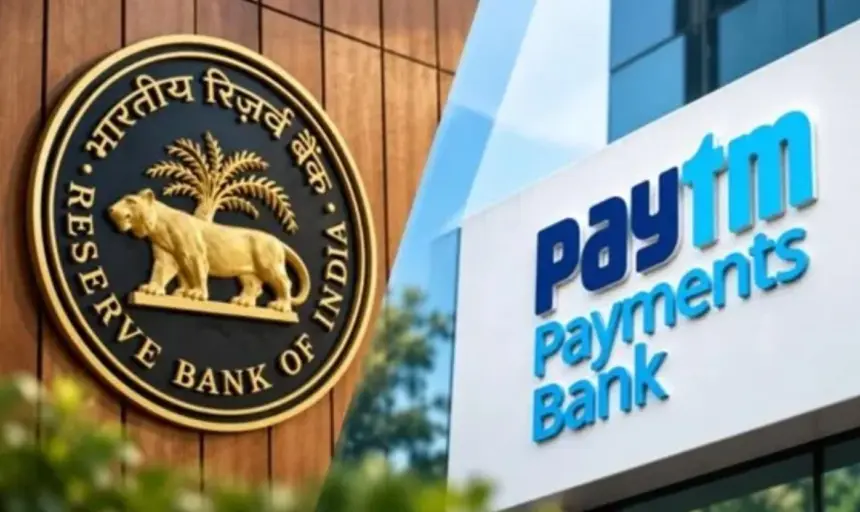
The Reserve Bank of India (RBI) has formally removed Paytm Payments Bank Ltd (PPBL) from the list of scheduled banks, completing another step in the regulatory action that followed cancellation of the bank’s licence.
In a statement, the central bank said:
“Paytm Payments Bank Limited has been excluded from the Second Schedule to the Reserve Bank of India Act, 1934…”
The action follows the cancellation of PPBL’s banking licence in April 2026 and the subsequent decision of the Delhi High Court to wind up the payments bank.
PPBL removed from RBI’s scheduled banks list
The RBI Act’s Second Schedule contains the list of banks classified as scheduled banks.
See more of our coverage in your search results.
Add INDYASTORY on GoogleA bank included in the schedule is generally referred to as a “scheduled bank” under the RBI Act and must meet the applicable conditions prescribed under the law.
More Read
The RBI’s latest action means Paytm Payments Bank is no longer included in that recognised category.
According to the information supplied, the relevant notification was issued on July 31, 2026, and subsequently published in the Gazette of India in September.
The exclusion follows the earlier cancellation of PPBL’s banking licence and the winding-up proceedings ordered by the Delhi High Court.
More Read

RBI had cancelled PPBL’s banking licence earlier
The latest notification is the result of a regulatory process that began several years ago.
See more of our coverage in your search results.
Add INDYASTORY on GoogleIn April 2026, the RBI cancelled Paytm Payments Bank’s banking licence, citing non-compliance with regulatory requirements.
The central bank said the affairs of the bank had been conducted in a manner that was detrimental to the interests of the bank and its depositors.
The RBI’s decision came after a series of supervisory and operational restrictions imposed on PPBL.
See more of our coverage in your search results.
Add INDYASTORY on GoogleRestrictions began with customer onboarding ban
The payments bank first faced a major regulatory restriction in March 2022, when the RBI directed it to stop onboarding new customers.
The prohibition took effect from March 11, 2022, following what the central bank described at the time as “material supervisory concerns”.
More Read

The RBI also directed the bank to appoint an IT audit firm to carry out a comprehensive audit of its information-technology systems.
The IT review formed part of the regulator’s efforts to examine the bank’s systems and compliance framework.
Further business restrictions imposed in 2024
Additional restrictions were imposed on PPBL in early 2024.
On January 31, 2024, the RBI announced a series of measures against the payments bank, followed by further clarification and action on February 16, 2024.
Among the restrictions was a prohibition on accepting additional deposits, credits or top-ups in existing customer accounts, prepaid instruments and wallets, subject to the terms of the regulatory directions.
These measures significantly reduced the scope of PPBL’s banking and payments-bank activities.
The subsequent cancellation of its banking licence marked a further escalation of the regulatory action.
Delhi High Court later ordered winding up
After the licence cancellation, the Delhi High Court ordered Paytm Payments Bank to be wound up, according to the information supplied.
The court proceedings represent another stage in the formal closure of the banking entity.
The RBI’s removal of PPBL from the Second Schedule now follows that sequence of regulatory and legal actions.
Paytm Payments Bank is separate from Paytm’s parent company
The regulatory action is specifically related to Paytm Payments Bank Ltd, rather than meaning that the Paytm brand or its parent company automatically ceases all operations.
PPBL is associated with the fintech business promoted by Vijay Shekhar Sharma.
Its ownership structure has historically involved Sharma and One 97 Communications Ltd, the publicly listed parent of Paytm.
The distinction between the payments bank and the broader Paytm business is important when assessing the financial and operational implications of the RBI’s actions.
What does “scheduled bank” mean?
The term “scheduled bank” refers to a bank included in the Second Schedule of the RBI Act, 1934.
Inclusion is based on statutory conditions and gives qualifying institutions access to certain facilities and treatment within India’s banking framework.
Removing an institution from the schedule is therefore a formal regulatory step reflecting a change in its status under the RBI Act.
In PPBL’s case, the removal comes after the more fundamental action of licence cancellation.
A long regulatory process reaches another milestone
The exclusion of Paytm Payments Bank from the scheduled banks list is not an isolated regulatory event.
It follows a sequence that includes:
2022: RBI directs PPBL to stop onboarding new customers amid supervisory concerns.
2024: Further restrictions are imposed on deposits, credits, top-ups and certain payment-bank instruments.
April 2026: RBI cancels PPBL’s banking licence.
2026: Delhi High Court orders the winding up of the payments bank.
July 31, 2026: RBI order excludes PPBL from the Second Schedule.
September 2026: The notification is published in the Gazette of India.
The latest action therefore represents another formal step in the closure and regulatory unwinding of Paytm Payments Bank.
What happens next?
For PPBL, the key process now is the winding-up ordered by the Delhi High Court and the associated legal and administrative procedures.
For Paytm’s shareholders and customers, the more relevant question is how the closure of the banking subsidiary interacts with the operations of the wider Paytm ecosystem.
The RBI’s latest notification itself concerns PPBL’s status as a scheduled bank. It should not be described as a fresh cancellation of the licence, because the licence cancellation occurred earlier in 2026.
The latest development instead formalises the bank’s removal from the RBI’s Second Schedule following the regulatory action already taken against the institution.