








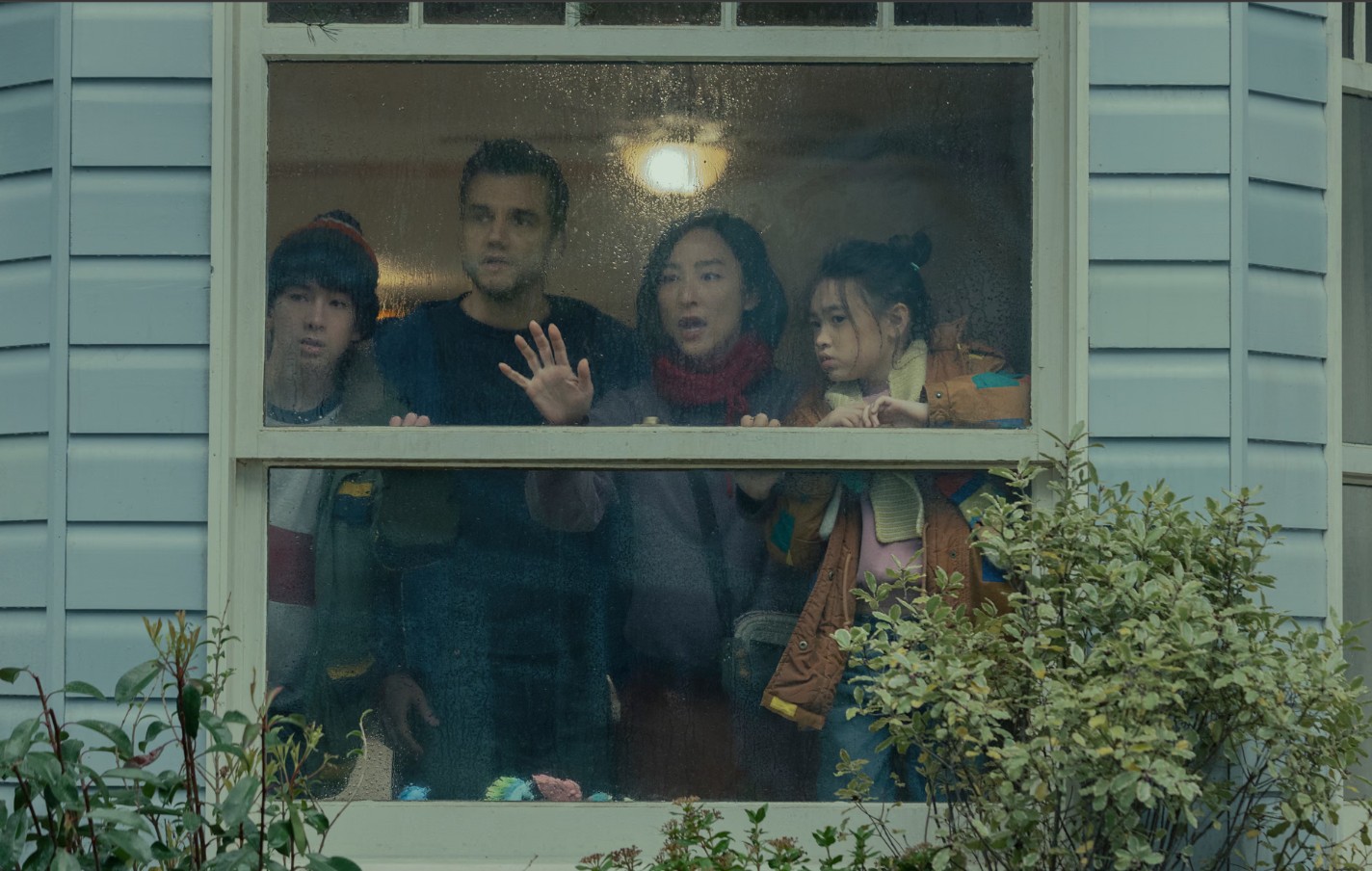
Verdict: A decent Netflix survival thriller with an intriguing premise, strong moments and a disappointing final stretch.
There is something immediately unsettling about The Last House. Its central idea takes an ordinary experience—the desire to stay safe inside your own home—and turns it into a survival problem.
Directed by Louis Leterrier and led by Wagner Moura and Greta Lee, the Netflix sci-fi thriller follows a family forced to remain inside their suburban home after a mysterious phenomenon makes the world outside increasingly dangerous.
The film starts with a promising question: what happens when home stops being a refuge?
Unfortunately, while The Last House builds that question effectively, its eventual answers do not always match the strength of the setup.
A Family Trapped Behind Four Walls
Jason and Riley live with their two children in what initially appears to be a completely ordinary suburban house.
Then an unexplained event changes everything.
A torrential downpour arrives, and the family discovers that going outside is no longer a simple option. The strange phenomenon surrounding the rain effectively transforms their home into both a shelter and a prison.
At first, survival feels almost manageable.
The family has food, supplies and familiar surroundings. Everyday inconveniences become surprisingly important. Without reliable internet access and with normal routines disappearing, the family has to find new ways to spend their time.
That early section is arguably where the film feels most convincing.
There is an interesting tension between the comforting familiarity of family life and the growing realisation that the outside world may have become inaccessible.
The Survival Elements Work Best
The Last House becomes more effective when it concentrates on practical survival rather than explaining its larger mythology.
Food becomes increasingly important. Supplies have to be preserved. Everyday household objects take on new value.
Jason’s technical abilities and experience also become useful as the family attempts to adapt to their increasingly restricted circumstances.
These details give the movie a grounded quality that makes its more extreme elements easier to accept.
The film also understands that isolation isn’t simply about physical survival.
As the days stretch into weeks and longer periods, the psychological pressure begins to affect the family. Arguments become more serious, fear becomes harder to suppress and the boundaries between protecting one another and controlling one another begin to blur.
That gives the film some of its strongest dramatic material.
Wagner Moura Anchors the Film
Wagner Moura brings a controlled intensity to Jason.
His performance helps sell the idea of a father trying to maintain authority and protect his family while confronting circumstances he cannot fully understand.
Jason is not presented as an invincible action hero. His usefulness comes from his ability to improvise and his determination to keep the family functioning.
Moura gives those scenes enough weight to prevent the character from becoming a conventional survival-movie protagonist.
Greta Lee’s Riley has more complicated material to work with, although the character is not always as clearly developed.
Lee brings emotional restraint to the role, but the screenplay occasionally leaves her with less dramatic definition than Jason.
The Film Is Better When It Doesn’t Explain Everything
One of the more appealing aspects of The Last House is its early mystery.
The audience is given enough information to understand that something has gone seriously wrong, but not enough to completely explain the phenomenon.
That uncertainty creates suspense.
Unfortunately, the film eventually has to explain the rules behind its central threat, and this is where the screenplay becomes less convincing.
The larger science-fiction ideas are considerably less interesting than the family drama happening inside the house.
Instead of making the mystery increasingly compelling, some of the later explanations feel more functional than genuinely surprising.
The Horror Never Quite Lands
The movie occasionally moves from survival thriller into creature-feature territory.
That shift is understandable, particularly as the danger outside the house becomes more important. But the threat itself is not consistently frightening.
The creature work does not leave the same impression as the film’s premise, and several potentially tense sequences are weakened by editing and pacing.
There are moments when The Last House seems close to becoming a genuinely unsettling horror movie, only to retreat into more familiar genre territory.
The result is suspenseful in places but rarely terrifying.
A Strong Premise, Uneven Payoff
The biggest problem with The Last House is not the idea.
The premise is strong enough to support an excellent contained thriller. A family trapped in their own home while an unexplained force transforms the outside world into a threat is an inherently effective setup.
The problem is that the second half does not consistently build on the strengths of the first.
The movie introduces questions about the phenomenon, the outside world and the future of the family, but some of those questions receive answers that feel less satisfying than the mystery itself.
The final act therefore has less impact than the premise promises.
Is The Last House Worth Watching?
Yes, with the right expectations.
The Last House is unlikely to become a landmark of post-apocalyptic science fiction, but it works reasonably well as a contained Netflix thriller.
The strongest material comes from watching an ordinary family adapt to extraordinary circumstances. The domestic details, resource shortages and psychological pressure provide more tension than the film’s larger mythology.
Moura gives the film a dependable central performance, while Lee contributes to the emotional conflict despite a character that could have been more fully written.
The movie ultimately feels designed for a home-streaming audience: accessible, polished enough to hold attention and packed with a high-concept premise that can make for an entertaining evening.
It is not consistently scary, its mythology is less satisfying than its setup and the final stretch struggles to deliver the payoff the story appears to promise.
But if you’re looking for a relatively low-commitment survival thriller with a family-at-the-centre premise, The Last House has enough going for it to justify pressing play.
IndyaStory Rating: 3/5