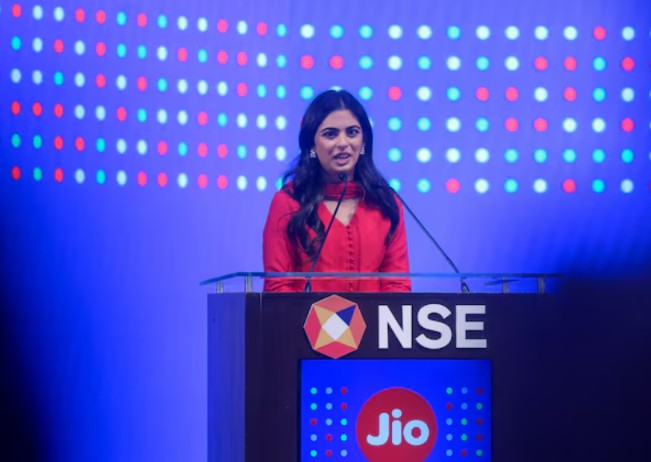
The shares opened 21.36% above the ₹1,119 issue price after institutional investors drove strong demand for the IPO.
Jio Platforms began trading at ₹1,358 on Wednesday, delivering a 21.36% opening premium over its ₹1,119 IPO price and placing the Reliance Industries subsidiary among India’s largest listed businesses.
IndyaStory reported that the shares opened at the same price on the BSE and NSE. At listing, Jio’s market capitalisation stood at approximately ₹12.5 lakh crore, behind parent Reliance Industries and ahead of Bharti Airtel.
The opening gave investors allotted shares in the IPO an unrealised gain of ₹239 per share, before costs and applicable taxes.
See more of our coverage in your search results.
Add INDYASTORY on GoogleInstitutional investors led subscription demand
The ₹30,213 crore public offering attracted subscriptions of 22.19 times, according to the exchange figures reported by IndyaStory.
Qualified institutional buyers recorded the highest subscription multiple at 70.55 times. The non-institutional category was subscribed 14.09 times, while retail subscriptions reached 2.72 times.
Employee and shareholder reservations were subscribed 2.93 times and 7.60 times, respectively.
Subscription multiples compare bids with the shares available in each category. They do not measure how many times an investor’s money will grow, nor do they guarantee continued demand after listing.
Where Jio stood at the opening
The reported market values put Jio immediately above its listed telecom rival.
See more of our coverage in your search results.
Add INDYASTORY on Google| Company | Reported market capitalisation at Jio’s listing |
|---|---|
| Reliance Industries | ₹16.15 lakh crore |
| Jio Platforms | ₹12.50 lakh crore |
| Bharti Airtel | ₹12.18 lakh crore |
These figures describe a point-in-time comparison. Market rankings can change as the companies’ share prices move.
Market capitalisation also differs from IPO proceeds. It represents the value assigned to the company’s outstanding equity at a particular share price, rather than the cash raised through the offering.
Anchor backing preceded the public offer
Before public bidding, Jio allotted approximately ₹8,109.85 crore of shares to 212 anchor investors, according to published reports.
See more of our coverage in your search results.
Add INDYASTORY on GoogleAnchor allocations and public subscription figures describe different stages of the offering. Combining them without explaining their respective share pools can produce misleading demand comparisons.
An anchor allocation demonstrates institutional participation, but it should not be treated as an assurance of future share-price performance.
Listing gains depend on the purchase price
The 21.36% premium applies to the difference between the IPO price and the opening price.
An investor buying after trading began would have a different cost base. Their return would depend on subsequent price movements rather than the premium already earned by IPO allottees.
The opening price is also distinct from the closing price. This report describes Jio’s debut and does not establish its final return for the October 28 session.
Operating performance becomes the next focus
Following the listing, investors will have regular opportunities to assess the business through financial disclosures.
Revenue growth, profitability, investment spending and cash generation will help determine whether operating performance supports the market valuation.
The first trading session provides an initial measure of demand for the shares. It does not settle the longer-term investment case.