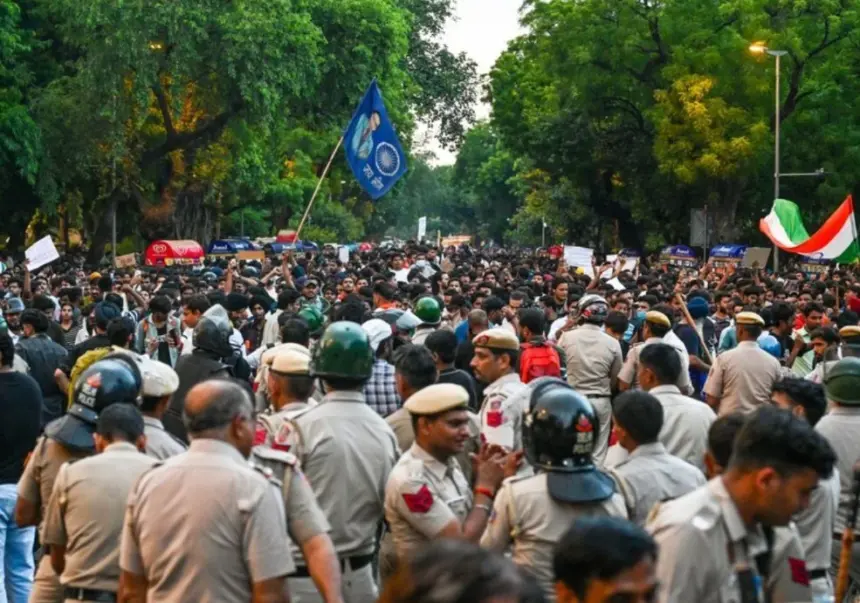
New Delhi: Protests in Delhi could put business transactions worth approximately ₹400 crore at risk each day, with the potential exposure reaching ₹4,000 crore over ten days if disruptions continue, the Confederation of All India Traders (CAIT) has warned.
CAIT Secretary General and Chandni Chowk MP Praveen Khandelwal said on Sunday that prolonged disruptions to traffic, transportation, customer movement and access to commercial markets could affect business activity across the national capital. The concerns are particularly significant during the festive and wedding season, when trading activity typically plays an important role for retailers and wholesalers.
Khandelwal clarified that the figures are indicative estimates of business activity potentially affected by the protests, rather than confirmed or independently verified financial losses.
CAIT Estimates Up to ₹440 Crore in Daily Business Exposure
According to Khandelwal, Delhi’s average daily business turnover is estimated at around ₹2,200 crore. Even a relatively modest decline in commercial activity could put a substantial volume of transactions at risk.
See more of our coverage in your search results.
Add INDYASTORY on GoogleBased on CAIT’s estimates, a 10% reduction in business activity could affect transactions worth approximately ₹220 crore per day. A 15% decline could raise the figure to ₹330 crore, while a 20% reduction could put around ₹440 crore in daily business activity at risk.
If disruptions persist for ten days and business activity falls by around 20%, the cumulative exposure could reach approximately ₹4,400 crore. CAIT’s headline estimate of ₹4,000 crore therefore represents a rounded projection of the potential impact.
These figures describe the value of business activity that could be affected. They should not be interpreted as a direct measure of losses suffered by traders, since some transactions may be postponed, shifted to other locations or completed later.
Traffic Disruptions Could Affect Delhi’s Commercial Markets
Khandelwal said restricted market access and transportation delays could affect the movement of goods and customers, creating difficulties for wholesalers, retailers, distributors and other businesses operating in Delhi.
The capital serves as a major commercial distribution centre, connecting manufacturers and suppliers with retailers and consumers in several parts of India. According to Khandelwal, sustained disruption could therefore have consequences extending beyond Delhi’s local markets, potentially affecting supply chains and livelihoods elsewhere.
See more of our coverage in your search results.
Add INDYASTORY on GoogleThe impact could be especially concerning for businesses that depend on physical customer visits, timely deliveries and high trading volumes during the festive and wedding season.
CAIT Calls for Balance Between Protest Rights and Trade
Khandelwal acknowledged that the Constitution protects citizens’ rights to freedom of speech and peaceful assembly. However, he argued that these rights should be balanced with the ability of traders and workers to carry out their livelihoods without avoidable disruption.
“Delhi is not merely the national capital; it is one of the country’s most important centres of wholesale distribution, retail trade and commercial activity. Its markets connect manufacturers, distributors, retailers and consumers across India. Any prolonged disruption in Delhi therefore has a cascading impact on supply chains, business transactions and livelihoods far beyond the city,” Khandelwal said.
See more of our coverage in your search results.
Add INDYASTORY on GoogleHe added that the right to protest and the right to trade are both important in a democratic society and called for an approach that respects democratic expression, the rule of law, economic activity and livelihoods.
Actual Economic Impact Remains Uncertain
The final economic impact will depend on the duration and location of the protests, the extent of traffic restrictions, market accessibility and whether customers and businesses can shift transactions to alternative channels.
CAIT’s projections offer an indication of the possible scale of commercial activity at risk, but the estimates do not establish the amount of business actually lost. A clearer assessment would require data on market sales, delivery delays, footfall and trading activity during the period of disruption.