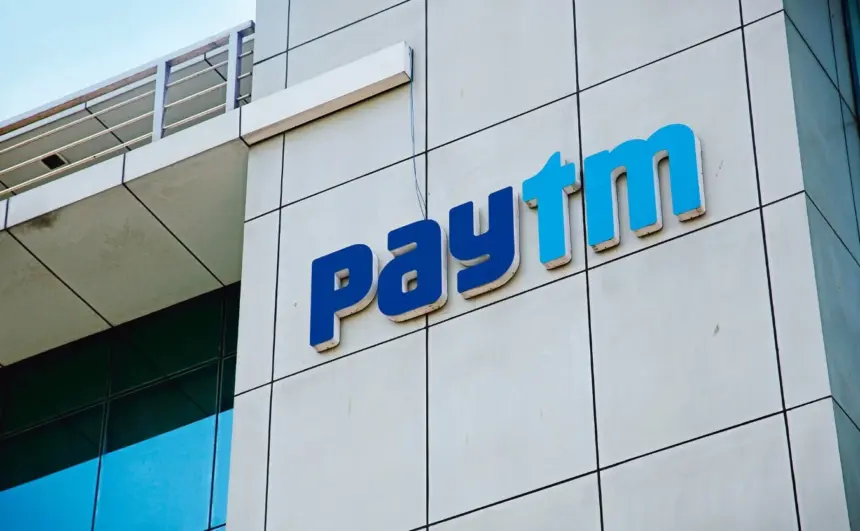
Shares of One 97 Communications Ltd, the parent company of Paytm, fell as much as 10% on the BSE to ₹1,560.60 in early trade on Thursday after the Reserve Bank of India (RBI) removed Paytm Payments Bank Ltd (PPBL) from the list of scheduled banks.
The Paytm stock decline came after the central bank disclosed that PPBL had been excluded from the Second Schedule to the Reserve Bank of India Act, 1934.
At the time of reporting, Paytm shares were trading at ₹1,598.45, down 7.82% from the previous close of ₹1,734. The company’s market capitalisation stood at approximately ₹1.03 lakh crore, according to the figures supplied.
The broader Indian market was also under pressure, with the Sensex at 72,207.60 and the Nifty 50 at 22,450.55 at the time of reporting.
See more of our coverage in your search results.
Add INDYASTORY on GoogleRBI removes PPBL from scheduled banks list
The RBI said on Wednesday that Paytm Payments Bank Limited had been excluded from the Second Schedule of the RBI Act, 1934.
The exclusion was made through an order dated July 31, 2026, according to the central bank. The order was subsequently published in the Gazette of India on September 7.
The RBI order was titled “Exclusion of ‘Paytm Payments Bank Limited’ from the Second Schedule to the Reserve Bank of India Act, 1934.”
It was issued by Brij Raj, Chief General Manager at the RBI, according to the information provided.
Removal from the Second Schedule follows the earlier regulatory action that ended PPBL’s banking operations.
See more of our coverage in your search results.
Add INDYASTORY on GooglePaytm Payments Bank has faced a series of RBI actions
The latest development is part of a broader sequence of regulatory measures involving PPBL.
According to the RBI information cited in the supplied report, the Delhi High Court ordered the winding up of Paytm Payments Bank and appointed former State Bank of India Chief General Manager Girikumar M Nair as the Official Liquidator.
The court’s orders dated July 8 and July 22 directed that PPBL be wound up under provisions of the Banking Regulation Act, 1949, read with the Companies Act, 2013.
See more of our coverage in your search results.
Add INDYASTORY on GoogleThe RBI had previously cancelled PPBL’s banking licence, effective at the close of business on April 24, 2026.
The central bank cited what it described as serious regulatory violations and concerns over the manner in which the bank’s affairs were conducted in its decision to cancel the licence.
Why Paytm stock reacted
The sharp movement in One 97 Communications shares came immediately after the RBI’s latest action involving its former banking subsidiary.
However, Paytm and Paytm Payments Bank are separate entities, and the parent company’s exposure to PPBL is relevant to assessing the direct financial impact.
Paytm has maintained that the regulatory action would not have a direct financial impact on the fintech company because it had no exposure to, or material business arrangements with, PPBL, according to the information supplied.
That distinction is important because PPBL’s regulatory status does not automatically mean that Paytm’s entire payments and fintech operations have been shut down.
Paytm and PPBL ownership structure
Paytm Payments Bank was established as a joint venture involving Vijay Shekhar Sharma, Paytm’s founder and chief executive, and One97 Communications.
According to the supplied information, Sharma holds 51% of PPBL, while One97 Communications owns the remaining 49%.
The latest RBI action relates specifically to the banking entity and its regulatory status.
For Paytm shareholders, the more important issue is whether the developments surrounding PPBL create any direct financial, operational or regulatory consequences for One 97 Communications.
Paytm investors focus on regulatory overhang
The latest share-price decline shows that regulatory developments involving PPBL continue to influence investor sentiment towards Paytm.
The company’s stock is also being traded against a broader market backdrop in which benchmark indices were under selling pressure during Thursday’s session.
Investors are likely to distinguish between the historical issues surrounding PPBL and Paytm’s current fintech business while assessing the longer-term implications.
The RBI’s latest order formally removes PPBL from the scheduled banks framework, following the earlier licence cancellation and subsequent winding-up proceedings.
For now, the immediate market reaction has been negative, with Paytm shares falling as much as 10% in early trade.
The longer-term impact on One 97 Communications will depend on the financial and operational consequences, if any, arising from the closure and winding-up of Paytm Payments Bank.